Published: 14 June 2012
Virtual sailing gives competitors the edge
Simulating weather and water conditions before a race could give sailors the advantage they need to win, new research reveals.
Simulating weather and water conditions before a race could give sailors the advantage they need to win, new research reveals.
The study, carried out by the Yacht and Superyacht Research Group (YSRG) at Newcastle University, UK, with the Yacht Research Unit of the University of Auckland and the Italian super-computer centre CILEA, looked at how accurately we can predict the way a yacht will behave during a particular race using parameters such as sea conditions and currents.Modelling the way each factor impacts on the yacht at every stage of the race, the team - led by Newcastle University’s Dr Ignazio Maria Viola - has shown that it is possible to use a virtual simulation to steal an advantage over your competitors.
Dr Viola, who over the last ten years has worked with several Olympic Sailing teams and America’s Cup teams, explains: “Until now, competition-level sailors would have to carry out physical tests to accurately choose the best boat for that particular race.
“What we have shown is that by simulating the conditions we can predict with the same degree of accuracy as the most reliable of these tests how each boat will behave across the course.
“At the highest competitive level every second counts and using this information, competitors can choose the boat that can potentially win them the race and give them an edge over the rest of the field.
Ultimately, however, whether they win or not is down to the sailor and how he or she performs on the day.”
The team modelled the resistance on the hull in a range of scenarios, racing virtual crews in state-of-the-art yacht designs, comparing the results with data from model-scale towing tank tests.
The research, published this month in the leading academic journal for yacht engineering, the International Journal of Small Craft Technology (Transactions of the Royal Institution of Naval Architects), shows for the first time that simulation can be used to precisely measure water resistance against a boat’s hull.
The new method, developed by Dr Viola, can now be employed by any sailor, yacht designer or researcher to test the performance of a boat under different weather conditions.
Newcastle University Yacht and Superyacht Research Group is the most published and largest research-focussed group in Europe. Currently working with America’s Cup sail and yacht designers, the team are world-leaders in the numerical modelling of sailing yachts.
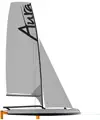
“Virtual races could be the key to helping Britain finally clinch the America’s Cup,” explains Dr Viola, who has also just completed tests on a new candidate for the 2016 Olympics - the AURA, built and designed by Ovington Boats Ltd. of North Shields.
“The America’s Cup is the oldest trophy in the world and the most expensive to win with each challenger spending tens of millions of dollars in designing, building, and sailing its boat, which represents the state-of-the-art of the worldwide marine industry.
“First held in 1851 at Cowes, on the Isle of Wight, America held the title for 132 years. Since 1983, however, the Cup has been successively won by Australia, USA, New Zealand and Switzerland, before finally being brought back to the USA in 2010 with the San Francisco Yacht Club’s victory of the 33rd America’s Cup.
“The race will be won by the team with the most skill but our research shows that we can use virtual sailing to remove other unknowns.”