Materials Testing
Background
The reliability and performance of gears is greatly influenced by material quality and condition. The most common mode of failure is fatigue and is dependant on:
- Steel composition, cleanliness, grain size, hardenability and heat treatment;
- Post heat treatment finishing processes such as shot blasting, shot peening, grinding and superfinishing;
- The effect of lubricants and lubricant additives.
The Materials Laboratories at Design Unit support industrial gear research and consultancy projects in three main areas:
- Metallography and evaluation of material properties.
- Quality control (eg gear manufacture and heat treatment).
- Characterisation and analysis of gear failures.
Facilities
A range of up-to-date laboratory equipment is used to study the metallurgy of gears and the factors affecting fatigue performance. The facilities available include:
- Sectioning, mounting and polishing equipment for metallographic sample preparation;
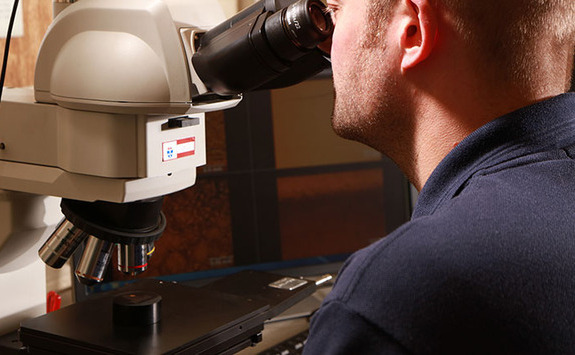
- Video imaging and analysis software connected to stereo and reflected light microscopes;
- Micro- and macro-Vickers testers for hardness and case depth measurement;
- X-ray diffraction equipment for measurement of residual stress and retained austenite;
- Barkhausen Noise analysis for detection of grinding burn;
- Glow discharge optical emission spectroscopy (GDOES) for chemical analysis;
- Eddy Current crack detection equipment.
Design Unit also has access to the University's scanning electron microscopes fitted with EDX analysers, an optical profilometer for characterisation of surface topography.