Infectious Diseases Facility Containment Level 3 Laboratories

Our Infectious Diseases Facility is available to internal and external users.

Our Mission

The Infectious Diseases Facility provides state of the art laboratories to ensure a safe and secure environment for researchers from Newcastle University, other local academic institutions, Newcastle upon Tyne Trust Hospitals and commercial organisations to study hazard group 3 (HG3) infectious biological agents.  

Biological agents are classified according to their risk to human health by the Advisory Committee on Dangerous Pathogens (ACDP). Hazard group 3 biological agents include bacteria and viruses that can cause severe human disease.  

The Infectious Diseases Facility (IDF) has been specifically designed to meet containment level 3 control measures required for working with hazard group 3 (HG3) infectious biological agents and enables us to provide a rapid response to emerging pathogens and be prepared for the next pandemic. 

Available Services

The IDF provides access for researchers to containment level 3 (CL3) laboratories to provide a safe and secure environment for working with HG3 infectious biological material. The facility complies with the control measures specified in Schedule 3, COSHH and the security measures in Anti-terrorism, Crime and Security Act 2001 Part 7 Security of Pathogens and Toxins. 

Our containment level 3 (CL3) laboratories have been designed to be completely sealable to allow for fumigation and operate at negative air pressure which is maintained by an independent state of the art air handling system with all extracted air being HEPA filtered. The integrity of the facility is validated annually, magnahelic gauges calibrated, and air pressures and air handling systems are validated to ensure negative pressure is maintained. 

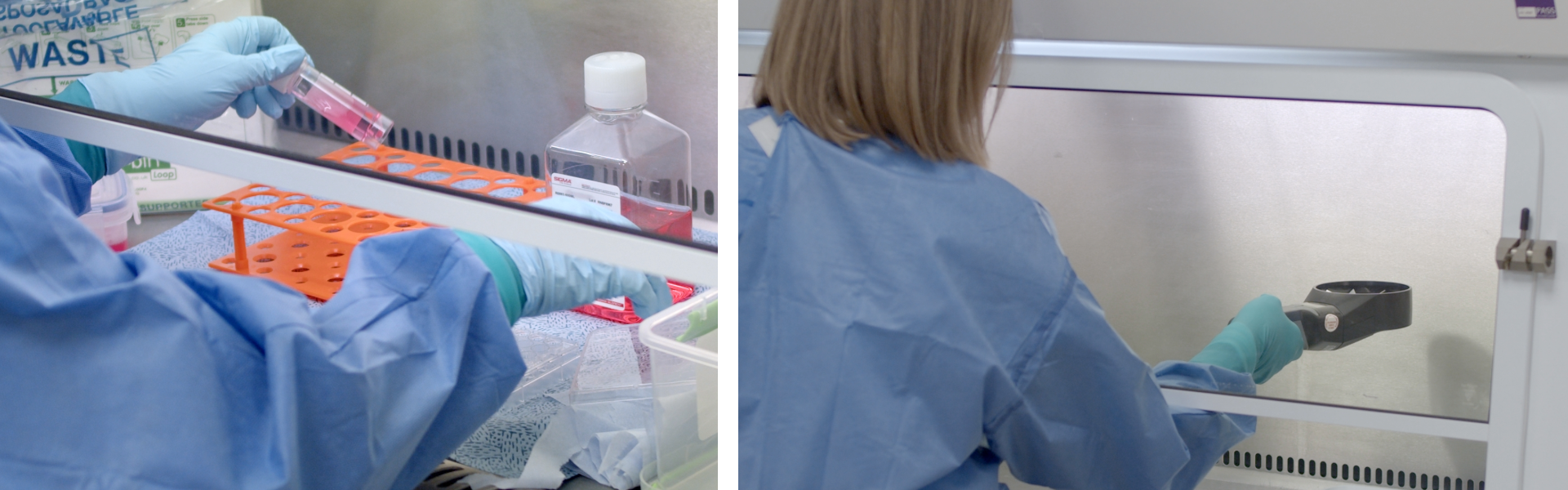
The IDF comprises of two self-contained laboratory suites each providing Class I and Class II Microbiological Safety cabinets for containment of all work and an autoclave for the inactivation of waste before removal from the facility. 

The laboratories also contain a wide range of laboratory equipment for the processing of infected samples and culturing of viral and bacterial strains. 

Access to the facility is restricted to personnel that meet the pre-requisites and have undergone stringent CL3 safety training and competency assessment.  
Workflow

Please contact us to discuss your project proposal. Following approval of the BioCOSHH risk assessment and SOPs the University Biological Safety Advisor submits the notification of intended work (CBA1 application, CU2 application for GM contained use) to the HSE on behalf of the PIThe timescale from submission to clearance of CBA1 application is at least 20 working days, CU2 applications 45 days. On receipt of an acknowledgement letter from the HSE the PI will be notified that the project can commence. 

  1. The project outline describes the HG 3 biological material and procedures requiring containment level 3 to ensure the correct notifications to HSE are submitted e.g Cba1/ GMCU. We will discuss the scope and costing of project, experience of workers and training required.  
  2. BioCOSHH risk assessment - determines the risks, control measures and emergency procedures. 
  3. Detailed SOPs are required for all procedures carried out at CL3 
  4. All work with HG 3 biological agents requires approval, BioCOSHH and risk assessments are reviewed by the Biosafety Committee 
  5. Following approval from the Biosafety Committee the University safety advisor will submit the notification of intended work to the HSE on behalf of the PI. Work cannot start until an acknowledgement letter from the HSE has been received.  

CL3 training: 

  1. Attendance at CL3 Health and Safety Induction 
  2. Acknowledgement of the IDF H&S Policy and Code of Practice 
  3. CL3 laboratory practical induction training on the critical systems and entry checks, safe use of MSCs and air flow measurements required, and the use of autoclaves for waste disposal in the Infectious Diseases Facility (IDF). 
  4. CL3 competency assessment is against standard operating procedures (SOPs) and completion of CL3 assessment test. 
  5. Newly trained workers will work under supervision by an experienced CL3 worker until they have been assessed as competent and sufficiently experienced to work unsupervised. 
Requirements to work at CL3

The University has a legal obligation to ensure all CL3 workers are suitably trained and understand the risks of working with HG3 biological agents and the actions to take in the event of exposure.CL3 induction and training can be arranged, followed by regular competency assessment. Newly trained workers will work under supervision by an experienced CL3 worker until they have been assessed as competent and sufficiently experienced to work unsupervised

All new users must be able to demonstrate a minimum 12 months laboratory experience at CL2 and have completed FMS mandatory safety training prior to commencing any CL3 training

CL3 competency assessment is against standard operating procedures (SOPs) and completion of CL3 assessment test.

To access the booking system you will need to make a PPMS account (https://ppms.eu/newcastle/login/?pf=6 )for the Infectious Diseases Facility (NUIDF), once registered you will be able to view the online booking system.

PPMS user guide (https://newcastle.sharepoint.com/hub/medical/Pages/Core-Facilities-Booking-System-PPMS.aspx)


Sustainability

The LEAF UCL, Laboratory Efficiency Assessment Framework, is a framework that helps research laboratories to improve their sustainability and efficiency. LEAF is based on a wide range of actions to help laboratories reduce waste, resource consumption and carbon footprint to create an environment that supports quality research.

The Infectious Diseases Facility has maintained GOLD award for sustainability since 2023.

The Infectious Diseases Facility is also a member of the Leech Building Green Impact team working together with colleagues to improve the sustainability and environmental performance of the work area. The Leech building was awarded NUS Green Impact Silver award 2025.

FAQ