Published: 26 September 2017
A new era for marine engineering research at Newcastle
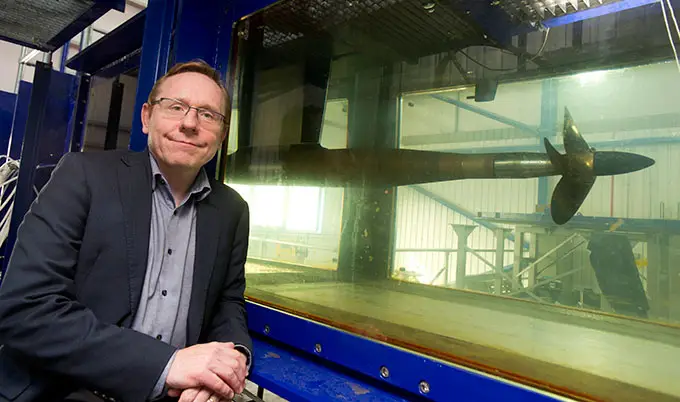
Newcastle University will today unveil its newly-refurbished Emerson Cavitation Tunnel as part of a £2.5m investment in marine engineering.
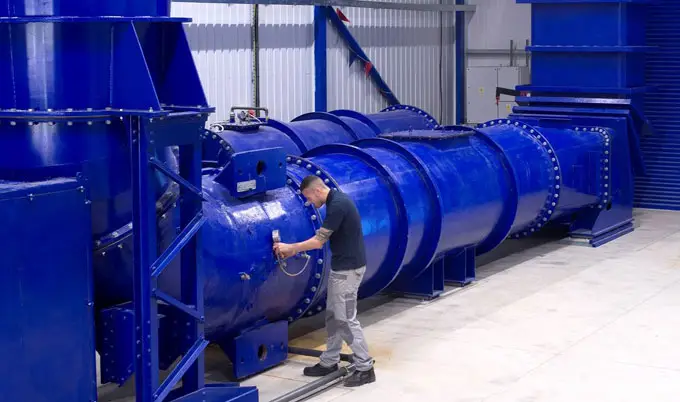
Carefully re-located from the University’s city centre campus, the cavitation tunnel’s new home at Port of Blyth is twice the size of its former location and includes a number of other experimental facilities to support world-leading research on propeller design and biofouling.
Part of the new Centre of Excellence for Marine Hydrodynamics, Coatings and Materials, this latest development at Blyth builds on the University’s investment in marine science and engineering. These include the Blyth Marine Station, which houses teaching rooms, workshops and an aquarium, and the University’s Research Vessel – the Princess Royal.
This new build at Port of Blyth will allow us to strengthen our research capacity and also increase our opportunities for new collaborations and partnerships with marine sector industries, which are so important to the North East economy
Leading the way in marine engineering
Today’s announcement follows a Government audit into the offshore renewable energy industry in the North of England and Scotland – the Offshore Renewable Energy Science and Innovation Audit (SIA).
Highlighting the area’s world-class research in the field of offshore renewable energy, the report also focussed on the strong collaborations between industry and academia.
Professor Phil Taylor, Head of the new School of Engineering, said the investment at Blyth further reaffirmed the region’s role as a global leader in marine engineering research and innovation.
“This new build at Port of Blyth will allow us to strengthen our research capacity and also increase our opportunities for new collaborations and partnerships with marine sector industries, which are so important to the North East economy,” said Professor Taylor.
“Together with industry leaders such as Bel Valves, SMD, Shepherd Offshore and Akzo Nobel, Newcastle University is helping to re-invigorate the sector to become a leader in new and emerging technologies.”
60 years of excellence
Dating back to the 1950’s, the cavitation tunnel is an experimental facility used to test propellers and turbine blades and is the only one of its kind in the UK.
Named after Dr Arnold Emerson, its long-serving superintendent whose dedication and service to the facility was acknowledged following the 1980 refurbishment, the facility was transported to Poland for refurbishment.
The purpose-built space comprises a 10t handling capability, 800 amp three phase supply, a flume for timed studies of marine coating formation and a soon-to-be-installed slime farm.
Peter Bowes, Technical Manager for Newcastle University’s Faculty of Science and Engineering, said: “There is an increasing demand to use the tunnel to explore tidal and current turbines, and to investigate foul-release coatings and next generation self-polishing coatings. Our vision has been to assure the next fifty years of operation and service to the marine sector.”
World-renowned teaching and research
The refurbishment of the cavitation tunnel and expansion of the Blyth marine facility is the latest in a series of major achievements by Newcastle University in marine engineering and technology. In June, Newcastle launched its deep-sea research facility, Tyne Subsea: National Centre for Subsea and Offshore Engineering in Wallsend.
And the School of Engineering has also won a number of research grants around its Sensors, Electromagnetic and Acoustics Laboratory (SEALAB).
Dr Alan Murphy, Reader in Maritime Engineering, added:
“It’s a very exciting time at Newcastle University and for our new School of Engineering. In the Marine, Offshore and Subsea Technology group, we’re opening up new opportunities for research, teaching and collaboration with many academic and commercial disciplines, as well as unlocking investment in facilities.”