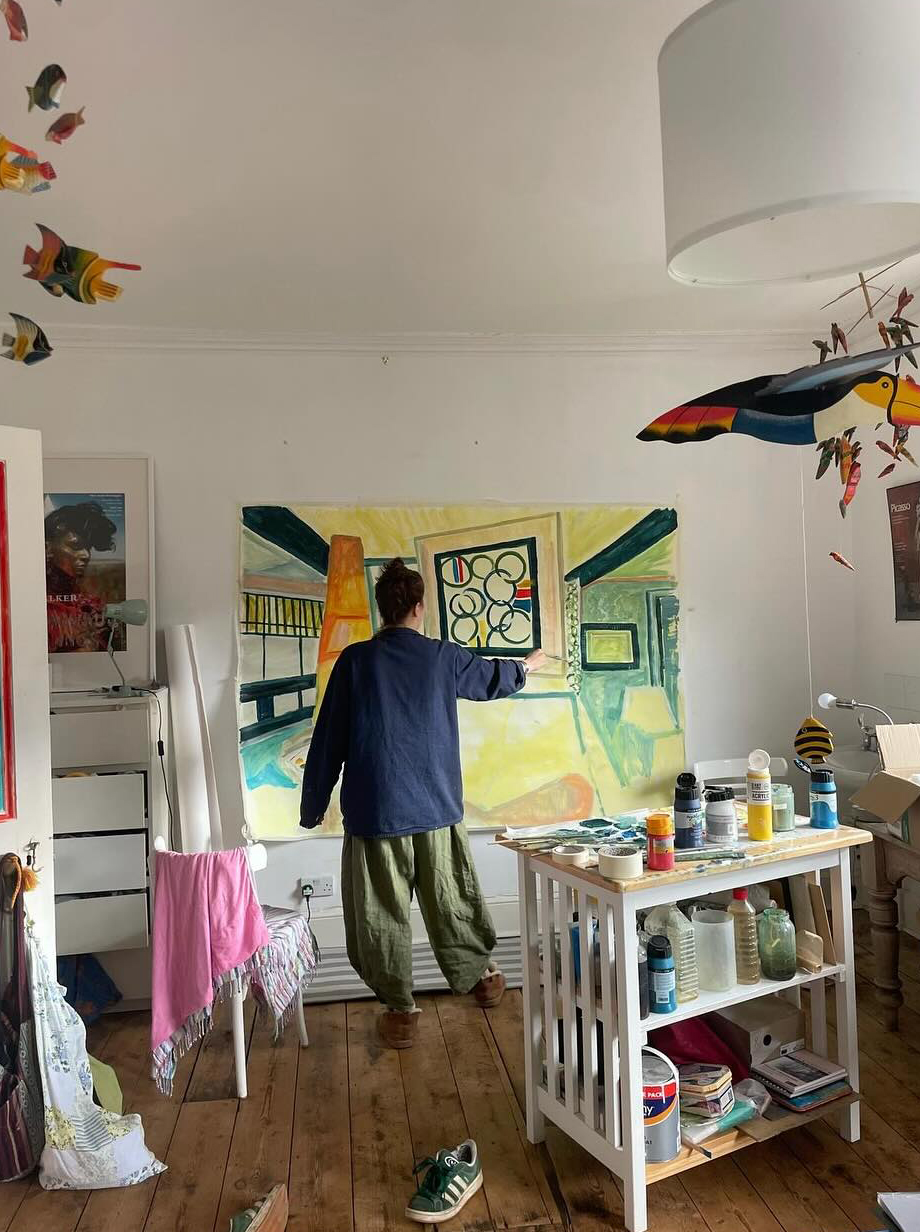
Fine Art application guide
Learn more about the application process, what we look for in applicants, and how to submit your work.
Your guide from application to interview
In this guide we'll go through each stage of your application. These are:
1. Constructing your application
-
your portfolio
-
your personal statement
-
submitting your application
-
what happens after you've submitted your application
2. Interviews
Your portfolio
This is an important part of your application. It's where you show us your creativity, your passion, and enthusiasm for art.
You should include coursework, but also - importantly - work you have initiated yourself.
We're not just looking for ‘finished’ work either. We're interested in seeing where your ideas come from and how they develop.
Your portfolio should include at least 30-50 pieces of work.
It can include anything from paintings, drawings, and sculptures to links to videos and installation . The best format for a portfolio is a Powerpoint or PDF.
What to include
We're looking for work that demonstrates:
- creativity, enthusiasm, commitment and excitement about making art
- ability to study through looking – e.g. drawings or paintings made from observation
- sustained development and exploration of ideas or themes using different approaches and media
Don’t worry too much about making your portfolio look ‘professional’. We're interested in the work and understanding what you're interested in.
A simple label below each bit of work with the title, medium (i.e. ‘page from sketchbook’, ‘acrylic painting’) and the dimensions is also helpful.
We would love to see:
- Work in progress: Show us how your ideas develop.
- Notebooks and sketchbooks: Include pages that reveal your creative thinking and experimentation.
- Working drawings: Preliminary sketches or studies that lead to finished pieces.
- Resolved work: Completed drawings, paintings, sculptures, videos, or other media.
- Details of work: Close-ups or sections that highlight specific aspects of your pieces.
- Work from non-Fine Art projects: Examples from design, photography, fashion, media, or other disciplines - anything that represents your creativity and flair
- Independent or extracurricular work: Projects from workshops, personal exploration, or collaborations (e.g., videos for a band, stage design, etc.).
- Video or sound work: Submit files or links (e.g. Vimeo) for us to review.
Your personal statement
Your personal statement is your chance to tell us about you, your artistic journey, and why you’re interested in our BA Fine Art programme.
It will be made up of answers to these three questions:
- Why do you want to study this course and subject?
- How have your qualifications and studies helped you to prepare for this course and subject?
- What else have you done to prepare outside of education, and why are these experiences useful?
As an artist you'll often be asked to write statements about yourself and about your work. So think of this as a useful starting point for that process.
What we'd love to see
- The connection between your answers and your portfolio. How does your work reflect your interests and creative process? For example:
- If your portfolio includes a series of works on a specific theme, why is that theme important to you?
- Have you been influenced by particular artists, experiences, or movements? How is this influence reflected in your work?
- Have you faced challenges or failures in a project? What did you learn, and how did it shape your artistic practice?
- Your future plans and why our degree is a good fit for you: Why do you want to study Fine Art? What interests you about the course, and how do you think it will help you grow as an artist?
- Your current studies: What are you studying now, and why did you choose those subjects? What is their connection to your decision to apply for a Fine Art programme?
Our Top Tips for answering your personal statement questions
- Connect your answers to the work in your portfolio
- Use straightforward and clear language
- Make a list of the points you want to make, then expand on them
- Don’t worry about word length at first
- Get someone to proofread it, making sure they understand what you're trying to say
Submitting your application
We begin to review portfolios from November.
Portfolios submitted within a week or two of the UCAS deadline will be reviewed.
If you anticipate submitting a portfolio later please let us know by emailing fineartadmissions@newcastle.ac.uk
How to submit your portfolio
Once you have created your portfolio, ideally as a PowerPoint presentation, you must save it as one PDF file. You should then upload it to the Apply to Newcastle Portal. Please do not upload individual images to the Portal.
The PDF should be no larger than 30MB. You can download our Portfolio Size Reduction Guide (PDF: 0.8MB) to find out how to manage the file size of images in your portfolio.
1. Register to access the Apply to Newcastle Portal
2. Click on Upload Documents next to your application to W150 Fine Art BA Honours
3. Click Upload Document
4. In the Document type drop down menu, choose Portfolio. Your course should automatically populate, but if you are applying to more than one degree, please choose the Bachelor of Arts with Honours in Fine Art in the Your course (Choice) drop down menu
5. Click Choose Files and attach your file
6. Click Save & Close
Your portfolio will display in the Documents Uploaded section. You can view the document by clicking View. Please note the Portfolio will take 15 minutes to disappear from the Documents Required section. Your status will then change to Awaiting Decision.
If you have any technical difficulties during this process you can request that our I.T Team contact you to assist you further
What happens after your application
Once we receive your application, we'll email you to ask you to upload a digital portfolio to the Apply to Newcastle portal. This, along with your application, is how we decide if we wish to invite you to an interview.
If you're successful at the portfolio stage, we will invite you for interview.
If you're unsuccessful, we will notify you via UCAS.
The interview process
You can choose to have either an in-person or an online interview.
If it's an in-person interview you'll need to bring a physical portfolio with you.
In-person interviews are usually held in the School of Arts and Cultures and include a tour of the department with a current Fine Art student.
The majority of interviews take place by the end of March.
If for any reason you’re not able to make any of the dates offered, please email us at fineartadmissions@ncl.ac.uk so we can make alternative arrangements.
What to expect during the interview
- The interview lasts around 20 to 30 minutes and will be with one staff member and a current student
- On-campus interviews include a department tour led by the student. For online interviews, you’ll watch a student-led tour video.
- You’ll discuss your work, interests, and previous learning experiences. We may ask you to talk about specific pieces or projects that are important to you.
- We’ll explore how you’ll benefit from the course and whether our environment suits your growth as an artist.
- You’ll have plenty of time to ask questions about the course, department, university, and city.
- You’ll have the chance to speak with current students (in-person or online) to help you decide if this is the right course for you.
If you have any questions about applying to Fine Art BA Honours please email us at fineartadmissions@ncl.ac.uk
View the full course profile and full details of how to apply through UCAS