Bee-ing Human
An Interactive Bee Book for the 21st Century.
Project summary
"Bee-ing Human: An Interactive Bee Book for the 21st Century" is a three-year research project (2022-2025) funded by The Leverhulme Trust. It centres on a seventeenth-century book on bees and bee-keeping, Charles Butler's The Feminine Monarchie of Bees.
Butler (1571-1647) was a beekeeper, as well as a musician, grammarian and parish priest. He was responsible for introducing England to the fact that bees have a queen, not a king.
He also recorded in music notation what we now refer to as the "piping" and "quacking" of new queens in the first edition of his book (1609). He incorporated this into a four part "bee's song", or Melissomelos, published in a table-book format in the second edition of his book (1623), which is the main focus of the project.
This increased incorporation of sound in the second edition is further developed in the third edition (1634). Here he adopts his own system of phonetic spelling, as a corrective to the inconsistencies of English spelling conventions of his time.
This focus on the book as a sounding entity has informed much of the direction of the research.
The Feminine Monarchie serves as both an object of study in its own right, but is just as significantly a departure point from which to investigate early modern knowledge and culture around bees and beekeeping. This can then be compared with up-to-date research in animal behaviour and emotion.
Biological and behavioural research into the emotional states of bees helps to understand the phenomena Butler records, even if the contemporary explanations differ in significant ways to his interpretations.
Sound studies and musicology also contribute to the emerging discourse, helping to hermeneutically unpack the meaning of his music notations and his Melissomelos and to parse out Butler's observations of the wide range of sounds associated with the hive.
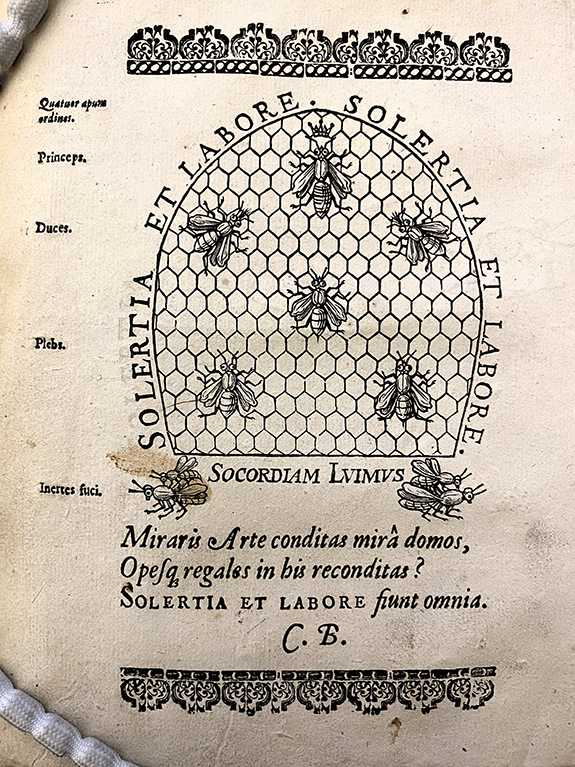
The final output of the project will be a rich and detailed digital publication overseen by our expert digital humanities researchers.
The project also seeks to better understand, and to devise useful models for interdisciplinary research between biology and the humanities, which is a relatively neglected interface
The project is led by Professor Jenny Richards at Cambridge University, with Professor Magnus Williamson and Dr Bennett Hogg working on the music and sound studies side of the project in Newcastle.
Dr Vivek Nityananda leads on biology and behavioural sciences, and Dr Tiago Sousa Garcia leads on digital humanities, both also based in Newcastle.
There are two full-time postdoctoral research associates working full-time on the project. Dr Luigi Baciadonna at Newcastle Centre for Behaviour and Evolution, and Dr Olivia Smith at Cambridge.