Unpacking Chinese Political Culture during the Korean War
Outlining how the arts and government-sponsored communications supported nation-building and societal reform in the 1950s.
Project summary
Unpacking Chinese Culture during the Korean War is a Leverhulme Early Career Fellowship project lead by Dr Meng Ren.
This qualitative project will provide an interdisciplinary inquiry into Chinese political culture and propaganda strategies during the early days of the People’s Republic of China, especially during the Korean War (1951-1953).
The project outlines how the arts - highlighted through music performance and public promotion - and government-sponsored communications supported nation-building and societal reform in the 1950s.
This research focuses upon case studies of Chinese performing arts, especially Chinese revolutionary songs and operas, that embodied the state ideologies and propaganda strategies during the Korean War.
Why is the period of the Korean War so important? As the first international conflict involving the newly founded PRC, the Korean War was a crisis threatening the political regime of the Chinese Communist Party (CCP).
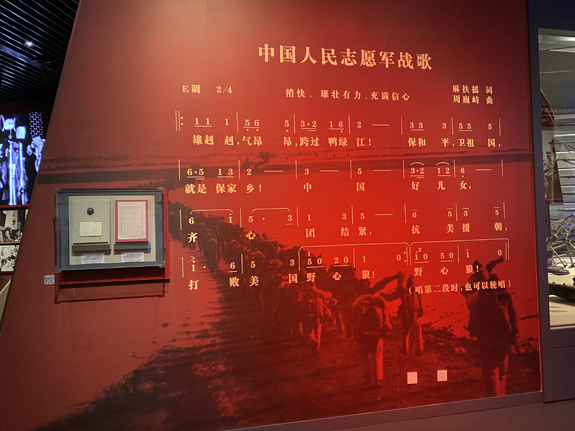
Photo: The music score (cipher notation) of “The Battle Song of the Chinese People’s Volunteer Army” at the Memorial Hall of the War to Resist US Aggression and Aid Korea (Dandong, March 2024).
During this time, various forms of performing arts were adopted by the new government as a crucial vehicle to convey ‘correct’ political messages and ideologies to educate the masses and gain their support.
The themes and contents of the performing arts were particularly designed for provoking and communicating patriotic and nationalist feelings among the general population.
During the spring of 2024, I conducted fieldwork research for my project in China. I visited the Memorial Hall of the War to Resist US Aggression and Aid Korea (a.k.a. the Korean War Museum) in Dandong and the Military Museum of the Chinese People’s Revolution in Beijing to obtain necessary research materials.
I took photos of valuable historical items (including some music scores and instruments) from the Korean War period (See Figure 1).
In Beijing, Dalian, Shijiazhuang and Zhengzhou, I was able to conduct personal interviews with several Chinese veterans of the Korean War. Most of my interviewees are in their late 80s and early 90s.
Their recollections and insights about Chinese songs and operas in the early 1950s are key to my book project.
After my fieldwork trip in China, I felt an urge to conduct oral history interviews with Chinese veterans of the Korean War due to their old ages and health conditions. Therefore, I plan to conduct further fieldwork in several Chinese cities in 2025.