
Pre-Health I
From classroom to clinic - students learn how to screen for cardiovascular disease then spend time working with real patients in a supervised setting.
Pre-Health I (Fall)
This programme runs from September to December each year.
For students planning a career in healthcare, opportunities to gain hands-on clinical experience are extremely valuable but often difficult to arrange. At Newcastle University, our specialised semester abroad programme gives pre-health students the chance to develop clinical and communication skills in the classroom, then practice these skills on real patients at our student-led ‘Young@Heart’ health clinic in Newcastle’s bustling city centre.
Students are taught in our historic King George VI Building, directly opposite the Royal Victoria Infirmary, a major NHS teaching hospital and healthcare professionals.
Pre-Health I is taken in conjunction with two or three additional modules chosen by the student. This programme runs in semester 1 each year, beginning in September and ending in December. Campus housing is available and visiting students will live and learn alongside full degree students at the university.
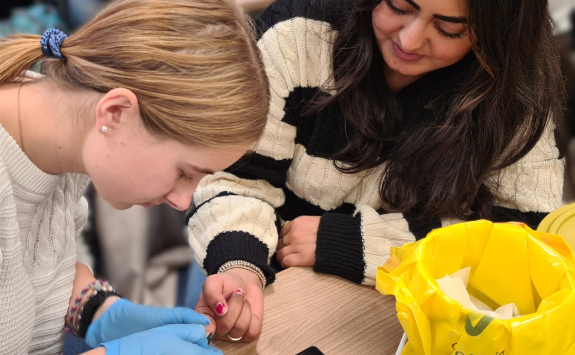
I became much more comfortable managing real patients and addressing their health-related questions... it provided invaluable hands-on learning.
Newcastle University’s Young@Heart Clinic
This innovative student-led cardiovascular health clinic is based in the famous Grainger Market - a busy, vibrant market dating back to 1835. It is located in the heart of Newcastle’s city centre 10 minutes’ walk from the university campus. Home to many of Newcastle's favourite local traders and small businesses, this bustling retail hub has proven a superb location for the university’s Young@Heart clinic that caters to the healthcare needs of Newcastle’s local population.
At the Young@Heart clinic, students offer walk-in patients a basic health screening for cardiovascular disease – an assessment that mimics the standard NHS assessment commonly carried out by General Practitioners. Students administer tests for blood pressure, blood glucose and blood cholesterol. They will also measure and weigh patients to calculate Body Mass Index. Following the tests, students will have a discussion with the patient about cardiac health and make recommendations based on these discussions. All interactions are supervised by expert clinicians from the university’s Faculty of Medical Sciences.
Study Abroad pre-health students can expect to meet up to 20 patients over the course of a clinical day. Through work-based learning in multidisciplinary teams, students will develop the skills and experience to start building their professional identity, contribute to the healthcare provisions in a frequently underserved local community and help tackle the challenges associated with cardiovascular health.
In addition to this experiential, overseas learning experience, participating students will also receive:
- bespoke Newcastle University surgical scrubs
- membership to Pharmsoc - a student-led society that offers support, social events and professional networking opportunities
- invitation to the formal Winter Ball
- a range of services and benefits offered to all Study Abroad students
This unique programme allows students to develop important clinical skills, but to also develop an understanding of a diverse patient population and how socio-economic factors can affect health outcomes.
The Module
Pre-Health I is structured in two parts.
Part One: Training
Students undertake clinical and communication skills training within the School of Pharmacy at Newcastle University – currently ranked in the top 100 pharmacy schools in the world.
Students will learn how to gather important information from a patient and perform physical examinations. They will be taught how to interpret clinical test results and communicate information and advice to patients in a professional and reassuring manner. During this period of teaching and learning, students will familiarise themselves with the professional aptitudes that allow them to use the clinical skills appropriately and competently. They will learn to recognise the wide range of patient needs arising from backgrounds, demographics, and physical and mental conditions to develop appropriate approaches to care that are inclusive and culturally competent.
During the first part of the semester, students will learn how to:
- administer test for blood pressure
- administer test for blood glucose
- administer test for blood cholesterol
- weigh and measure patients
- calculate Body Mass Index
- interpret and deliver screening results
- navigate data protection and privacy
- assess risk
- handle and deliver sensitive information
- understand and uphold patient consent policy
- provide relevant healthy lifestyle advice to patients
- signpost patients to local services and resources to enhance health and wellbeing
Part Two: Practice
Part two of the module allows students to practice these competencies in a supervised clinical setting at Newcastle University’s Young@Heart clinic. They will work with walk-in patients from the local community who are seeking information and reassurance relating to their cardiovascular health.
This application of practical skills is known as work-based learning. This practice is embedded in the programme curriculum and allows students to apply what they have learned in the classroom to real-life situations.
Assessment
Students are assessed based on their portfolio of clinical practice - just as is done in the medical field. This is a series of professional reflections based on their work-based learning at the clinic. This mode of assessment will improve the student's confidence and provide feedback in a responsive manner to support their learning.
Additional/Elective modules
In addition to the compulsory core module, students will register for two or three additional modules of their choosing.
From the Faculty of Medical Sciences, Fall semester options include:
- Control of Physiological Systems
- Factors affecting Pharmacokinetics and drug disposition
- Microbial Mechanisms of human pathogenesis
- Neuroscience: Essentials and Beyond
- Proteins: Structure, function and biochemistry
- Molecules of Life
- Infectious Threats
- Applied Biochemistry
- The Molecular Basis of Cancer
- Evolution and Genomics
Students may take modules from other subject areas if the timetable facilitates this.
Some students will find they can transfer credits earned on this programme back to their university at home to count towards their degree award. Other students may simply value the experiential aspect of the programme and it will allow them to add a unique component to their resume or postgraduate study applications.
Carrying out the clinical skills and practicing patient communication made me more confident in my future career plans.