
Pre-Health II
A unique opportunity to live and study alongside Newcastle based medical students and allied healthcare students to develop essential skills in a simulated clinical setting.
Pre-Health II (Spring)
This programme runs from January to May each year
Taught within the School of Biomedical, Nutritional and Sport Sciences and the School of Medicine, this bespoke module integrates experiential learning into the curriculum, giving students the opportunity to connect scientific learning and clinical simulation with real-world medicine. Visiting students will have access to a superb range of facilities to support their learning within the Medical School, situated next to one the UK’s principal teaching hospitals (The Royal Victoria Infirmary).
With strengths in areas such as ageing and longevity, cancer, genetics and cardiovascular medicine, programme participants will immerse themselves in a research-intensive, translational medicine environment whilst living and studying alongside current medical and allied health profession students.
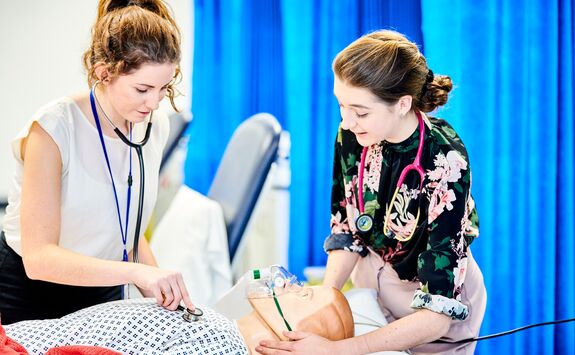
Interprofessional education is vitally important in developing compassionate and reflective health professionals of the future.
Professional Outcomes
This module is designed to help students develop key competencies outlined by the AAMC. Multiple opportunities to develop these competencies (cultural awareness, teamwork and collaboration, ethical responsibility) will provide participating students with tangible evidence to support applications to medical school.
Participating students will:
- Develop confidence in behaviours and approach in clinical environments
- Begin forming their professional identity
- Recognise the value of a holistic approach to patient diagnosis and case management
- Practise essential communication skills
- Understand how knowledge translates into patient care
- Identify the strengths and insights of allied health professionals in clinical diagnosis
- Learn how to think critically about their own performance
This type of practical experience will stand out on my resume – the fact that it is international is even better!
The Module
Pre-Health II aims to cultivate the clinical and communication skills at the heart of medical training, preparing students to work confidently and effectively across professional boundaries. The ability to gather broad and meaningful case information from a range of clinical perspectives is vital in training to become a health professional. This module provides the opportunity to collaborate with training healthcare students to develop the problem-solving skills and attention to detail required in medical care.
The module uses three key strands:
- Clinical skills development
- Progressive anatomical understanding
- Interprofessional education
Clinical Skills
Learning begins with clinical case overviews or medical scenario information, followed by training in performing physical examinations; an essential requirement of clinical practice. The clinical skills component of the module is taught by clinical staff and resident doctors from the School of Medicine. It consists of a selection of practical procedures at the heart of medical training. The ability to perform physical examination of the patient and carry out procedures competently and safely is an essential requirement of clinical practice. Clinical skills require the application of acquired basic anatomical knowledge, clinical application and demonstration of professional behaviours.
Students complete preparatory work involving online tutorials and guided additional reading prior to in-person clinical skills sessions, The format of each clinical skills teaching session comprises a brief scene-setting introduction followed by a clinical simulation on models, manikins and/or fellow students, always supervised by the module team including the course leader and teaching fellows. Clinical skills are taught in the safety of Newcastle University’s purpose-built Clinical Skills Laboratory, offering a realistic simulated clinical environment. Skills which students have previously completed include:
- Introduction to Clinical Reasoning
- Basic Life Support
- Blood pressure and reflections
- Venepuncture
- Cardiovascular Examination
- Gastrointestinal examination
- Knee examination
- Respiratory Examination
Anatomy
To enhance their anatomical understanding of health and disease, students will have access to a progressive series of self-directed computer-based sessions that explore various anatomical topics. There is the option to complete this learning ‘in-class’ with guidance from Anatomy experts. These sessions complement the Clinical Skills sessions by offering computer simulation activities in major anatomical systems (including musculoskeletal, nervous, circulation, respiratory, gastrointestinal, urinary, reproductive and immune).
In addition to the computer-based sessions there are two gross Anatomy practical classes in the dissecting room when students will have the opportunity to examine human material under the direct supervision of the Clinical Anatomy team.
Interprofessional Education
In the third strand, students will participate in multidisciplinary healthcare professional activities through interprofessional education. Through these activities, students are exposed to structured learning opportunities that will give them the skills, attitude and knowledge necessary for effective, collaborative healthcare practice. Interprofessional education session content varies per year according to clinical specialty and student cohorts, example activities include:
- Northumbria Health Day – a special Interprofessional Education event bringing together varied cohorts of allied health professional students and clinical and healthcare colleagues.
- Multidisciplinary Team (MDT) session – in conjunction with undergraduate students from healthcare specialisms including Medicine, Pharmacy, Dietetics, and Physician’s Associates. Following the case-led learning style as recommended by the General Medical Council, learners will prepare using simulated patient information before applying that knowledge and insight with a simulated patient to develop a multidisciplinary diagnosis and management plan.
- Scrubs and Suits simulation game – with students from Newcastle University’s Medical School and Business School. The session models the complexity of hospital management, with a role-play multidisciplinary team making decisions about management, budget allocation and patient care. It is a practical and engaging way to support students’ development of skills and knowledge in ethical healthcare management
- Interprofessional Escape Rooms – interdisciplinary problem-solving sessions using clinical case study scenarios in a dynamic learning environment.
By simulating real-world scenarios, we empower students with insights into each other's roles, drivers, and decision-making, fostering authentic professional readiness. This exemplifies the effectiveness of teamworking within healthcare settings.
Assessment
This module is assessed through a 2,500-word ‘portfolio of practice’ containing five 500-word reflections from time spent in the clinical skills lab, anatomical skills sessions, and interprofessional healthcare sessions. This form of assessment helps students to:
- Track their own development
- Develop their clinical preparedness
- Identify unconscious bias or ethical issues surrounding clinical cases
- Encourage proactive engagement in the sessions
- Apply their understanding of anatomical systems to clinical situations
- Develop insight into health management and patient communication
- Improve their writing skills and reflective ability
- Build a professional portfolio relevant to future clinical training
In addition, a ‘professional competency assessment’ will be conducted throughout the module to develop the essential attributes needed of a patient-facing health professional.
Additional/Elective Modules
In addition to the compulsory, core module, students will register for two or three additional modules of their choosing. The School of Biomedical, Nutritional and Sport Sciences offers a wide range of modules, including those from the recently redesigned Royal Society of Biology accredited programmes in Biomedical Sciences and Biochemistry.
For Spring semester these include:
- Cells to Systems
- Therapeutic Mechanisms
- Biochemistry of gene expression
- Principles of Cancer
- Cell Signalling in Health and Disease
- Immunology of Health and Disease
Students may choose modules from other subject areas, including humanities and social sciences, if the timetable facilitates this.
Some students will find they can transfer credits earned on this programme back to their university at home and have them count towards their degree award. Other students may simply value the experiential aspect of the programme and allow them to add a unique component to their resume or postgraduate study applications.