NCL in Action: Uniting executive leaders and current students to shape the future of education
On 5 March, executive leaders from the higher education and financial industries met with current Newcastle University students for a skill-sharing session focused on transforming the future of our student offering.
17 March 2026
Part of the 2025/26 NCL in Action programme, and delivered in partnership with Lloyds and Debate Mate, the Boardroom to Classroom session provided an opportunity for students, Executive Board, senior alumni and corporate partners to generate ideas to support Newcastle University in becoming a future-facing provider of leading-edge, inclusive and transformational higher education.
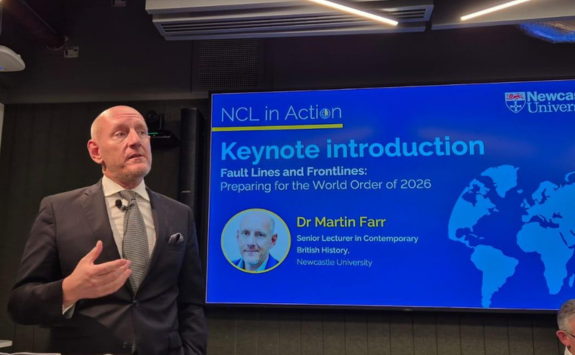
In acknowledgement of the ongoing rifts and shifts facing society, from the climate crisis to the rise of AI, and the uncertain future facing many new graduates, delegates were encouraged to bring a lot of energy and new ideas, underscored by real purpose.
.png)
Professor Jane Robinson, Pro-Vice-Chancellor of Business, Partnerships and Place at Newcastle University, opened the session and said:
“What’s really exciting about today’s session is the opportunity to connect and inform the future of what education at Newcastle University could look like. The workplace is changing rapidly, and we, as an institution, need to create opportunities for all our students to develop the skills they will need in the future. This is at the heart of our Education for Life 2030+ strategy and the Leading Edge Curriculum.”
Newcastle University’s Education for Life 2030+ Strategy is a bold and ambitious plan to shape the future of education on campus, with focuses on strengthening academic quality, improving the student experience, and encourage greater innovation across the institution.
The Leading Edge Curriculum (LEC) is key to delivering the ambitions set out in the strategy, offering a university-wide framework to support high-quality, future focussed education that is academically rigorous, inclusive and clearly articulated across the student journey.
Part of the new curriculum is leading-edge encounters, which provide opportunities for students to engage with research, the workplace or the voluntary sector before they graduate. These encounters were at the heart of the Boardroom to Classroom session.
The award-winning concept, designed and facilitated by Debate Mate, combines skills sharing with a social purpose. Professionals can enhance their communication and leadership skills whilst students gain valuable industry insights and workplace readiness.
James Waterfield, Head of Product at Debate Mate, said:
“Learning is a two-way process, and that’s at the heart of the Boardroom to Classroom programme. Over the past eight years, we’ve literally seen organisations change policy and culture after interacting with our young people who will soon be entering the workplace, so it’s exciting to bring this ethos to Newcastle University as part of the NCL in Action series.
“At the heart of everything we do is learning by doing – but also having fun! The agenda for the session really focuses on breaking down the barriers between boardroom and classroom and equipping those involved with the communication skills to share ideas and disagree better.”
-(1).png)
-(2).png)
The day began with a quick-fire debate on the motion ‘By 2030, most graduate jobs will require skills that universities don’t currently teach’, before students were grouped with executive leaders from Newcastle University and Lloyds to ask their burning career questions.
One of the students in attendance was final year Computer Sciences student Ricardo. Speaking of his career Q&A session with Managing Director of Commercial Banking at Lloyds, Scott Barton, Ricardo told us:
“My main takeaway has been to avoid seeking perfectionism and learn to take risks. Even if I have a clear plan for my career after graduation, I should probably be flexible to branching out and trying different things.”
The session concluded with delegates splitting into seven teams – with three students and one professional in each – to come up with an innovative, leading-edge encounter that could be embedded into the Newcastle University curriculum to prepare students for the future.
Ideas ranged from a hackathon with local businesses to address issues in line with the UN’s Sustainable Development Goals (SDGs) and a practical assessment focused on solving a global issue as an alternative to traditional dissertations, to a ‘ClickNConnect’ app to connect students with employers offering work experience and mentorship.
It was this final idea, described in the pitch as a “blend of LinkedIn and Tinder” and a productive way to ‘doomscroll’, that was voted as the winner of the day by an expert panel. Students in this team – Dandya Chen, Natasha Harley and Maria Kibtia – were awarded with their own leading-edge encounter, a one-day work experience trip to Lloyds’ new office in Leeds!
Scott Barton, MD, Corporate and Institutional Coverage at Lloyds Banking Group, said:
“Our purpose at Lloyds is deeply rooted in helping Britain prosper. If we’re going to play our part in driving economic growth, then developing the skills of the future workforce is absolutely essential and both our higher and further education institutions have a crucial role to play in that.
“It’s been fantastic to hear the curiosity from the students in the room today. One moment that really stood out came during the career Q&A at the start of the session, when I was asked: ‘What makes a good CEO?’. Reflecting on that question, based on the CEO’s I have worked with across my career, I believe it comes down to developing strong relationships, being open, agile, constantly learning, and building in some healthy resilience! So, even with the rise of technology and AI shaping the workforce, what remains fundamentally important are those core human skills.”
Rifts and Shifts: Our Changing World
The world is currently characterised by shifting geopolitical power dynamics, hopes and concerns for technological advancements, economic uncertainty and a ticking clock against climate change.
We have never been more connected thanks to developments in technology. But this same technology is exacerbating inequalities and polarising society.
We spend with a simple tap while economies crash and the number of those falling below the poverty line increases.
We have more reason than ever before to work together as a global people, but we continue to grapple with conflicts that are displacing and destroying communities.