
Recent graduate wins Greek International Women Award for ageing research
Huge congratulations to alumna Maria Kyriazi (BSc Biomedical Genetics, 2021; MRes Ageing and Health, 2022), who received the Young Star Award at the fourth annual Greek International Women Awards in Athens this November.
16 December 2025
Meet the award-winning alumna advancing our understanding of human ageing
Greek national Maria Kyriazi first arrived in Newcastle in 2019 as a fresher set to embark on a Biomedical Genetics degree. Just six years later, she has gained international recognition for the strides she is making in ageing research and the potential she has shown as an early-career scientist.
Today, Maria is a doctoral researcher in Molecular and Cellular Medicine at the University of Oxford, with her research focusing on how cells change with age and how understanding this process can identify strategies to delay the onset of age-related diseases – including osteoarthritis, which affects over 500 million people worldwide. It is for this research, alongside her contributions in volunteering, outreach, education and mentoring that she was named ‘Young Star’ by the Greek International Women Awards 2025 (GIWA).
Recently back from the GIWA awards ceremony in Athens – with a trophy in tow! – we caught up with Maria to hear about her Newcastle journey and the scientific breakthroughs she is helping deliver.
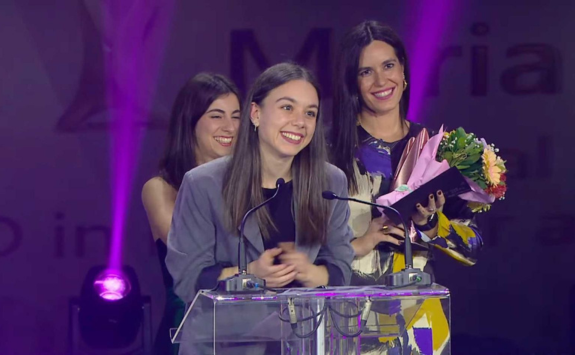
Hi Maria. Congratulations on winning the Young Star Award! What was it like attending the Greek International Women Awards?
It was a truly enchanting event, held in the Hellenic Cosmos Cultural Centre. I had a wonderful few days back in Greece to attend the ceremony along with my family. The event was exceptionally well organised, set in a beautiful venue, and celebrated an outstanding group of inspiring women, thriving in their fields worldwide. Among the attendees were women currently living in the UK, the US, and even as far as Australia.
I left feeling invigorated and deeply humbled to be among such remarkable individuals. As well as championing the impact Greek women make in society, the awards also provide an important opportunity for us to meet, connect and build meaningful networks. I had the honour of meeting fellow award nominees who work in similar fields, with whom I very much hope to stay in touch!
You grew up in Greece but made the brave decision to move to a different country to embark on your university career. What made you choose Newcastle?
It was the uniqueness of the course that initially brought me to Newcastle – it was the only one of its kind in the UK. I didn’t know much about the city at the time, but I quickly found a second home in Newcastle. I really miss the friendliness of the city and the vibrancy of the student community.
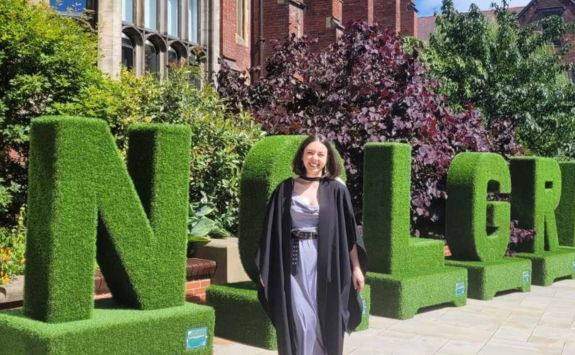
When I arrived on campus in 2019, I lived in Liberty Plaza right near St. James’ Park and remained in this area of the city for my four years in Newcastle. My original plan was to complete my BSc in Biomedical Genetics and then train to become a doctor. However, the degree fascinated me in ways I didn’t expect. By the end of my three years, I knew I wanted to continue exploring the biology behind diseases and how they accumulate in the genes. So, I stayed in Newcastle for another year to complete my MRes in Ageing and Health.
And we’re so glad you did! Can you tell us a bit about your research to date?
Over the years, I have been committed to contributing to research that aims to advance our understanding of human ageing, hoping to help in discoveries that will provide people with a better quality of life throughout their lives.
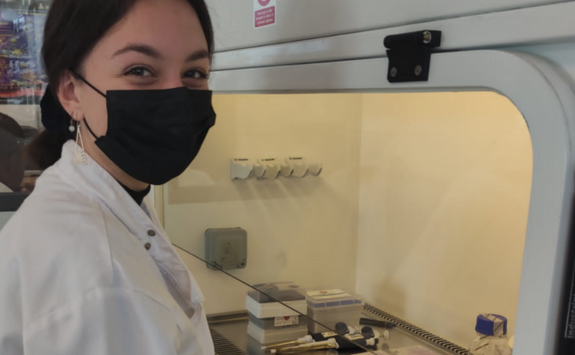
My very first steps in research began during my second year of studies. I was eager to gain hands-on research experience, but due to the COVID-19 pandemic, all the practical sessions, and the research opportunities were either moved online, or were cancelled. During one of my workshops, I expressed my concerns to one of my lecturers, Dr Andreas Werner. He was very supportive and helped me gain that laboratory research input by hosting me in his lab where I worked during that summer. I will be eternally grateful to him, and to his group, for introducing me to that beautiful side of science. As I completed this work, and continued through my studies, my interest in human ageing grew. It was a curiosity that quickly became drive to understand more about the complexities of human disease, especially since ageing is a common risk factor for nearly all chronic conditions.
In my final year, I had the honour to work with Professor Mary Herbert. My final-year research project focused on female reproductive ageing under the mentorship of Professor Herbert and Dr Barbora Baďurová. I investigated why women after a certain age are at high risk for miscarriage and for delivering children with chromosomal problems (e.g. Down syndrome).
Alongside my final year research project, and with the valuable guidance of the Newcastle University Career Services, I also completed an internship at Hexis Lab. It started as a few months’ internship, that then extended for an additional two months during the summer due to our great partnership. Here, I investigated compounds associated with DNA skin testing, focusing on skin damage and ageing. Working with a wonderful team, this experience greatly enhanced my understanding of pharmaceutical industries and of the industrial environment.
And today, my PhD research is investigating the cellular processes of autophagy and senescence to uncover the biological markers of ageing in tissues that can lead to age-related disease, with a particular focus on osteoarthritis. This is the most common joint disease in the UK and worldwide, and ageing is the biggest risk factor for developing osteoarthritis; 1 in 3 adults over 65 develop it. Despite how common the condition is, there are no currently available therapies to treat or prevent the condition. The gold standard is joint replacement. So, my project focuses on studying the disease from a slightly different angle with the aim of identifying new targets for novel treatments.
Despite how common osteoarthritis is, there are no currently available therapies - just joint replacement. I'm studying the disease from a slightly different angle with the aim of identifying new targets for novel treatments.
That sounds so exciting! What other exciting projects have you been involved in?
Our group in Oxford is primarily focusing on different aspects of studying human ageing. Recently, my PhD supervisor, Associate Prof. Ghada Alsaleh, founded the first UK Space Innovation Lab, for which I am grateful to be a member of. In November 2024, our group sent samples to the International Space Station to study the effects of microgravity on human ageing and use it as a platform to study ageing on Earth better.
Studies have shown that when astronauts return from space, they show signs of accelerated ageing. If we can find the link between the biological mechanisms that alter when in space and make the cells progressively deteriorate in this way, this could give us new ways of treating age-related diseases on Earth.
The Young Star Award celebrates the potential you have shown as an early-career researcher. Where would you like to be in ten years’ time?
I hope that in 10 years, I am still in research, ideally in ageing research – there is a significant gap in this field, and I would really like to continue working and contributing in this area. I have also taken my first steps into education, which I believe is crucial since teachers shape the next generation and create the leaders of tomorrow. Inspiring the next generation of researchers is extremely important to me – I want to be to them what my Newcastle lecturers were to me and to my journey.
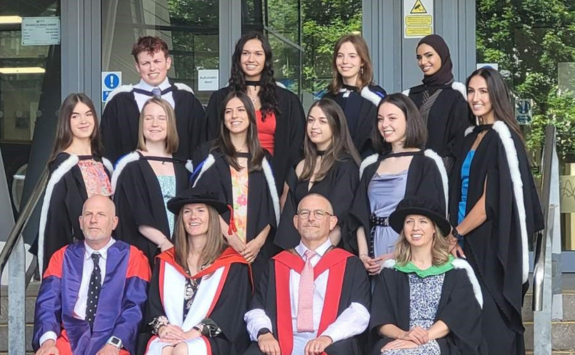
And finally, what are your favourite memories of your student days in Newcastle?
Newcastle was my foundation, and it will always hold a special place for me. My time at Newcastle helped me begin shaping my career, thanks to the constant encouragement and inspiration I received. I feel truly fortunate to have met and worked alongside scientists who guided me in finding my niche and striving for excellence.
To this day, I continue to work and collaborate closely with lecturers and researchers from Newcastle University, in the fields of biosciences as well as education, particularly with Dr Vanessa Armstrong. Our beautiful partnership has continued beyond my studies, now engaging as an early-career researcher. I even had the pleasure of inviting former lecturers, such as Dr Satomi Miwa, here in Oxford, to deliver a keynote speech at a conference on ageing that I had the opportunity to co-organise.
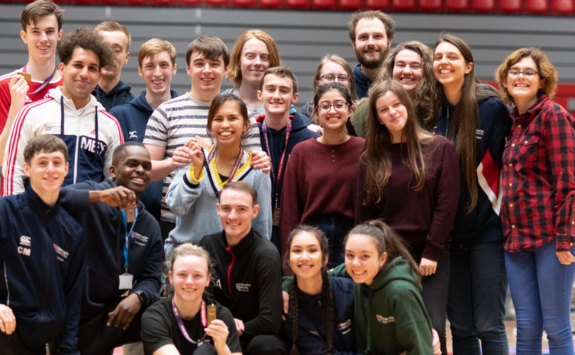
I’m also still in touch with many friends that I met at Newcastle, with friendships forged on my course and in various sports clubs and societies. I fully embraced student life during my time at Newcastle. I was part of the Taekwondo club, a society that warmly welcomed me when I arrived in the UK, and I volunteered for Make a Smile, Teddy Bear Hospital, and N.E.S.T. I enjoyed being part of the Street Scientists team, participating in the Peer Mentor initiative, and also helping as a Study Skills and Student Ambassador.
I can’t praise the university and academics enough – I know that my connection with Newcastle is for life. My time on campus completely shaped my future and changed the path I anticipated I would follow, for the better. No matter where my path will take me, Newcastle will always be my beginning, and I will be eternally grateful and honoured for that.
That’s so lovely to hear. Thanks for speaking with us Maria!
Do you have news to share with our alumni community?
Get in touch and share your latest news and achievements so we can let your fellow Newcastle alumni know!