“There is no planet B”: The economic argument for combatting climate change
Newcastle alumnus Dr Stuart Mackintosh shares his view of the climate crisis as one of the defining economic challenges of our time. Explore why governments, financial institutions and individuals must recognise the true cost of pollution, support developing economies in the transition, and accelerate the shift toward a cleaner, more resilient global economy - before the tipping points of climate change outpace our ability to respond.
2 April 2026
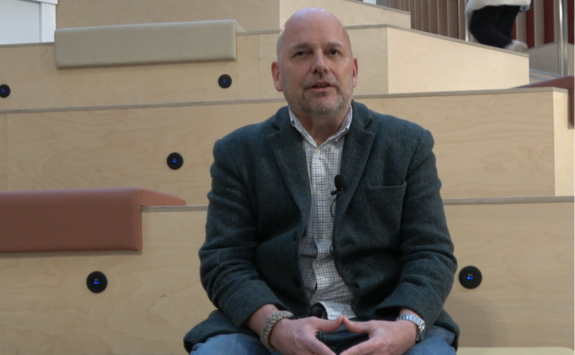
To mark Earth Day 2026, we sat down with Newcastle graduate, economist and author of ‘Climate Crisis Economics: A Race of Tipping Points’, Dr Stuart Mackintosh.
Dr Stuart Mackintosh (BA Hons Politics and Social Policy, 1989; PhD, 2014) is a strong advocate for global systemic action on climate change. Having “drunk the Kool Aid”, he has dedicated the latter part of his career lobbying the world’s leading central bankers and CEOs to see the climate crisis not simply as an environmental challenge, but an economic crisis too.
After graduating from Newcastle University in 1989, Stuart began his career at the European Parliament before joining Mitsubishi as an economist. He is perhaps best known as the Executive Director of international think tank the Group of Thirty. Having stepped down from this role in 2025 after over two decades, Stuart led the strategy for long term finance and economic growth, governance and supervision at major banks and financial institutions, and the future of central banking. He is also a Visiting Fellow at his former department on campus, Newcastle University’s School of Geography, Politics and Sociology, and a financial author of titles including ‘The Redesign of the Global Financial Architecture’ and ‘Climate Crisis Economics: A Race of Tipping Points’.
It is around this latest title, published in 2025, that our conversation with Stuart centred on when he returned to campus in March 2026. Describing the climate crisis as “the maximum challenge of our lifetimes”, Stuart shared his vision for a climate-aligned global economic system, the importance of paying the right price for our pollution and how to right the wrongs against developing countries whose progression is being halted by blanket climate policies.
The risk of climate change never goes away
When you ask leaders in the corporate world, economics or other fields what the biggest risks facing the world are, geopolitical risk would be uppermost – as we’re seeing currently with the war in the Middle East – but after that comes climate change, and that’s because it simply does not go away.
In my view, this is the maximum challenge of our lifetimes. There is no planet B. If we don't get it right, we're all going to be in terrible trouble within the next few decades.
When you've got complex systems, there are multiple risks happening simultaneously, and they're interrelating and interlinked. So, you've got an immediate war in the Middle East at the moment, but you also have water scarcity and worries over severe weather in Africa, and you have spiking energy prices. We can simultaneously hold the very human concern for the situation in the Middle East and the reality that climate risks continue to unfold around us. In fact, many of those climate risks affect the probability of war in some of these regions.
Sometimes climate change can seem diffuse and far away. That's the struggle, isn't it? On the human scale, they're hard to grasp until there's a severe weather event, and then it becomes obvious that you have a crisis. It’s the same from Central Banks’ perspective, and they have a really important role in this because they’re regulating our financial system, our insurance companies, and have to be the ultimate determinant of risk management in the global system.
The good news is that the central bank in Britain, run by Andrew Bailey, is squarely focused on climate risk and will regularly stress test the banks and insurance firms against certain climate risks. This is also the case in the European Central Banks. Central Banks that are smart are on top of these issues because they recognise that climate risk is financial risk.
By paying the real price of our pollution, we can change behaviours and you can accelerate the rate of transition.
Paying the real price of our pollution
Financial risk and pressure can also be a way to create real change to combat the climate crisis. For example, Britain has very high petrol taxes, which are essentially a tax on carbon. So that’s why, in comparison with the US, where I live, Britain has smaller cars and many more electric vehicles on the road. By paying the real price of our pollution, we can change behaviours and you can accelerate the rate of transition.
The real changemakers are national governments – who control the regulations about our markets and businesses – and individuals choosing what they do as consumers, rather than global forums like COP. It's those national governments that determine the regulations around EVs and carbon taxes, the costs we pay for different types of services related to energy and so on. So, it's really about national and local determinations.
I'll give you an example from Washington DC where I live. All large apartment buildings in Washington are now required by law to upgrade their energy systems, and they are being audited against the median rate of the area. Every year, we must lower our energy usage and if you don't hit that target, you get fined. So now I see people in my building changing their behaviour to avoid the financial risk – they’re putting in double glazing, they're checking the roof, checking the insulation.
Addressing the global imbalance
The problem with paying the true price for our fossil fuel use comes when sanctions and rules are applied globally without recognising the economic and social injustice facing developing countries. Our nations have benefited from the use of fossil fuels in industrialisation for centuries, and at events like COP, the Global South are quite rightly complaining about the fact that they’re bearing the burden: they have not developed yet and indeed are most at risk because of this and their position in tropical regions where the most severe effects of climate change occur.
If you look at the per capita carbon emissions of an American and you compare them with the per capita emissions of a Malian farmer in Africa, a Malian farmer uses 100 times less carbon than an American. That has to be a massive injustice. You can't say to the farmer, "Sorry, we've had it, you can't have it." That's just not acceptable. It's socially unjust, it's economically unjust. We must address that imbalance.
You address that imbalance in several ways. There should be larger net transfers from the advanced economy polluting countries to these poorer countries, many of which are in sub-Saharan Africa, so that they can industrialise at speed. Yes, their carbon emissions will rise, but from a very low base. Meanwhile, the technologies that have been developed elsewhere can help them essentially leapfrog technologies.
Most advanced economies are shrinking in terms of population. Where is the new opportunity from a sort of investment perspective? Where are the new population centres that are going to drive economic growth in the future? It's going to be in those developing economies. So, we need to facilitate those economies in adopting these new green technologies to grow.
The transition will not be to some kind of dystopian hell. Rather, a climate-sustainable net zero economy will be the type of economy that will be better to live in.
The struggle when you’re working on climate change is not to despair
Sometimes you can despair when you look at a big picture of more frequent and larger unpredictable severe weather events. The struggle when you're working on climate change is not to despair. And the way to get past that is to focus on the local: focus on what you're doing, focus on what your community is doing. Because that's real and tangible, and you can influence it - even as you also seek to influence policy.
It's an antidote to frustration when you're working in the climate space. It has to be a top-down thing. Every individual change we make as citizens, moving us towards the goal of net zero and climate sustainability, is an essential piece of getting there.
The transition does not have to be some kind of dystopian hell. Rather, a climate sustainable net zero economy will be the type of economy that will be better to live in. It'll be lower pollution, it'll be walking and it'll be electrically driven non-polluting vehicles.
It's not instantaneous to get from here to there. But when I look at other countries that are achieving these goals faster, I don't see a negative, I see a positive. When I go to Amsterdam and I see EV chargers on almost every street and everybody cycling – including children on the way to nursery! - I see the kind of country I want to live in.
We don't have to rely on fossil fuels for our future. The major countries are showing that that's possible.
Creating a brighter future
The critics of climate transition, which we must undertake one way or another, claim it’s too expensive and it will be bad. Renewable energy is now the cheapest energy in the world, and looking at places like Amsterdam, Sweden, Costa Rica or (I might say proudly, as a Scotsman) Scotland where 100% of electricity is now renewably generated, I see them creating a future that is better than the future we have today.
I'm not going to suggest that we change the entire economic system. But I think we have the tools and the solutions. The frustration is sometimes that the lack of urgency is such that we don't achieve as much as we could.
We don't have to rely on fossil fuels for our future. The major countries are showing that that's possible. China is the largest emitter in the world at the moment, but they’ve peaked and look set to decline. China has been investing in green technologies and renewables for more than 20 years now. Last year they installed more renewables in one year than have been installed in the entirety of history in America. They are installing 100 solar panels per second. So, they grasp the future.
Why do all this? Well, it means that we can continue to live in a stable, planetary environment without unremitting catastrophes. That's the way to look at it. Because otherwise, if we fail and we don't secure the transition, we'll be forced to do it anyway. But it'll be done in a disoriented, chaotic, damaging, dangerous, dystopian way.
We can have green, sustainable economic growth. We can decarbonise economies. We can decouple growth from carbon fossil fuel, both here and in the developing world. It's not easy to get from here to there, but we must be focused on the future, and a green, renewable, sustainable, growing future.
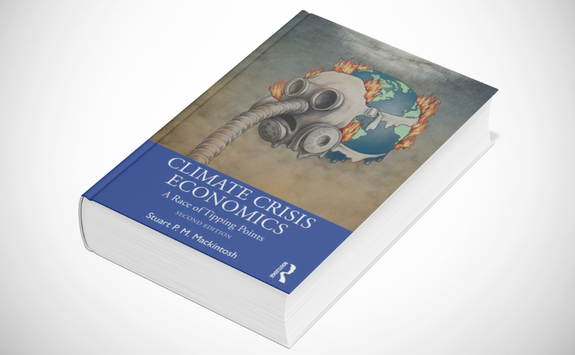
Climate Crisis Economics: A Race of Tipping Points
Stuart’s latest book, ‘Climate Crisis Economics: A Race of Tipping Points’ reframes climate change not simply as an environmental challenge, but as a systemic economic crisis defined by accelerating feedback loops and converging tipping points.
At the heart of the book is the argument that we are in a “race” between negative climate tipping points and positive economic and policy tipping points. On one side are physical thresholds in the Earth system — melting ice sheets, permafrost thaw, forest dieback — that, once crossed, could trigger irreversible and self-reinforcing damage. On the other side are social, technological, financial, and political tipping points that could rapidly accelerate decarbonisation and climate resilience if activated in time.
NCL in Action: Exploring the rifts and shifts facing society today
The world is currently characterised by shifting geopolitical power dynamics, hopes – and concerns – for technological advancements, economic uncertainty and a ticking clock against climate change.
Over the course of the current academic year, Newcastle University invites its global community of students, alumni, colleagues and partners to explore how these ongoing changes and challenges can be tackled together.
Join Newcastle honorary graduate and former Chief Economist of the Bank of England, Andrew Haldane CBE, on Tuesday 30 June to explore what the ongoing global disorder means for our economic prospects, business outlooks and individual livelihoods.