An Architect of Stories: Caroline Hardaker on building worlds and finding her voice
This World Book Day, we sat down with Class of 2009 graduate Caroline Hardaker (nee Brown) to discuss her journey as a published novelist and poet and hear how her time on campus shaped her writing.
5 March 2026
Newcastle graduate Caroline Hardaker (BA Hons English Literature, 2009; MA Museum Studies, 2010) is a creator and author of dark and brooding tales exploring everything speculative, from folklore to future worlds.
Since completing her studies with us in 2010, Caroline’s work has been featured in The Washington Post, The Guardian, New Scientist, and BBC radio. Her first novel, Composite Creatures, was published in April 2021 and shortlisted for a Golden Tentacle Award in The Kitschies, followed by her second novel Mothtown in November 2023.
To celebrate World Book Day 2026, we caught up with Caroline to look back at her time as an English Literature student on campus, traverse her meandering career journey and reflect on the advice she would offer to budding authors in our alumni community.
From campus to the cosmos of imagination
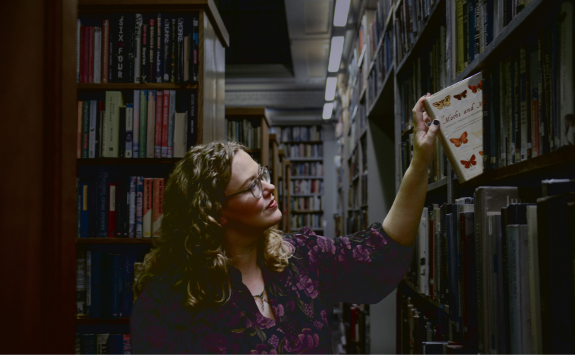
When I first began thinking about university, I was torn between studying English Literature or Engineering. I loved subjects where I became an architect – either of systems or of stories – and I loved breaking them apart just as much as constructing them.
In the end, stories won. When I thought about where I might be in the future, I saw myself communicating more than anything else. It just felt exquisitely important that I should talk to people, and what more intimate way to do that than through their imaginations?
I grew up locally and lived at home as a student, commuting to campus. At first, it definitely made me feel a bit ‘separate’ from everything happening, but once I’d found a group of friends, it didn’t make a great deal of difference.
One of the very random memories I have was having lunch in the Basement of the Student Union every Tuesday with my friendship group. It was so every day, but we all ate almost the same thing every time, and it became a very odd sort of tradition. When I imagine myself there, I feel lighter, excitable, ready to laugh.
I’m still in touch with some friends from uni today. I think that when you study stories, beginnings and endings are never as clear-cut again. We’re all just drifting in and out of each other’s lives, and that’s a lovely thing.
I’m still in touch with some friends from uni today. I think that when you study stories, beginnings and endings are never as clear-cut again. We’re all just drifting in and out of each other’s lives, and that’s a lovely thing.
The start of something
I loved the English Literature course at Newcastle, but a special mention has to go to any module led by Dr Stacy Gillis – whether it was the mind-blowing possibilities of Cyberpunk or the classic tropes of detective fiction! Other modules that still linger in my mind are the Scottish Divided Self and the English Ghost Story, both of which probably influence my writing today more than I give them credit for!
Outside of the lecture theatre, I wrote a little bit for the film-making society and was involved in the Theatre Society (NUTS) as a Stage Manager. That basically meant a lot of running around with a manic look in my eye, trying to locate very random, but very plot-vital, props!
I didn’t have the confidence at the time to think that I could be a published author, but I thought I might branch into something else wordy. Marketing. Advertising. Copywriting. It was only as a graduate that I gained the world experience and confidence to write creatively as a career.
Freedom to experiment
I stayed on campus for an extra year to study for a Master’s in Museum Studies, and since then my career trajectory has been quite varied. From selling art and curating in the heritage sector (the closest I’ve been to becoming Indiana Jones!), to organising outreach with older people and running a schools programme, today my job involves content strategy and writing stories about research and innovation happening at Newcastle University.
Throughout this meandering path, I wrote constantly on the side and began experimenting with poetry in my mid-twenties. Once I started to be published, my confidence grew, as did how much I wrote.
In one way, being a poet first was born from practicality. Naturally shorter and more concise, the hope of completing one good poem seemed much more realistic than a novel. I was also entranced by the possibilities, and – if I were to ignore all formal poetry structure – the freedom to experiment.
There was something so wonderfully musical about the rhythm, too. The emphasis put on particular words by placement, white space and rhyme. My first collection came from bringing together a lot of my early poem-stories of strange and unusual characters. My second collection was more deliberately formed, as a look through time at the nature of discoveries.
At this point, several of my poems were made into an opera performed in London. It was a mind-blowing experience. It gave me the chance to write about ancient, misinterpreted goddesses and see actors emote all the words I’d written. Awe-inspiring.
I find it difficult to pinpoint my favourite thing about being an author. The boundless possibility of it, the satisfying ‘snap’ when a plot falls into place like it was meant to be, seeing an idea grow from a spark to a hardback on a shelf.
From poetry to prose, and plans for book number 3
My first novel – Composite Creatures – was born from a poem I had written for a Scottish journal. As I was drafting these science fiction poems for publication, I clocked one as having potential to grow into a short story. As I pulled that thread and planned it out, it became a novella and then a full-blown novel!
Composite Creatures is set in the near future on an Earth-like world that has been damaged by climate change. That novel won me an agent and a publishing deal, was shortlisted for a Blackwell’s Kitschie Award and named as one of the top science fiction books of the year in The Washington Post. Since then, I’ve balanced the poetry and prose work, even bringing them together in some cases. And for my second novel – Mothtown – I joined forces with the illustrator Chris Riddell to bring my story to life, and we’ve collaborated endlessly since.
I can’t say much at all about my current plans for book three, unfortunately! I wish I could! But what I will say is that its completed, and about the enter the publishing machine. It's a new literary novel, exploring the sea and maternal trust in an apocalyptic near-future.
I'm currently working on novel four, which means I've taken a deep dive into a new obsession. Possibly for the first time, I’m also falling in love with the two protagonists, too. I'm balancing this with a few other ongoing projects too, mainly a graphic novel and a poetry collection. So, there’s lots keeping me busy!
Changing points of view
I find it difficult to pinpoint my favourite thing about being an author. It could be the boundless possibility of it. It could be the satisfying ‘snap’ when a plot falls into place like it was meant to be. It could be seeing an idea grow from a spark to a hardback on a bookshop shelf.
But what makes me really glow is the feeling that I’ve made a reader think about something. See a topic in a new light. See themselves or others more kindly. I like the idea that I might have changed someone, even in a tiny, unconscious way.
Writing is one of those things that – even if you have a natural talent for – needs practice. So my advice to any budding authors would be to write as much as you can! And I always advocate understanding and writing poetry as a great storytelling training exercise. When drafting a poem, you’re being lean with language, you’re cutting out the unnecessary, you’re learning how to speak and write with rhythm and white space.
But it’s also about changing your point of view. Cliché is the enemy of poetry. When you think poetically, you’re training yourself to see old things in a new light. And those are the moments that stick in a reader’s head.
You can keep up to date with Caroline's writing on her website or by following her on Instagram @caroluna_writes_stuff.
Do you have news to share with our alumni community?
Get in touch and share your latest news and achievements so we can let your fellow Newcastle alumni know!