Rebuilding Memory: Meet the alumna safeguarding heritage after conflict in Iraq
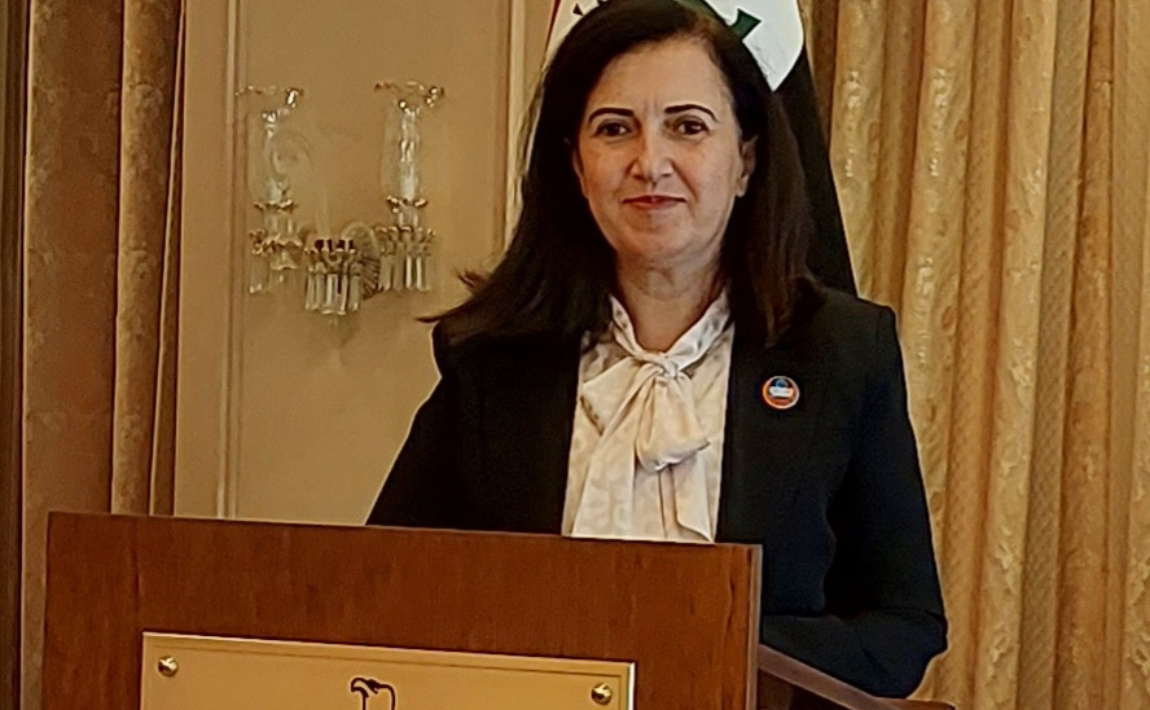
Ahead of World Heritage Day (18 April), we sat down with Newcastle University alumna Dr Rawaa Qasha (PhD Computing Science, 2018) to hear about her experience of rebuilding the city of Mosul following ISIS occupation and how digital tools can help us protect our culture for future generations.
6 April 2026
Protecting the past, powering the future: Preserving culture in a changing world
While Dr Rawaa Qasha was on campus studying for her PhD in Computing Science, her home city of Mosul in Iraq was occupied and severely damaged by ISIS forces. Upon graduating, Rawaa felt a personal responsibility to return and rebuild the area, protecting her cultural heritage.
Rawaa is an Assistant Professor at the University of Mosul (UoM) and former Director of Scholarships and Cultural Relations, where she managed international academic collaborations and joint programs. Since returning to Mosul after graduating in 2018, Rawaa has been instrumental in preserving Mosul's cultural heritage, working with partners such as UNESCO and the British Academy to restore the city's ancient historical legacy.
18 April 2026 is the International Day for Monuments and Sites, also known as World Heritage Day, established in 1982 to advocate for and celebrate cultural heritage. With this year’s theme being ‘living heritage’, we asked Rawaa about how her work is protecting the oral traditions, social practices and craftmanship of Mosul and the wider Nineveh region, and how her background in computing science is protecting this cultural legacy for future generations.
Understanding the value of cultural heritage
I grew up in an ancient archaeological town, Alqosh, and so I recognised the importance of the cultural heritage and Mesopotamia Civilisation from an early age. I always felt a special responsibility towards it, especially following the destruction inflicted on Nineveh during the occupation by ISIS, where important parts of the cultural and civilisational heritage were lost that represent the identity and memory of society.
The city of Mosul suffered extensive destruction during ISIS occupation, with numerous heritage sites and religious buildings sustaining severe damage, particularly in the right side of the city, which is considered among its oldest quarters and richest in historical landmarks.
Many mosques, churches, ancient markets, and heritage houses were either lost or irreparably damaged, resulting in the disappearance of a significant portion of the material evidence that once embodied the collective memory and history of the place. The impact, however, was not confined to the tangible heritage alone. It extended equally to the intangible dimension of cultural life, as certain social and religious customs gradually transformed over time, while several folk arts, including traditional songs and handcrafted trades that had long been woven into the fabric of daily life fell into decline.
With so many of these cultural expressions fading from lived reality, the memory preserved by the city's original inhabitants has become an indispensable source for understanding the essential stories of Mosul's historic way of life.
Witnessing the scale of destruction that affected cultural institutions and heritage sites in Nineveh was deeply painful, but it heightened my awareness of the importance of our heritage. I realised that heritage is not just ancient ruins or buildings, but a fundamental part of a society's identity and sustainability.
After completing my PhD at Newcastle University, I felt it was my responsibility to return to Mosul and utilise what I had gained during my studies in Newcastle - scientific experience, research skills and academic and social connections - for the post-war society needs, particularly in supporting the reconstruction of my university and participating in efforts to preserve and document cultural heritage.
Heritage is not just ancient ruins or buildings, but a fundamental part of a society's identity and sustainability.
Using AI and other technologies to amplify our connection to heritage
Returning to Mosul from Newcastle with a PhD from the School of Computing, I had a practical toolkit of skills and expertise that I was determined to put to meaningful use. Rather than confining these capabilities to conventional computing applications, I made a conscious decision to direct them toward the preservation and documentation of cultural heritage, a field where technology has an enormous and largely untapped role to play.
My first initiative involved working with my master's students to systematically collect and analyse data from social media platforms, focusing on cultural heritage sites and artefacts that had been destroyed or damaged during the ISIS occupation and the subsequent conflict. This exercise demonstrated early on that those digital platforms, even in their most informal expressions, could serve as valuable repositories of heritage documentation when approached with the right analytical framework.
From there, I expanded into more sophisticated technological applications. Drawing on my background in cloud computing and the Internet of Things, I began deploying IoT-based monitoring systems across heritage buildings and archaeological sites in Mosul, enabling real-time tracking of environmental conditions and helping to protect these structures from the compounding threats of climate change and physical deterioration.
My current work goes further still. In collaboration with colleagues at the University of Mosul and partner institutions in the UK, I am applying a broader suite of technologies, including data analytics, cloud continuum infrastructures, deep learning, and machine learning to address multiple dimensions of heritage preservation, spanning both tangible sites and intangible cultural expressions across Mosul and the wider Nineveh region. Looking ahead, one project that carries particular personal significance is my intention to use these modern technologies in the preservation of Aramaic, my own ancestral language, which faces a very real risk of extinction. For me, this represents the fullest expression of what technology can offer: not merely as a tool for documentation, but as a means of ensuring that endangered languages, traditions, and identities survive into the future.
When placed in the hands of people who understand both the technology and the culture it serves, digital becomes an indispensable instrument for safeguarding what conflict, neglect, and time threaten to take away.
A living thread that connects us to history
I belong to a community where an ancient language like Aramaic is still present in the details of daily life, used in our religious rituals, hymns, and social celebrations, and taught in some schools, which helps pass it on to new generations. This language is not simply a means of communication; it is a living thread that connects us to a long history of culture, knowledge, and tradition. Heritage is also very much present in my family environment. Our home holds a number of Aramaic calligraphy pieces and sculptures inherited from my grandfather and father's works of art that carry deep symbolic and cultural meaning for us.
One of the first things I felt compelled to check on when I returned to Mosul from Newcastle was the carving and calligraphy tools belonging to my grandfather and father, kept in churches, monasteries, and museums in and around my hometown. To me, these represent a living continuation of an artistic and family tradition passed down through generations.
Beyond this personal and family dimension, I make a point of taking part in cultural activities and initiatives in my hometown, in Mosul, and at the university. All aimed at supporting local heritage and raising awareness of its importance. These include projects that seek to document cultural heritage and introduce young people to its value and its role in strengthening community identity.
The knowledge passed down by local residents in Mosul, particularly elderly community members, concerning the destroyed sites, traditions, and cultural practices is of considerable scholarly value, as it contributes meaningfully to reconstructing a fuller picture of a heritage that has been either lost or profoundly altered. This reality underscores the pressing need to document and record these oral narratives through rigorous, modern methodologies to ensure their preservation and transmission across generations and to establish a reliable reference that can guide future efforts in heritage revival and reconstruction.
For me, then, the concept of "living heritage" – the theme for this year’s World Heritage Day - is not about the past alone, it is an ongoing practice, expressed in the language we speak, the arts we preserve, the traditions we keep, and the efforts we make to protect this legacy and hand it on to future generations. It is a living part of my daily life, and of most of the work and activities through which I try to support the culture and heritage of my community.
Training future custodians of culture
One such way is through the partnerships with several UK institutions and UNESCO that the University of Mosul has established to train current students and alumni in conducting oral history fieldwork across minority communities in the Nineveh region. This has enabled our ‘custodians of culture’ to document both tangible and intangible heritage by collecting valuable narratives from elderly residents. The university has also organised festivals, exhibitions, and community workshops to bring heritage into everyday campus life. A personal highlight for me was an exhibition of my father’s Aramaic calligraphy, reflecting how individual and family heritage can be meaningfully integrated into broader cultural initiatives.
Over the course of more than twenty projects spanning from 2019 to the present, I have had the privilege of working alongside UNESCO, ICCROM, the British Academy, the British Council, the British Library, the University of Bologna, Newcastle University, and numerous other UK universities. Each of these partnerships has left its mark on how I understand the relationship between global expertise and local recovery. Perhaps the most profound lesson these collaborations have taught me is that cultural heritage is not a local concern, it is a universal one.
What was lost or threatened here represents a loss for all of humanity.
The level of genuine interest, commitment, and expertise that our international partners brought to the history and heritage of Mesopotamia and Iraq was both humbling and deeply encouraging. Experienced heritage professionals from across the world were not merely willing to engage with Mosul's story; they were eager to do so, recognising that what was lost or threatened here represents a loss for all of humanity. The collaborations were not one-directional; they created genuine exchanges of knowledge, methodology, and vision, strengthening our institutional capacity while simultaneously connecting Mosul's heritage to global networks of scholarship and advocacy.
I am sincerely and deeply grateful to every one of these partners for their interest, their generosity, and their unwavering support. What I carry from all of these collaborations is a firm conviction that local cultural recovery, particularly in post-conflict settings, cannot be achieved in isolation. International partnerships bring resources, technical expertise, and perhaps most importantly the message to local communities that their heritage matters, that the world is watching, and that the effort to preserve it is a shared human responsibility.
Don’t wait for the threat to arrive before you act
Prevention, in the realm of cultural heritage, is infinitely more powerful than recovery. The single most accessible and impactful action available today is digital documentation. Recording heritage, whether that means photographing historic buildings, filming traditional craftspeople at work, transcribing oral histories, or archiving manuscripts, costs relatively little, yet its value is immeasurable.
In Mosul, we witnessed firsthand what happens when this step is neglected. Some of our people had the foresight to document certain sites and traditions digitally before the conflict, and those records have since become irreplaceable. But many others did not, and because there was no systematic or well-resourced preservation effort in place, we lost manuscripts, heritage buildings, and cultural artefacts across successive waves of conflict in Iraq; losses that simply cannot be undone.
When people gather around their heritage repeatedly and joyfully, it ceases to be something abstract or institutional and becomes instead a living, breathing part of their shared identity.
Festivals, exhibitions, workshops, cultural celebrations, and public events, held regularly and covering different aspects of both tangible and intangible heritage, keep cultural identity alive in the collective consciousness of a community. When people gather around their heritage repeatedly and joyfully, it ceases to be something abstract or institutional and becomes instead a living, breathing part of their shared identity. This continuity of engagement is itself a powerful act of preservation.
Equally important is the work of awareness, particularly among young people. When younger generations understand the value of what surrounds them, they become its most committed protectors. Education, community engagement, and storytelling all play a vital role in ensuring that heritage is not taken for granted while it still exists.