
From Audio Booth to Lecture Hall: Dr Jesús Salazar’s journey through media.
An interview with alumnus Dr Jesús Salazar conducted by Global PR student Chloe Friberg
20 January 2026
Growing up in Mexico, Jesús spent time with his family, playing and watching the classics like Indiana Jones.
Without realising, he was paving the way for his future as a lecturer of Public Relations and Media Communications at Newcastle University.
Just the start
After receiving a toy radio as a child, future Dr Jesús Salazar’s destiny was set. Equipped with a radio-style microphone, a plethora of sound effects, and a functioning channel, 5-year-old Jesús was able to broadcast his show onto Mexican airwaves. Reflecting on the hours of fun he had at his makeshift radio station, Jesús, now sat in his office in Windsor Court, fondly considers this the start of his career in radio. Jesús regaled in presenting and discussing his thoughts with others, which “pleased his inner child.”
Continuing his passion for radio at the Universidad Autónoma de Tamaulipas, Jesús gained his degree in Media and Communications. While researching his dissertation topic, the national analogue switch-off in Mexico, Jesús had his interest piqued by the BBC. Although previously aware of the BBC, he had not realised its incomparable presence in the UK.
At this point, he began considering venturing over the Atlantic to England to continue his studies. Aided by his undergraduate dissertation supervisor who, themselves being a Goldsmith’s graduate, advised Jesús that “time passes anyway. Next year, you’ll be a year older regardless. The only difference is whether you’ll be a year older with a UK master’s degree, or a year older without it.” This pearl of wisdom reminded Jesús that “there’s never a perfect time to do something,” so he built up his courage and went for it.
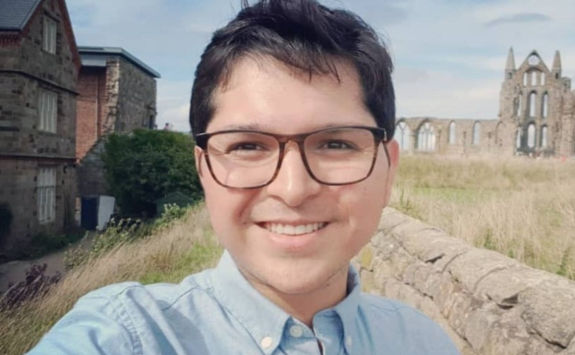
On colder shores
While at university, Jesús began working at a PR agency which influenced his decision to take up his master's degree in media and PR. Unfortunately, the big move away from his family and the challenges of adapting to a “different country, a different language, a different everything” proved too taxing. To add to the difficulty of the situation, Jesús’s confidence in the PR industry began to fade; he saw faults in the industry that he felt overwhelmed by. Despite this, he fought on, completing his masters, choosing to take a different approach to PR. Jesús decided that he “could be more critical about the PR industry, if [he] moved towards a more academic route…[he] could critique the industry from an informed position.”
That’s just what he did. On the precipice of returning home to Mexico at the end of his master’s degree, Jesús was given the option by his scholarship from the Mexican government to extend his studies to PhD level. “It was almost like it was meant to be,” he recounts the considerations and sacrifices made to continue his study in Newcastle but decides it was the obvious choice. Jesús decided to focus his doctoral thesis on “360-degree videos, on VR headsets, as a promotional tool for Mexican cultural tourism in the UK.”
Research under lockdown
“To give you some background…” Jesús explained, “I’ve always loved exploring how technology shapes the way people experience places and stories, so connecting that to Mexican tourism felt especially meaningful.” Beginning his research in 2016, Jesús was inspired by the rise in popularity of VR headsets and wondered what impact these could have as a marketing tool to encourage tourists to experience a place, first through virtual reality, then to visit it. Unfortunately, Jesús faced many obstacles along the way, including unreliable technology. Jesús visited Mexico with a 360-degree camera to create some footage for his studies when his camera ran into some difficulty recording. Thankfully, he managed to get other videos that he could return to the Culture Lab at Newcastle with to begin editing.
As he edited high quality videos in the Culture Lab, Coronavirus lockdown measures prevented Jesús from continuing his work. Locked away, his videos remained unedited, stalling his research. However, this gave Jesús the opportunity to rethink the rest of his methodology which had been flipped upside down by the lockdown. Focus groups and sessions using the VR headgear were abruptly cancelled and Jesús had to improvise with online questionnaires, Zoom meetings, and even posting out makeshift cardboard VR headsets for the participants to experience the virtual reality he had created for them. Throughout all of these challenges, there was one thing that kept Jesús “motivated to finish,” and that was his personal connection to the topic he was researching. As someone from the north-east of Mexico, Jesús’ heritage reflects the “melting pot” that Mexico is. The mix of Spaniards, Portuguese, Sephardic Jews, and North African Moors as well as his Great-Grandfather who escaped the Chinese Revolution encouraged Jesús to learn more about Mexico and its cultural past. Or as he calls it, “an anthropological exploration.”
Looking to the past and the future
The importance and proximity of this topic to Jesús was the motivation he needed to complete his doctorate despite the many obstacles he faced. His resilience was rewarded almost immediately by what some may call destiny but Jesús considers “luck,” when he was hired as a lecturer here at Newcastle University.
After years of research, travel, and writing, Jesús is now enjoying settling into university life at Newcastle from a lecturer’s perspective. He wishes to use his own experiences in academia to make learning more fun, interactive, and accessible to his students. In particular, revisiting his love of emerging technologies and the ever-changing trends in communication. As our meeting concludes, Jesús explains he has a meeting with a student, with whom he’s looking forward to passing on his journey of knowledge, and sharing his passion for the subject.