
What the new global (dis)order means for our economic future
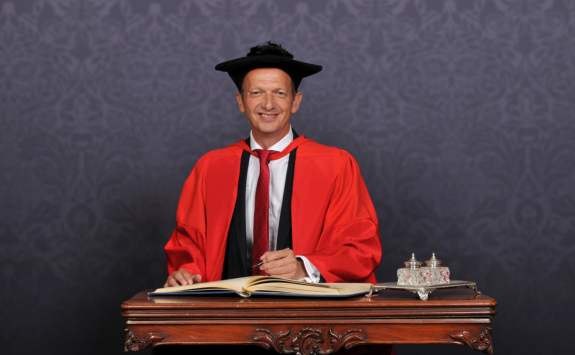
We live in a world where the only certainty is uncertainty, and economic and moral issues are intertwined. What does the ongoing (dis)order mean for our economic prospects, our business outlook and individual livelihoods? Honorary graduate and economist Andy Haldane explains all.
7 August 2026
Andy Haldane is one of the UK's leading economists, having served as Chief Economist at the Bank of England, a member of the Monetary Policy Committee, Chief Executive of the Royal Society of Arts (RSA), and currently Chief Economic Advisor at PwC. He has spent much of his career helping governments, businesses and communities navigate economic change.
Today, as President of the British Chambers of Commerce and Chancellor of the University of Sheffield, he is increasingly focused on how societies can respond to the profound disruptions reshaping our world.
In this blog (adapted from his closing address at this year’s NCL in Action programme) Andy shares his expert view on what the ongoing rifts and shifts around the world, geopolitical power dynamics, technological advancements, economic uncertainty and a ticking clock against climate change – mean for our livelihoods.
Welcome to the new world order
We are living through a period of global disorder unlike anything I have witnessed in my professional lifetime.
Economic, geopolitical, technological and ecological tectonic plates are all moving at once. Historically, societies have adapted to major shifts in one or two of these areas at a time. Today, they are colliding simultaneously. The result is a series of economic and social earthquakes whose impacts are being felt by households, businesses and governments alike.
The geopolitical landscape has become more fragmented and uncertain. Trade relationships are becoming more politicised. Security concerns increasingly influence economic decisions. At the same time, climate change is no longer a future risk but a present reality, bringing disruption to agricultural production, infrastructure, insurance markets and energy systems.
These forces are amplifying one another. Climate shocks create economic pressures. Geopolitical tensions affect resource availability and energy costs. Technological disruption changes labour markets faster than institutions can adapt. Together, they create a level of uncertainty that challenges many of the economic assumptions that guided the last three decades.
Periods of disruption are also periods of opportunity. The challenge is not to resist these shifts but to understand them and position ourselves to benefit from them.
Yet disorder should not be confused with decline
Periods of disruption are also periods of opportunity. The challenge is not to resist these shifts but to understand them and position ourselves to benefit from them.
For individuals, this means recognising that economic resilience is becoming every bit as important as economic prosperity. The careers of the future will require continuous adaptation. Flexibility, curiosity and lifelong learning are increasingly becoming economic necessities rather than optional extras.
For businesses, the message is similar. The organisations most likely to thrive will not necessarily be the largest or the most established. They will be the most adaptable. Firms that can manage risk while embracing innovation will be best placed to navigate the years ahead. Resilient supply chains, investment in technology, workforce development and strong community relationships will become competitive advantages rather than corporate luxuries.
The danger of a failure of imagination
One lesson I continue to draw from the global financial crisis is the danger of a failure of imagination. In 2008, many institutions and experts underestimated risks that were in plain sight. We must not repeat that mistake.
Climate disruption, technological transformation and geopolitical fragmentation require us to think beyond traditional economic frameworks. We cannot assume that yesterday's solutions will be sufficient for tomorrow's problems.
Indeed, central banking itself is entering a new era. For many years there was a belief that inflation had been largely tamed. Recent events have reminded us that economic stability is never permanently secured. It requires constant vigilance and adaptation.
Governments face an equally difficult balancing act. Public debts have risen significantly following successive crises. Yet growth remains essential to improving living standards and funding public services. The challenge is to stimulate economic activity without undermining fiscal sustainability.
Levelling up through local leadership
One of the most important lessons from economic development is that momentum matters. Places that project confidence attract investment, talent and opportunity. Conversely, talking down an economy or a community can become a self-fulfilling prophecy. Expectations influence behaviour, and behaviour ultimately shapes outcomes.
I have seen encouraging examples of this across parts of the UK. Sunderland, for example, where I was born, is demonstrating how local leadership, investment and collective ambition can begin to transform economic prospects. The green shoots are visible because people have chosen to focus on possibilities rather than limitations.
The UK's regional inequalities remain among the largest in the developed world. Closing those gaps is not only an economic imperative but a moral one. Every community should have the opportunity to fulfil its potential. Achieving that goal requires more than government action alone.
From Government to governance
In my view, one of the most important shifts of the next decade will be moving from a model dominated by singular institutions to one driven by multiple stakeholders.
The strongest outcomes emerge when government, business, universities, charities, community organisations and faith groups work together. Governance is becoming just as important as government.
This collaborative model will be particularly important as we respond to climate change and geopolitical uncertainty. The scale of these challenges exceeds the capacity of any individual institution. Success will depend on our ability to build partnerships that combine resources, expertise and trust.
The strongest outcomes emerge when government, business, universities, charities, community organisations and faith groups work together. Governance is becoming just as important as government.
So what should we take from the turbulence of 2026?
The future is not something that happens to us. It is something we shape.
Despite the scale of today's challenges, I remain optimistic. The UK's problems are serious, but they are not insurmountable. With the right leadership, stronger partnerships and a shared sense of purpose, we can generate the momentum needed not merely to withstand this new global disorder, but to prosper within it.
.png)
As this year’s NCL in Action programme comes to a close, we wanted to take a moment to thank everyone who took part and celebrate the incredible impact we’ve made together.
Over the past academic year, over 1,400 alumni, students and colleagues from 33 countries have come together to explore the theme “Rifts and Shifts: Our Changing World”. With support from our event partners at Lloyds Banking Group, Debate Mate, Northumbria University and Newcastle City Council, your enthusiasm, insight and willingness to engage in discussions on global politics, economic certainty, climate change and more has made this our most thought-provoking series yet.
As we look ahead, we’re excited to continue these conversations. Newcastle University’s world-leading research remains at the forefront of tackling many of the issues explored through NCL in Action, and we're already preparing for next year’s programme.