
Reaching for the stars: Plans for Newcastle observatory to once more inspire future generations
We speak with Newcastle University’s Dr David Rosario to hear about new plans to create a community observatory that will build on a distinguished history of space exploration in the North East.
5 October 2026
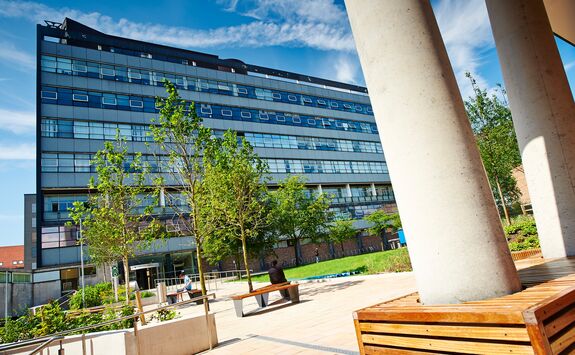
For many alumni, memories of the Herschel Building – named after the renowned family of astronomers - are woven into their time on campus. Few may realise, however, just how deeply the University's roots are connected to the story of space exploration in the North East, and how researchers on campus today are leading out-of-this-world projects to understand the universe.
Now, plans are underway for a new community observatory led by Newcastle University, with the aim of building on that proud tradition and creating a hub for education, outreach, research and collaboration.
As the University explores opportunities to bring the project to life, we sat down with Senior Lecturer in Astrophysics David Rosario to hear more on the region's remarkable astronomical heritage, the growth of astrophysics on campus and the impact this will make on future generations of Newcastle graduates.

A new era for astronomy at Newcastle
I joined Newcastle University around five years ago as part of an expansion of our physics programme into astrophysics. Since then, we've built a young, active and dynamic group of astronomers who specialise in everything from supermassive black holes and galaxy evolution to stars, planets and cosmology. At the heart of everything we do is perhaps the biggest question of all: what is the Universe made of?
My own research focuses on the connections between galaxies and the supermassive black holes at their centres. As an observational astronomer, I spend my time studying some of the coldest material in space, including gas, dust and molecules, to better understand how galaxies evolve.
One of the privileges of my profession is access to some of the greatest scientific facilities ever built. We use the James Webb Space Telescope and the Atacama Large Millimeter Array (ALMA) to uncover new insights into the Universe around us.
What people may not realise, is that Newcastle University also has its own telescopes. Students and visitors walk past one every day in the Herschel Building foyer. However, since the university observatory was closed over two decades ago, our telescopes have been unable to see the sky from their basement storage. We’re hoping to change that soon!
At the heart of everything we do is perhaps the biggest question of all: what is the Universe made of?
In the late 1860s, the largest telescope in the world was built in Gateshead, funded by industrialist Robert Newell. Later, some of Europe's greatest telescopes were manufactured in Newcastle by the Grubb Parsons Optical Company, and many remain in operation today.
That heritage is visible on campus too. Many alumni will know the Herschel Building well, but fewer may know the story behind its name. The building is named after Alexander Stewart Herschel, Newcastle's first Professor of Physics who was known for his work on meteors and comets. Alexander’s grandfather William Herschel is also one of the most famous astronomers from the telescope era – before cameras were used - and indeed the whole Herschel family made extraordinary contributions to astronomy. Their connection to the University is something we can all be proud of.
Bringing astronomy back to the community
Until 2000, the University operated one of the largest university observatories in England. It was used not only by students and researchers, but also by members of the public and local astronomical societies. Although the observatory was eventually decommissioned, we kept the telescopes and much of the equipment. In fact, some of those instruments are still with us today.
We have a very active astronomy research group now, and we want to lean into that and bring astronomy back to our community, reaching the heights that we had in the past.
Over recent years we've worked hard to share astronomy with wider audiences through exhibitions, school visits, planetarium experiences and public events. We organised the Space Investigators exhibition at the Great North Museum, in collaboration with Durham and Northumbria Universities, which celebrated the region’s history and future in space exploration, and have also helped develop planetarium shows for the visually impaired to make astronomy more accessible.
Creating a new observatory for the university and for the region will help us take this work to the next level.
Why an observatory matters
To an astronomer, the place where astronomy happens is the observatory. It's the nexus of many different things, not just the science but the technology too. It’s the point at which people come together to get astronomy done.
For me, an observatory is much more than a telescope. It is where scientific discovery, education, technology and public engagement come together.
Our vision is to create a community observatory that can be used for teaching, outreach and collaboration. We want it to become a place where schools, universities, astronomical societies, tourism organisations and businesses connected to the growing space sector can work together and inspire one another.
The plan is to restore and modernise equipment we already have, while developing a facility that includes a significant telescope, a purpose-built dome and adjoining teaching space. It would provide opportunities for hands-on learning and public engagement, while also helping to train the next generation of scientists, engineers and technology specialists.
An observatory is much more than a telescope. It is where scientific discovery, education, technology and public engagement come together.
Looking to the future
This is an ambitious project, and it will only succeed through collaboration.
We are already working closely with the Newcastle Astronomical Society and the Sunderland Astronomical Society, both of which bring invaluable expertise and experience. But we are also looking for new partners who can contribute ideas, technical knowledge, industry connections or financial support.
Astronomy has always been about bringing people together to explore big questions. As Newcastle University looks ahead (and up!), I believe this observatory can help reconnect the institution with an important part of its heritage while creating new opportunities for future generations.
For alumni and supporters, it is a chance to help ensure that the spirit of discovery which has shaped Newcastle's story for generations continues long into the future.
Interested in being involved?
Alumni can play an important role in helping to bring Newcastle University's planned community observatory to life. As the project develops, the Department of Physics will be hosting public stargazing events across the region, giving people the opportunity to experience the University's astronomy equipment and learn more about the vision for the observatory. Details of these events will be shared on the University website.
The University is also keen to hear from alumni, astronomy groups and organisations interested in partnering with the project and contributing their expertise as plans progress.
Crucially, the observatory can only become a reality with philanthropic support. We would welcome conversations with anyone interested in making a financial contribution to help fund the development of this community resource and create new opportunities for public engagement with astronomy across the North East.
To find out more about the project and how you can support it, please contact Head of Philanthropy, Aerian Rogers.