
Our global community unites to tackle the rifts and shifts facing modern world
This academic year, Newcastle alumni, colleagues, students and partners across 33 countries worldwide have been involved in the NCL in Action series, exploring shifting geopolitical power dynamics, technological advancements, economic uncertainty and a ticking clock on climate change.
1 July 2026
As our sixth annual NCL in Action series comes to a close, we reflect on a year of thought-provoking events and opportunities for our global community
The 21st century has seen the transition into a more fragmented, competitive, and technologically accelerated world order. With escalating conflict and trade tensions across borders, extreme weather events and the ever-increasing development of AI seeping into all aspects of life. Newcastle University’s flagship programme NCL in Action brought together over 1,400 members of the university community to explore how these ongoing changes and challenges affect our lives and livelihoods.
With an audience spanning over 30 countries and seven generations – from 20-year-old students to alumni nearing 90! – NCL in Action offered virtual and in-person events, career development workshops and mentoring to support the university community in overcoming the rifts and shifts facing society today and preparing for the future.
.png)
The series shone a light on inspirational thought leaders from Newcastle University’s alumni and academic communities to support graduates during this turbulent time, and was also supported by external partners including Lloyds, Debate Mate, Newcastle City Council and our friends at Northumbria University.
Read on to discover the highlights of the past year and how you can still get involved.
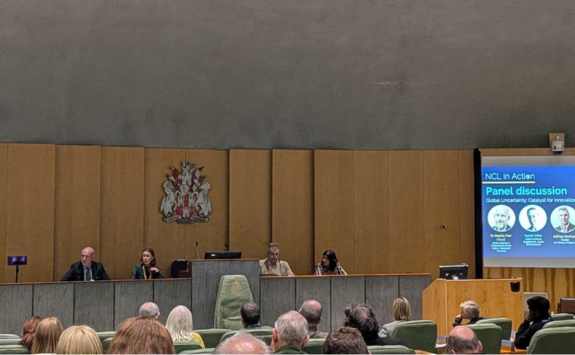
Global uncertainty: A catalyst for innovation or barrier to progress?
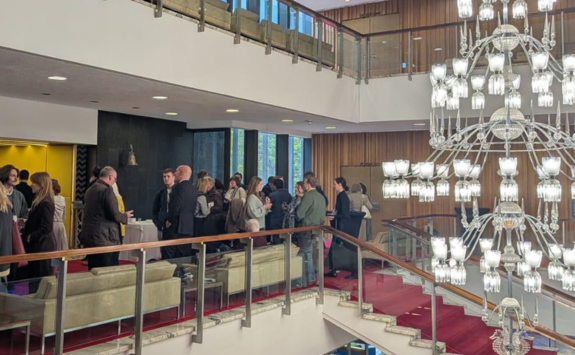
This year’s NCL in Action series, entitled ‘Rifts and Shifts: Our Changing World’, began with opening addresses from university leaders and alumni changemakers across the globe, inviting alumni to discover the impact the shifting world order has on all aspects of life.
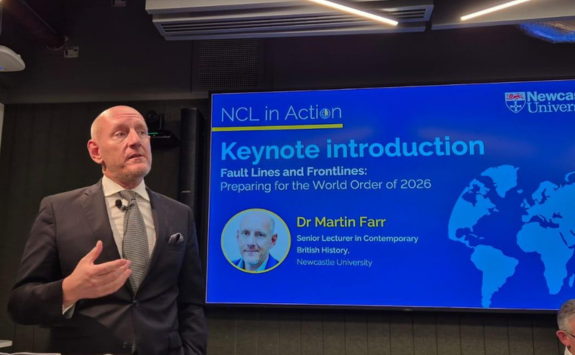
In the UK, guests heard from modern history academic Dr Martin Farr on the events that have led to the rifts and shifts we see today, and the lessons we can learn from the past. Martin was joined by leaders from Newcastle University and Lloyds to explore what the current world order means for educational institutions and the economy.
Speaking at the opening event in Newcastle in October, Martin said:
“Some people call this Cold War II, which can sound a little glib. But there are parallels.
“One response to all this might be simply to put one's hands over one's ears and hope that this isn’t actually happening, but I think this is not really to help the situation.
To be aware of things, to use properly mediated and rigorously sourced news… there's a huge imperative on educationalists to seek to inform and educate the public and to stimulate interest in these subjects.”
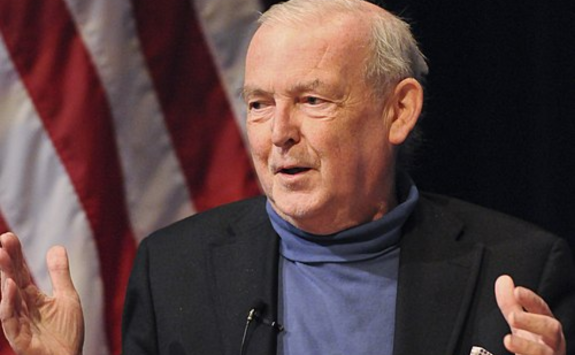
Across the pond in New York, our American alumni community welcomed world-renowned historian and fellow Newcastle graduate, Professor Paul Kennedy CBE, for a fireside chat.
And in Asia, alumni in Malaysia, Singapore and India joined conversations with Newcastle University’s Vice-Chancellor and Regional Provost to discuss the university’s role in supporting students who will be graduating and establishing careers in this turbulent time.
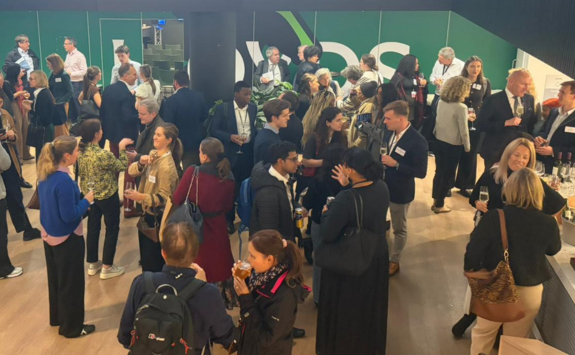
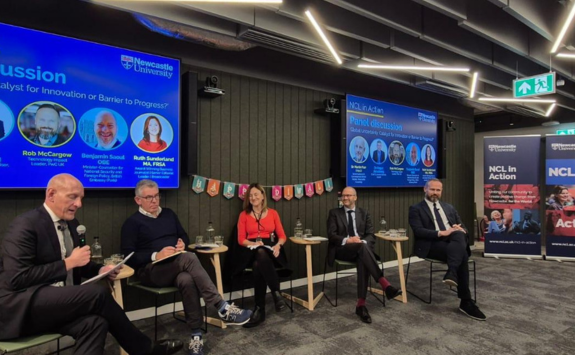
Scrutinising the future across 14 insightful events
The role of Newcastle University – and higher education more broadly – was explored in more detail in a debate held at Lloyds Banking Group HQ in the spring, with the conversation challenging guests to rethink the core mission of higher education in a world that demands both adaptability and integrity.
And later in the year, executive leaders from the higher education and financial industries met with current Newcastle University students for a skill-sharing session focused on transforming the future of our student offering.
It’s not just the education sector that was under scrutiny. In an era of rapid information flows and global political upheaval, journalism stands at the crossroads of truth and power. And so, in May, an all-female panel of world-leading journalists hailing from Newcastle University, including distinguished broadcaster Kate Adie, held a powerful conversation on how the press shapes democracy.
The final event of the NCL in Action programme saw former Chief Economist of the Bank of England, and honorary graduate of Newcastle University, Andrew Haldane CBE, speak on what the ongoing disorder means for business and our individual livelihoods.
Empowering alumni to weather the storm ahead
NCL in Action endeavoured to upskill the Newcastle University community for the future, as well as exposing what the future may look like if we continue this trajectory.
During the academic year, alumni, students and colleagues have had access to two free and accredited Continuous Professional Development (CPD) courses to boost their career prospects during periods of change. 45 CPD badges were awarded in total.
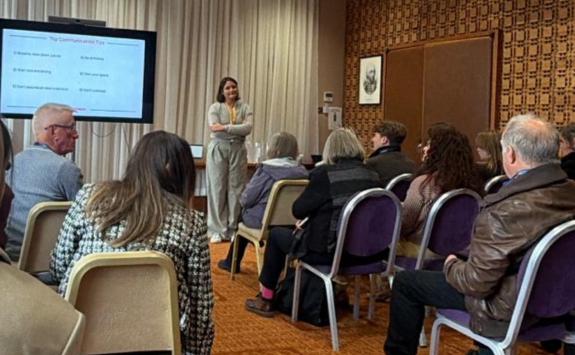
The first was delivered in partnership with Newcastle University Business School academic Dr Lucy Hatt and focused on how to become a confident leader. The second, led by the world-leading communication consultancy Debate Mate, equipped participants with the skills to communicate effectively and compassionately during times of change and uncertainty.
Gina Hunt, Senior Associate at Debate Mate, said of the CPD course:
“In an unprecedented changing world, we really need to have these skills of understanding opinions that are different to our own, disagreeing and challenging with respect, and being able to move through these tricky conversations in a way that actually brings us closer together rather than pushing us further apart.”
Special attention was given to the younger members of our alumni community who are still finding their feet in the workplace, and current students who will soon be graduating. A webinar series introduced these recent graduates to more experienced alumni to share their wisdom on relocating for career prospects, focusing on London and the US.
In recent years, we’ve witnessed great upheavals in the workplace, from COVID-19 to the rise of AI. For many of us, these upheavals are leading to a rapidly changing workplace. To combat this, NCL in Action’s informal mentoring programme paired alumni working in the same field to help them navigate an ever-changing work landscape and design their careers in a non-linear world.
Continuing to explore the rifts and shifts
Newcastle University is world-leading in its research. Whether we’re predicting the intensity of tropical storms, exploring the impact of the arts on dementia, or working to preserve our global heritage during times of conflict, we’re making our world a better place. Discover the latest research taking place on campus that is tackling society’s rifts and shifts head on.
And look out for announcements of next year’s NCL in Action programme theme soon, which will continue this deep dive into the new world order. Update your details with us to get the announcement in your inbox before anyone else.