
Meet the alumni stars shining bright in the space industry
To celebrate Space Day (1 May), we sat down with three out of this world Newcastle University graduates making an impact across the space sector.
1 May 2026
The sky is the limit for these Newcastle University graduates
This National Space Day, meet the alumni turning their Newcastle degrees into deep-space dreams - powering missions, shaping satellites and reaching for the stars.
Debarghyo Pandit (BEng Hons Mechanical Engineering, 2022)
Mechanical Engineering graduate Debarghyo has been interested in space for as long as he can remember, from childhood awe at celestial bodies and the scale of the universe to today working as a Space Engineer for Lightricity, where he works on space solar panels and deployable solar technologies for spacecrafts.
Debarghyo’s route into the space industry hasn’t been easy. After having his undergraduate studies at Newcastle impacted by the COVID-19 pandemic, he then underwent cancer treatment while studying for his MSc in Space Science and Engineering at UCL – often completing projects from a hospital bed. He said:
“I cannot say I miss those days, but they shaped me deeply. They taught me resilience, perspective, and how much I wanted to continue in this field.
“What interests me most about the space industry is that it brings together science, engineering, creativity, and ambition in a very direct way. Whether it is rockets, satellites, landers, spacecraft structures, or power systems, every part of a space mission must be carefully designed to survive extreme conditions and perform reliably.
“For me, space engineering is the perfect combination of curiosity and practicality. It allows me to work on real systems while also contributing to something much bigger than myself.”
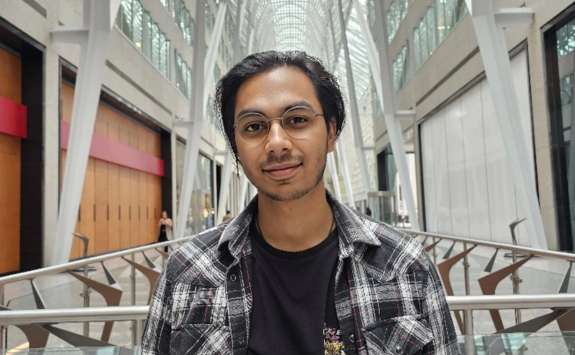
Having had much of his university experience impacted by the COVID-19 lockdown restrictions, Debarghyo looks back most fondly on the nights spent in the library studying in his third year once restrictions had lifted. He told us:
“After spending much of my second year in lockdown, third year felt like a chance to recover, rebuild, and prove to myself that I could push through. Those long nights of studying, working through difficult problems, and being surrounded by other students doing the same created a feeling that I have not quite managed to replicate since. It was exhausting, but there was also something very special about that shared sense of determination.
“Newcastle helped me build the confidence and technical base I needed to move into space engineering, complete my Master’s, and eventually work on spacecraft technologies such as deployable solar panels and space power systems. In many ways, it gave me the engineering language that I still use every day.”
Dr Ishita Gulati (PhD Electrical and Electronics Engineering, 2022)
After completing her PhD in space weather research at Newcastle University, Ishita joined the Met Office as a Space Weather Research Scientist, but her journey into the space industry has its origins in her undergraduate studies in India.
While studying at the ICFAI University in Dehradun, Ishita took a module in satellite communication and developed a keen interest for satellite operations, space debris, and orbital dynamics. When offered a PhD position at Newcastle, Ishita accepted without hesitation. She told us:
“My PhD experience at Newcastle was transformative. It shaped me both academically and personally, and led to several international publications and conference presentations, establishing my long-term interest in space weather research.
“My favourite memory from Newcastle is truly the people I met there. I made friends from all over the world who are not just former classmates, but lifelong friends. What also made the experience special was the academic environment; the staff are incredibly supportive, inspiring, and genuinely invested in your growth. It’s a place that stays with you long after you leave.”
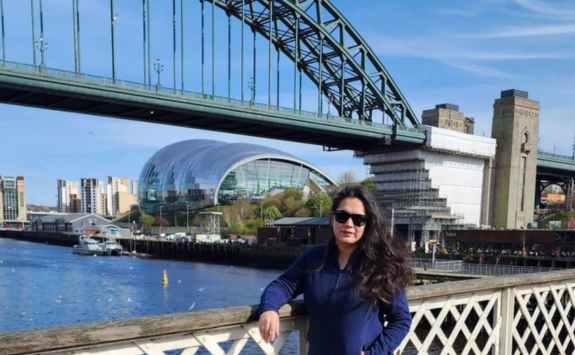
In January 2023, Ishita joined the UK Met Office’s EUMETSAT ROMSAF project, developing models to retrieve ionospheric electron density using GNSS radio occultation data. And alongside her research career, she has remained actively involved in academia as a lecturer, integrating her space industry experience into teaching areas such as signal processing, communications, and engineering analysis. Speaking of her experience so far in the space sector, Ishita said:
“What fascinates me most about the space industry is how vast and still largely unexplored it is. There is so much we don’t yet understand, and being part of a field that is uncovering those mysteries is incredibly exciting.
“In my work, I use data from the Sun, such as solar wind speed, plasma density, and ionospheric responses to geomagnetic storms to build models and simulations. Every time you run a model and see how space weather affects systems on Earth, it feels both fascinating and meaningful.
“Whenever I tell people what I do, their reaction almost always starts with “Wow!” That sense of wonder is something I really value.”
Kartik Goswami (MSc Advanced Artificial Intelligence, 2025)
Recent graduate Kartik is the Founder and CEO of CosmicAegis, an AI platform that forecasts solar activity and atmospheric drag, translating this into operational and financial risk insights for satellite operators and insurers.
With a background in data and analytics, over time Kartik became interested in applying AI to complex, high-impact systems, which led him to the space sector and a gap in how space environment risks are understood and managed.
His time studying on campus, exploring how data and AI could be applied to real-world problems played a big role in shaping his interest in building something of his own, and being within the diverse environment at Newcastle – surrounded by people with different perspectives – helped shape how Kartik thinks today as a founder.
Kartik has been supported on his entrepreneurial journey by Newcastle University’s START UP team, which is available to alumni for two years after graduating. He said:
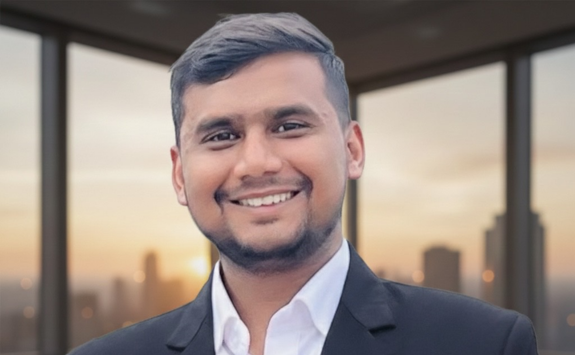
“My degree at Newcastle provided a strong foundation in data analysis and problem-solving. More importantly, it taught me how to approach complex and ambiguous challenges — a skill that is essential when building a startup.
“The university’s support ecosystem and entrepreneurial environment also played an important role in helping me take the first steps with CosmicAegis.”
Kartik is in the early days of his journey, currently working towards pilot partnerships to validate the CosmicAegis platform in real-world scenarios, but he’s excited to be launching a career in the space industry. He said:
“What excites me most about the space industry is that it is rapidly evolving into critical global infrastructure. From communication to climate monitoring, space systems are becoming essential.
“At the same time, this growth brings new risks — such as space weather and orbital congestion — and I’m particularly interested in solving these challenges to make space operations more reliable and predictable.”