From Front Street to Downing Street: Meet the Newcastle graduate championing sustainable entrepreneurship in the North East
This World Entrepreneurs Day (21 August), we spoke with Newcastle alumna and SME founder Sarah Thackray to discover the lessons she’s learnt being her own boss and how she’s leaving a positive legacy for the planet through her events agency.
21 August 2026
Sarah Thackray (née Willan) has used her entrepreneurial spirit and events know-how to grow one of the most successful events agencies in the country, having quickly discovered as a new graduate that the traditional 9-5 wasn’t for her.
She has spent the past decade at the helm of BeaconHouse Events, champions the North East’s tech sector as the co-creator of the TechNExt festival and was named a Power 50 Green Champion in the events industry for 2025. It’s little wonder, then, that Sarah was recently invited to meet with the first female Chancellor of the Exchequer, Rachel Reeves MP, at 11 Downing Street to champion female entrepreneurship born in the North East.
To mark World Entrepreneurs Day, we caught up with Sarah following her trip to Downing Street to hear about her journey as a woman in business and what her priorities are as a SME leader in the region.
.png)
Finding my feet on Front Street
I first arrived in Newcastle in the late 90s to study Spanish and French and was part of the last ever cohort to call Ethel Williams Hall home! Like everyone of my era, I was desperate to go to Castle Leazes and so when I was told my halls were in Benton I felt like I was going to be miles away from student life – but it ended up being the making of my time at university. Being slightly removed from campus really cemented us as a community and there are friendships that started on my corridor that live on today.
Outside of lectures, I played intramural netball and badminton and spent a year of my degree living in Northern Spain. This year abroad teaching English in a secondary school was the making of my language skills really. There were no other English people around, so you were thrown into the deep end and had to just get on with it. I’m still in touch with friends I met there, and we now visit each other with our families in tow.
Temping, travelling and trying the traditional 9-5
After graduating in 2002, I spent a year travelling around in France working and taking on temp jobs. I did all sorts: managed walking tours for wealthy Brits in the Cevennes region; worked in the pen shop warehouse packing online orders; and in a letting agency that showed folk (including some Newcastle United footballers!) houses to rent in the region. One that particularly sticks in the memory is a call centre job where I had to answer the phones in French, Spanish and English dealing with Microsoft anti-piracy reports. That was difficult!
I struggled to find what I wanted to do – I think that’s sometimes the way with the more open-ended degree courses like languages. Eventually I got a job in HR, relocation services at Procter and Gamble, which brought me back to Newcastle. After 18 months, though, I was frustrated at the number of ceilings I felt were blocking my way up the ladder.
I had always been interested in events and had sent emails to people over the years trying to get my foot in the door. My lucky break came from an agency in Newcastle, with the founder returning my email six months after I sent it! He asked if I was still looking for a job and invited me for an interview.
It does take a certain person and a certain attitude to set something up on your own. You need to be confident and good at building relationships.
Ascending in events and inventing my own path
I stayed at that agency for the next four years. Because it was a small agency, I was able to progress quickly and develop my skills. Even in this setting though, I found I was hitting a ceiling, and so the next route was doing it myself.
It does take a certain person and a certain attitude to set something up on your own. You need to be confident and good at building relationships. I took on part-time roles – first with Hartlepool Council running the Tall Ships Festival and then at HR consultancy Entrust – while I began growing my freelance portfolio. This meant I always had some consistent income.
One of the first big jobs I took on was a world conference organised by a former client from my agency days. It was meant to be in Egypt, but because of the Arab Spring in 2011 they were moving the event to Qatar and had no-one on the ground to represent the association. I was still in touch with them having ran the conference for them in London two years before. So that’s how I spent four weeks in 45-degree heat, a crazy experience!
Building a business with toddlers in tow
When I first started freelancing, I only had a couple of clients and so managed to juggle it all myself. Even when my first son was born, it was manageable, albeit I couldn’t take traditional maternity leave - he came along with me to events in his car seat! But when I was pregnant with my second child and had more and more jobs coming in, I suddenly began thinking, ‘How am I going to be able to keep running all these events?’
I had stayed in touch with an old colleague and friend from the agency, Cat, who was working full-time for a charity at the time but, like me, had former clients asking her to do work on the side. She couldn’t help them during the day because of her job, and I couldn’t do evenings easily because of my family, so we kind of collaborated. When we had two or three regular clients between us, we sat around the kitchen table and officially set up our business: BeaconHouse Events.
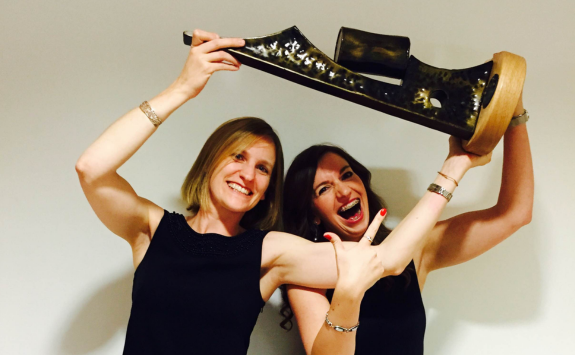
Over the past 12 years, we’ve gone from a team of two working at each other’s houses to having an office, first in Newcastle city centre and now at Hoult’s Yard in Ouseburn, with 9 members of the team. Today, we deliver annual conferences and exhibitions, awards ceremonies, outdoor events and more, and were proud to be named in the C&IT Top 50 Agencies last year. Looking to the future, one of my big priorities is making the events industry more sustainable.
You can only do good as a business if you've got profit to do good with. You can’t be so generous that you run your business into the ground, because then no one can do any good. It's a bit of a balance.
Leaving a legacy of planet-friendly practice in the industry
We've always felt like we want to operate a business that's doing the right thing, from supporting our staff and being fair employers to giving back to the local community. The events industry is really wasteful, and globally it can account for 10% of carbon emissions if you include massive sporting events and global congresses. Our footprint is quite a lot smaller with the scale of events we deliver, but we can still make a difference by approaching things differently and trying to change client and delegate behaviour.
This includes using venues accessible by public transport, offering plant-based catering and reducing food waste after an event too. We have a partnership with Olio so leftovers are picked up by a volunteer and then redistributed to app users in the local area. The real win, though, is when you’ve managed to not over order and there’s no catering leftover at the end of a conference!
We also have an ethical donation pot. Instead of buying carbon credits, we work out an equivalent value from the amount of carbon used by BeaconHouse Events in the year and then donate the value to a local charity. Last year we gave around £2,500 to Groundwork North East and Cumbria, and in the past, we’ve also supported The Children’s Foundation, FareShare North East and the Eagles Women’s Basketball team.
I also love giving back my time by volunteering to support local initiatives and charities and not for profit organisations in trustee positions and advisory roles where I can add value.
You can only do good as a business if you've got profit to do good with. You can’t be so generous that you run your business into the ground, because then no one can do any good. It's a bit of a balance. There is a lot more we want to do and we keep learning and striving to improve!
We should be confident in our abilities, know-how and talents, be open to learning what we don’t know, and work collaboratively with clients. My view is that together we can achieve greater things.
Getting down to business: Lessons from the early days
One of the biggest mistakes we made in the early days was being reluctant to spend much on our essential business support – things like your accountant. Having put up with old school, paper-based finance support, we learned that you have to spend some money in order to grow your business.
Relationships are key, whether that’s within your organisation or with partners, suppliers and clients. I don’t think I would have been able to grow the business without Cat – finding the right person to do business with is so important. We're lucky that we're so complementary, and that’s because we have very different skill sets and approaches. But our values and ambitions align.
If you go into business with someone who is exactly like you, you miss the challenge you need to encounter to grow. And on the client side, my first big job as a freelancer came from a former client who I had maintained a relationship with after leaving the agency – 15 years later, I’m still working with them.
And finally, us founders… we need to carry ourselves with confidence. It’s something I’ve found some of my peers in the North East can struggle with! We should be confident in our abilities, know-how and talents, be open to learning what we don’t know, and work collaboratively with clients. My view is that together we can achieve greater things.
45 new businesses take off with university support
This year, Newcastle University's START UP team have supported 45 students and recent graduates to successfully launch their own businesses.
The achievement highlights the growing entrepreneurial culture across the University, with students and graduates turning their ideas into thriving ventures across a wide range of sectors. The diverse mix of businesses launched this year include three social enterprises, 11 sole trader businesses and 31 limited companies.
Alongside practical business support, START UP has distributed £30,000 of equity-free grant funding this year to help students and graduates develop and launch their ventures, whilst also supporting advanced START UP businesses to attend Climb26, the UK’s largest festival of business growth.