
Science for Engagement Conference 2025: Highlights and key themes
Written by Micah Thomas and Sheena Davis
15 December 2025
In a wrap
- Micah Thomas and Sheena Davis write about the topics discussed at the Science for Engagement 2025 conference at Newcastle University.
- Are global challenges are too big and interconnected for science to solve them in isolation from other disciplines? What are the ethics of collaboration and sharing data?
- Can collaboration and community-led research help societies face today’s complex environmental challenges?
Tackling climate change, biodiversity loss, and pollution
The Science for Engagement 2025 conference brought together researchers, practitioners, policymakers, and community representatives to explore how science co-creation can reimagine responses to the escalating climate and environmental crises.
Hosted by the Centre for Climate and Environmental Resilience (CCER), the event unfolded against the urgent backdrop of what the United Nations has termed the “triple planetary crisis” of climate change, biodiversity loss, and pollution. The gathering sought to address these challenges not merely as scientific or technical issues, but as problems which are complex dilemmas that demand new ways of collaboration between science and society.
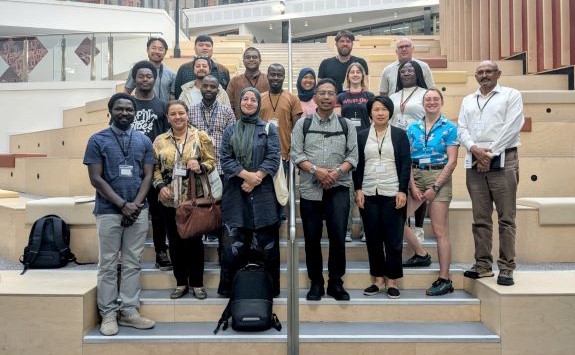
Climate change needs insights from many disciplines
The conference opened with a series of framing talks that set a reflective and ambitious tone. Professor Hayley Fowler, Director of the CCER, delivered an address titled “The Imperative of Interdisciplinarity.” She argued that today’s global challenges are too big and interconnected for disciplines to work in isolation. Climate change, ecosystem degradation, and the pollution crisis cannot be effectively addressed through isolated research efforts; they require joint insights from climatology, ecology, economics, geography, sociology, and the humanities. Fowler emphasised that interdisciplinary work is both intellectually important and morally necessary, as it allows researchers to consider justice, vulnerability, and cultural diversity in shaping climate and environmental responses. Her remarks called for institutional reform to support these collaborative approaches, including new frameworks for research funding, training, and public engagement that value co-created and context-sensitive knowledge.
Using local knowledge to address the climate crisis
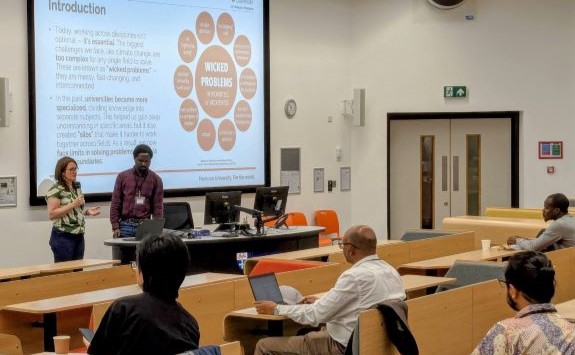
Complementing Fowler’s perspective, Micah Thomas, a visiting researcher at the CCER, presented an opening talk on “Why Scientific Dialogue Matters (and When It Does Not).” Thomas examined the limits of dialogue as a tool for addressing environmental crises. He argued that for dialogue to be meaningful, it must be rooted in mutual trust, humility, and shared authority, which are qualities often missing from traditional models of science outreach. “Dialogue matters,” he noted, “only when it opens up the possibility of co-creation rather than merely broadcasting expert consensus.” This means recognising that affected communities often hold vital local and indigenous knowledge that must inform adaptation, resilience, and mitigation strategies. Fowler and Thomas’s talks called on participants to move beyond conventional notions of engagement toward a vision of science as participatory, reflexive, and justice-orientated. Throughout the two days, these themes came up in discussions about how interdisciplinary collaboration, community-led research, and participatory governance can help societies face complex environmental challenges.
Biodiversity conservation thrives on collaboration
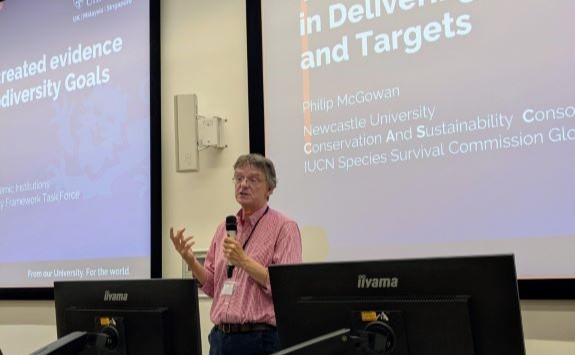
Co-Creating Biodiversity Futures was one of the core themes, highlighting how biodiversity conservation thrives when science, community, and care come together. In his keynote address, Professor Philip McGowan from Newcastle University emphasised the importance of co-creation in achieving global biodiversity goals. He argued that sustaining life on a changing planet requires not just better ecological data, but also shared ownership of knowledge between researchers, policymakers, and local communities. This message resonated throughout the sessions that followed. Talks and presentations showed how participatory approaches, such as community-led ecosystem monitoring, citizen science, and participatory mapping, are vital for linking biodiversity science with lived experience.
Creative thinking can help tackle the climate crisis
Speakers also encouraged participants to think critically about the ethics of collaboration. Conversations about knowledge ownership, modes of sharing, and the values that underpin scientific engagement reminded attendees that co-creation is as much about relationships as it is about outcomes.
Lauren Healey from Newcastle University gave a talk titled, “Imagining the Future: Why Creative Thinking Is Essential to Tackling the Climate Crisis." She explained that addressing the climate emergency requires not only scientific innovation but also imaginative collaboration across disciplines, sectors, and communities. By foregrounding creative thinking, she challenged the audience to consider how storytelling, speculative design, and the arts can open new ways of envisioning sustainable futures. Her talk underscored that the climate and environmental crisis is as much a cultural and ethical challenge as it is a technical one and demands that researchers move beyond conventional models of expertise toward more inclusive forms of knowledge-making. Examples from Nepal, Ethiopia, and other biodiversity-rich regions demonstrated how partnerships between scientists and local communities can restore degraded landscapes and foster a shared sense of responsibility.
Biodiversity protection is a shared endeavour
In the broader context, the discussions at Science for Engagement 2025 aligned closely with global conservation agendas such as the Kunming-Montreal Global Biodiversity Framework. By recognising that conservation must be rooted in collaboration, mutual learning, and local empowerment, the conference echoed a growing global consensus: biodiversity protection is not a task for science alone, but a shared human endeavour.
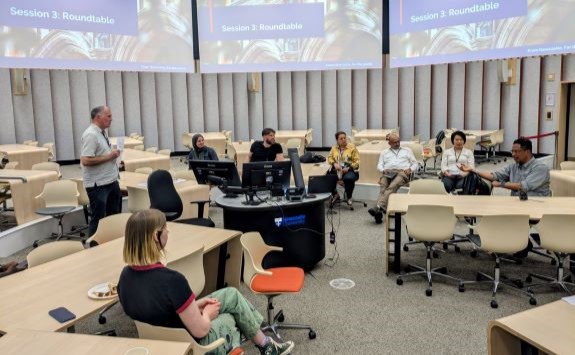
Building networks to tackle the climate crisis
As the conference closed, participants reflected on how Newcastle University’s Centre for Climate and Environmental Resilience can continue to lead in this area. Through interdisciplinary collaboration and partnerships that bridge research, policy, and community practice, the University is positioning itself as a hub for co-creative environmental research. Looking ahead, the momentum from Science for Engagement 2025 offers an exciting opportunity to expand these approaches and build networks of collaboration that can help to sustain both ecosystems and the communities that depend on them.