PhD Student Helps Drive Accessibility Improvements Across Newcastle University
PhD student Peter Hayton is using his lived experience to help improve accessibility across Newcastle University
21 August 2026
School of Computing PhD student Peter Hayton is combining his teaching background, research expertise and lived experience as a visually impaired student to help improve accessibility across Newcastle University.
Working collaboratively with colleagues in the Learning and Teaching Development Service (LTDS), Peter has contributed to projects designed to make teaching, learning and workplace practices more accessible, helping to create a more inclusive environment for students and staff.
The Importance of Human-Centred Design
Peter's work has included developing guidelines for creating accessible presentations and collaborating on policies so that those sharing their lived experience to improve accessibility have this recorded in their workplace allocation.
As a researcher with lived experience of visual impairment, Peter has a particular interest in ensuring human-centred design methodologies are more accessible for disabled researchers, illustrated through his contributions such as “The Blind Leading the Blind” which explores how co-creation workshops can be made more accessible.
Commenting on the importance of accessibility, Peter said: "As the world becomes increasingly digital, there are more opportunities for academia to be accessible, but without guidance it's not always easy to achieve. It's important that accessibility needs remain a priority because inclusive environments show disabled people that studying and working at a university is possible."
As a researcher in the Open Lab research group, Peter's work sits within the field of accessibility and disability justice-oriented human-computer interaction. His PhD focuses on how intelligent and embedded technologies can improve the accessibility of public transport for disabled people.
Building Knowledge Through Lived and Professional Experience
Peter previously studied for a BSc in Computer Science at Newcastle University, before working at Thomas Pocklington Trust, a charity which advocates for blind and partially sighted people.
During his time there, he worked in a number of roles helping visually impaired individuals use technology in educational and professional settings. It was an experience that shaped his understanding of both the opportunities and barriers that accessibility presents.
Peter said: "While working in these roles, I became familiar with a range of bespoke assistive technologies that, while solving individual problems, can be prohibitively expensive. By contrast, I saw that often simple practices, such as adding alt text, can solve many of the barriers visually impaired people face in education."
Why Accessibility Matters
While Peter recognises the significant progress educational institutions have made in recent years, he feels there is still more work to do.
During his time at Thomas Pocklington Trust, he regularly encountered blind and partially sighted students who faced challenges accessing teaching materials or specialist software required for their courses.
Reflecting on those experiences, Peter said: "My role was to make sure students could still complete their work by finding more accessible solutions. I carried those lessons into my own experience when I returned to Newcastle and began teaching as a Postgraduate Teaching Assistant. Simple changes, such as making slides accessible, can make a huge difference to a student's experience. A key factor in deciding to do a PhD was my desire to prove that the industry could be made more accessible.”.
Collaborating to deliver practical change
Drawing on his professional experience and research expertise, Peter approached LTDS to learn more about the University's work in accessibility and explore how he may be able to contribute.
As a member of SIGAccess, a special interest group supporting researchers who apply computing technologies to empower disabled people, Peter was already familiar with best-practice accessibility guidance. SIGAccess also produces resources on accessible conference presentations, and Peter saw an opportunity to adapt and apply this guidance within a higher education context.
Working collaboratively with LTDS, Peter helped create a resource outlining five easy steps to creating accessible presentations. The guidance is now shared with academics attending the LTDS webinar ‘Accessibility in Practice’. Peter has also contributed best-practice content informed by his doctoral research and own lived experience.
Alongside colleagues Kimberly May-O'Brien and Dan Graham, Peter recently presented at the Digital Accessibility '26 Conference, sharing insights from their collaborative approach with an audience of more than 200 attendees. Their presentation highlighted how lived experience can inform practical improvements to accessibility in teaching and learning.
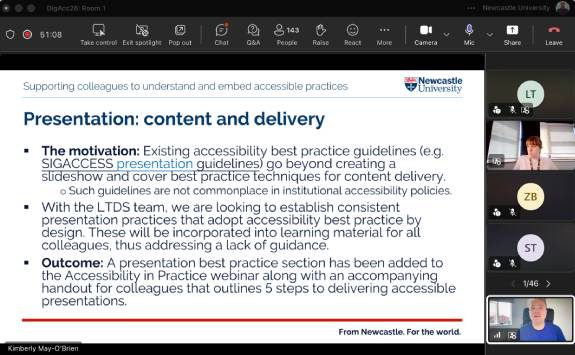
Kimberly commented: "Working with Peter to improve our accessibility guidance and Accessibility in Practice webinar in LTDS has been insightful and invaluable. We are really grateful for the work Peter has completed and his contributions to our recent presentation at the Digital Accessibility Conference 26 (hosted by University of Nottingham). It is a privilege to work with Peter on these projects and learn from him. We are also grateful to the School of Computing for allocating time within his workload to complete this work with us."
Looking Ahead
Peter's work with LTDS continues, with a growing focus on embedding accessibility into institutional policy and practice.
Future projects will explore how the University's accessibility and communication policies can be reflected in the resources and guidance used by colleagues to create internal communications and teaching materials, helping to ensure accessibility is considered from the outset.