.jpg)
New postgraduate programme prepares students for careers in international diplomacy
The School of Modern Languages (SML) has launched a new postgraduate programme in partnership with the Division for Multilateral Diplomacy of the United Nations Institute for Training and Research (UNITAR).
18 December 2025
The School of Modern Languages (SML) has launched a new postgraduate programme in partnership with the Division for Multilateral Diplomacy of the United Nations Institute for Training and Research (UNITAR).
The MA Interpreting and Conference Diplomacy builds on a four-year working relationship with UNITAR, which has culminated in the creation of this unique interdisciplinary Master’s programme. The course combines Newcastle University’s academic excellence with UNITAR’s practical professional expertise.
Education for global careers
The globally informed curriculum will shape a new generation of graduates who are responsive to future needs in international diplomacy and cross-cultural communication. It will offer this via experiential learning in simultaneous and consecutive interpreting, conference diplomacy, and negotiation. The course will prepare students to succeed in global careers in international organisations such as the United Nations.
Students will engage globally within the programme with structured learning delivered by Newcastle University and UNITAR experts on the Newcastle campus, online, and during a 10-day immersive residential at the UNITAR Headquarters in Geneva, where students will experience the UN in action and gain unique insights into the dynamics of real-world diplomacy.
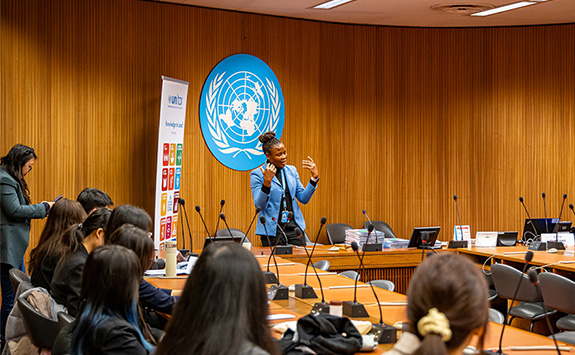
Image courtesy of UNITAR
Future-focused curriculum
Dr Myriem El Maïzi, Degree Programme Director, commented:
“When co-designing the curriculum of this programme, a key priority for us was to ensure that our students graduate with a well-rounded, future-focused skillset informed by the latest digital advancements. It was equally important to us that students on this programme are able to cultivate attributes that include global awareness, curiosity, adaptability, empathy, and intercultural understanding.”
Students will:
- gain proficiency in using state-of-the-art interpreting technology, including AI tools and platforms used in international forums
- acquire knowledge of the current and potential applications of AI in international relations
- develop a critical understanding of the ethical considerations and governance of AI in diplomacy
The wide range of teaching methods and pedagogical approaches embedded in the MA in Interpreting and Conference Diplomacy will equip students with:
- critical thinking abilities
- a reflective mindset
- strong speaking and writing competencies for research and intercultural communication
The MA in Interpreting and Conference Diplomacy will ensure that graduates have the necessary knowledge, competencies, and transferable skills to succeed in the age of AI.