Chinese Culture Week Lecture on the Poetic Beauty of Chinese Script
11 May 2026
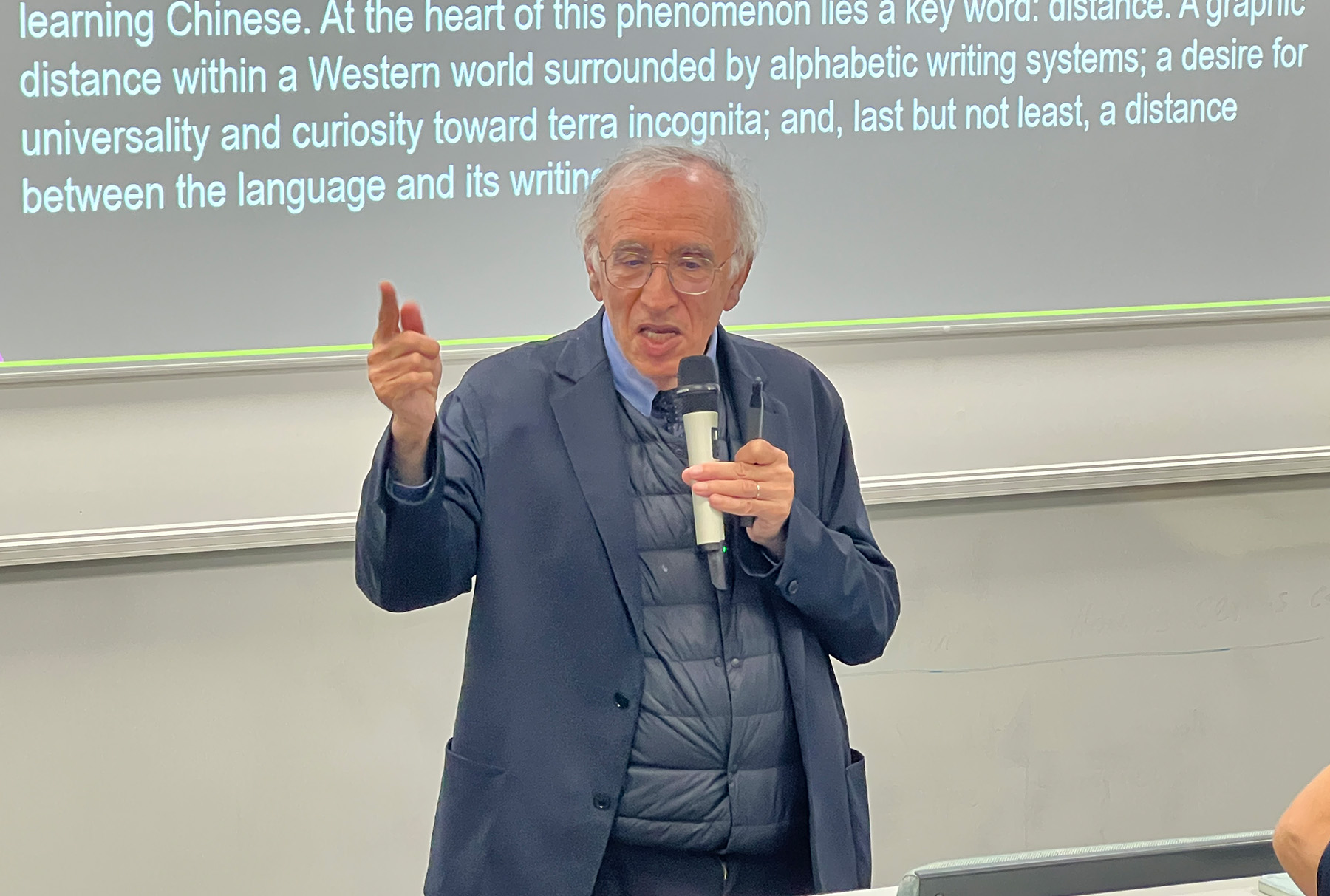
On the evening of 25 April 2026, the six-day Chinese Culture Week jointly organised by the Confucius Institute at Newcastle University (NUCI) and the School of Modern Languages (SML) concluded with a distinguished lecture by the world-renowned French sinologist Professor Joël Bellassen.
Held in Lecture Theatre G13 of the Henry Daysh Building, the lecture, titled “The Poetic Function of Chinese Script,” brought the week-long celebration of Chinese language and culture to an intellectually rich and memorable close.
The event was jointly coordinated by Professor Yuxiao Su, Chinese Director of NUCI, and Dr Su Fang, programme lead of Newcastle University Chinese Culture Week. As the concluding keynote event of the programme, the lecture received strong support from Newcastle University leadership.
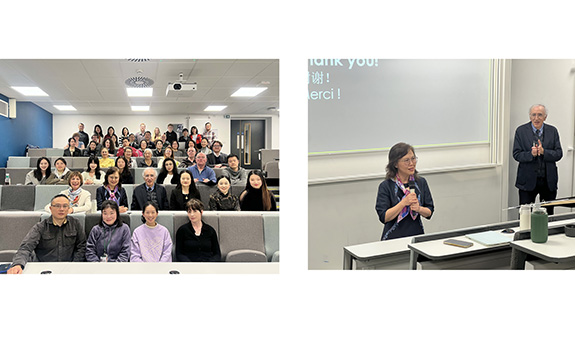
Professor Li Li, Pro-Vice-Chancellor (Global) and Chair of the NUCI Board, delivered the welcome address, warmly welcoming Professor Bellassen’s visit from Paris and praising the Confucius Institute’s continued contribution to intercultural dialogue and international cultural engagement. Andrea Wilczynski, Head of the School of Modern Languages, also attended and supported the event throughout the evening.
The lecture theatre was filled to capacity, attracting NUCI teachers, Newcastle University staff and students, local Chinese language teachers, evening-class learners, and members of the wider community, reflecting the growing interest in Chinese language and culture across the region.
The event was further enhanced by the generous support of Ms Lin Lin and Dr Michael Jin from SML, who arranged simultaneous Chinese-English interpreting, ensuring accessibility for audience members from different linguistic backgrounds.
Drawing on Roman Jakobson’s theory of the “poetic function” of language, Professor Bellassen explored the aesthetic and cultural dimensions of Chinese characters from a linguistic perspective. Through vivid examples, he argued that Chinese writing conveys meaning not only semantically, but also visually and artistically. Referring to more than two centuries of Chinese language learning history in France, he challenged the common perception that Chinese characters are merely “difficult,” suggesting instead that their visual beauty and poetic qualities have long inspired fascination and learning motivation among students.
Among the examples discussed was Xu Bing’s celebrated artwork Book from the Sky (Tianshu), whose invented “pseudo-characters” direct attention toward the visual form of writing itself, thereby highlighting the poetic function of Chinese script beyond conventional meaning.
Professor Bellassen also explored the historical affinity between Chinese language and philosophical thought in European intellectual history, referencing figures such as Victor Hugo and Jacques Lacan. Quoting Lacan’s famous remark — “Perhaps I became Lacanian because I studied Chinese” — he illustrated the profound relationship between language structure and modes of thought.
Throughout the lecture, Professor Bellassen emphasised that Chinese characters are far more than tools for recording language. From calligraphy and character games to inscriptions, paper-cutting, and folk art, Chinese script functions as a rich carrier of cultural memory and aesthetic expression. He further proposed that the “distance” between Chinese and European languages can itself become a source of attraction and intellectual curiosity, helping to stimulate learner motivation in international Chinese education.
The Q&A session remained lively long after the scheduled ending time, with discussions continuing late into the evening. Audience members exchanged views with Professor Bellassen on Chinese pedagogy, learner motivation, and the relationship between language, thought, and culture. Among the attendees was Jackson Swinhoe, runner-up in the 2016 European “Chinese Bridge” Competition and a Newcastle University Politics graduate, who remarked that the lecture had renewed his enthusiasm for Chinese studies and international Chinese education.
The lecture concluded in a warm atmosphere of sustained academic discussion and intercultural exchange, bringing Newcastle University Chinese Culture Week to a highly successful close. Through this landmark event, the Confucius Institute at Newcastle University once again demonstrated its important role in promoting Chinese language education, cultural understanding, and scholarly dialogue between China, the United Kingdom, and Europe.