History of Civil Engineering
The formation and growth of Civil and Geospatial Engineering at Newcastle University.
Establishment
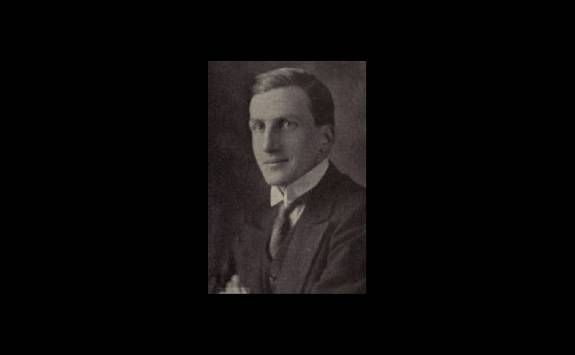
The Department of Civil Engineering was established In 1945, under the encouragement of Lord Percy, Rector of Kings College Newcastle.
William Fisher Cassie (1905-1985) founded and led the department from 1945 to 1970, initially teaching Structures, Hydraulics, and Surveying with Conn Standish O’Grady MC. Cassie expanded the curriculum to include soil mechanics, transport, and "public works."
Environmental Engineering
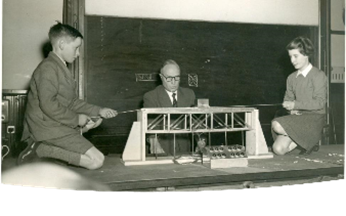
In 1946, Peter Isaac (Head of Department, 1970-81) was appointed to develop Public Health Engineering, now known as Environmental Engineering. Isaac recruited many diverse experts to the department, including biochemists and botanists. Some of these new colleagues were female, which was a progressive step for the 1940s. These experts included Sam James, Lillian Evison, and Warren Pescod (OBE, Head of Department 1983-98). Isaac also secured £1680 from the Rockefeller Foundation for a new laboratory. The computer cluster in the Cassie Building is named in his honour.
Public Health Engineering research was hands-on, utilising laboratories and pilot-scale equipment like nitrifying trickle filters. Today, the Environmental Engineering Group integrates disciplines such as biology, chemistry, physics, engineering, socio-economics, and legislation to ensure sustainable clean air, land, and water. They assess and mitigate pollution to benefit human health and the environment.
The Cassie building and Drummond building
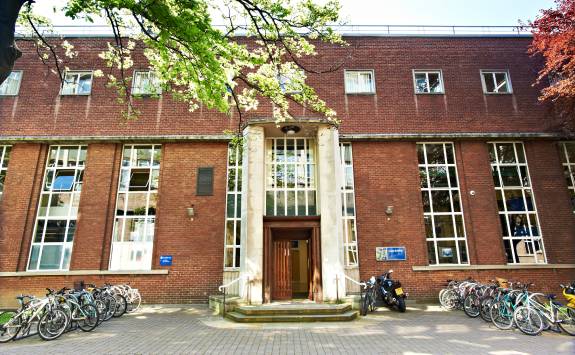
The Cassie Building, named after William Fisher Cassie, was constructed in 1955 as the main hub for Civil Engineering, with an additional floor added in 1974. The Geotechnical group moved to the Drummond Building in 1975, named after mining engineer Sir Walter James Drummond (1891-1965), and the Structural Engineering Group relocated there in the early 2000s.
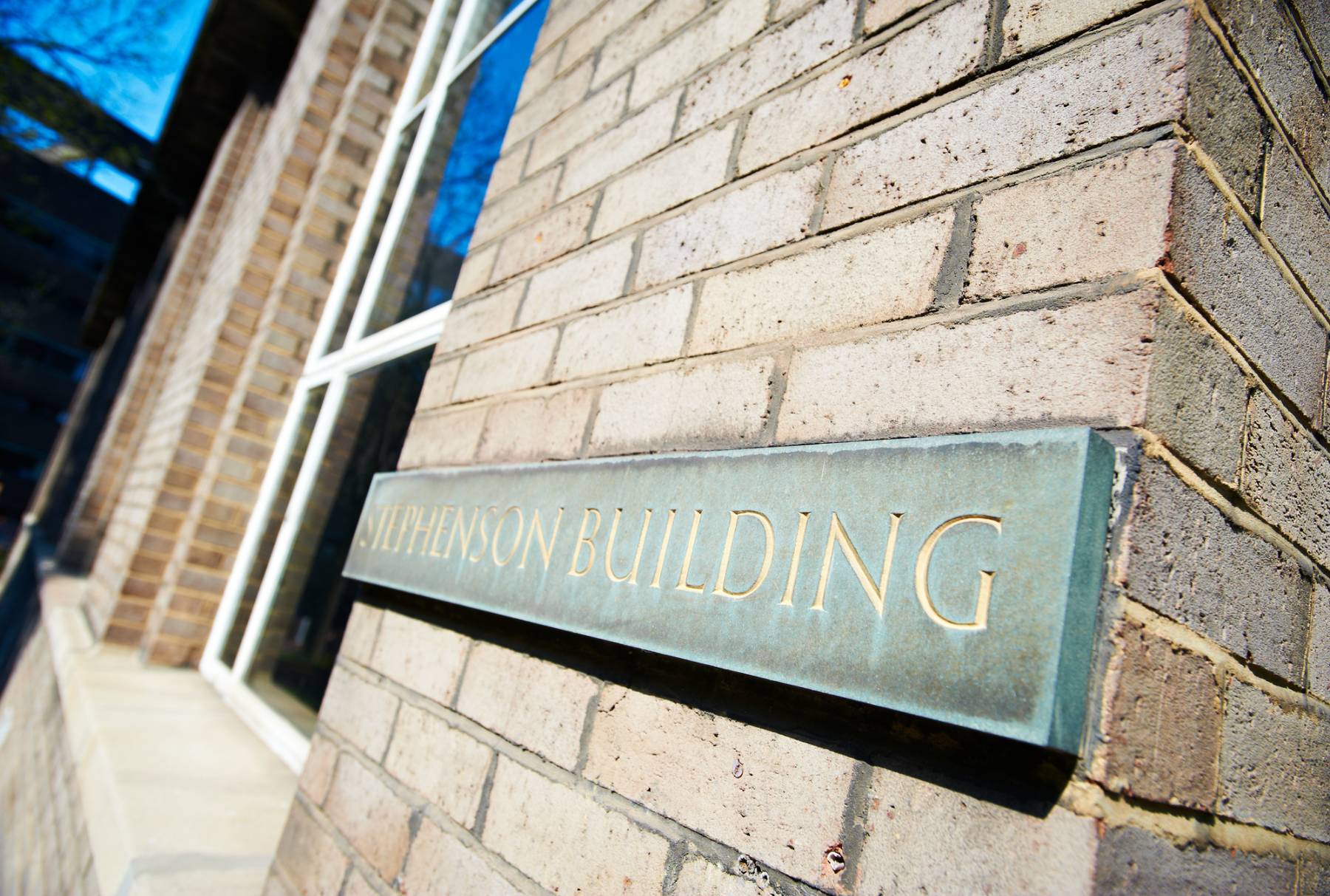
In the 1950s, hydrology and hydraulics initiatives began under Isaac to address local needs like those of the Tyne River Authority. Pavel Novak, who later became Head of Department, elevated this work. His textbook “Hydraulic Structures,” now in its 4th edition, is essential for civil engineering students. Novak fled his Czech homeland twice, first from the Nazis and then after the Soviet invasion. The hydraulic laboratories in the Stephenson Building are named after him.
Our research
Pioneering water research
Pavel Novak, Sam James, and Dave Elliot pioneered computer use in water research at Newcastle. In 1985 with the formation of the Water Resource Systems Research Unit (WRSRU) was formed, led by Enda O’Connell and James Bathurst. They developed SHETRAN, a system for modelling river catchments. The Water Group continues to integrate advanced computer simulations, statistical methods, and systems modelling, contributing to water management and hydrological risk mitigation amid climate change.
Transport engineering research
As head of the department, William Cassie promoted transport research in the Civil Engineering Department, including contributions from Tom Williams and Tom Constantine. In 1972, Professor Bob White secured funding for the Transport Operations Research Group (TORG) at Newcastle. Early work focused on traffic signal control. Richard Allsop was the inaugural director until 1976, succeeded by Peter Hills OBE, who expanded the remit to include road charging, tolls, and route planning. Later directors included Mike Bell and Phil Blythe (CBE, Chief Scientist to the Department for Transport, 2018-2023). The group moved from Claremont Tower to the Cassie Building in the 1990s and then to the new Stephenson Building in 2023.
Addressing the issues of mining subsidence
In the early 1960s, Civil Engineering, led by Dr. Jim Geddes, collaborated closely with the Mining Department, headed by Professor Ted Potts, on mining subsidence and its impact on structures. Dr. M Salamon developed mathematical models of surface movements and ground strain from long wall mining or old workings collapse. These models were later applied by Colin Jones to design bridges on M1, M62, A1M, and M18 to accommodate mining subsidence.
Reorganisation of the Civil Engineering department
In the late 1970s and early 1980s, Civil Engineering was reorganised into three linked departments:
- Civil Engineering (covering Structures, Water, Public Health, and Transport) led by Professor W. Pescod
- Geotechnical Engineering (covering Engineering Geology, Soil and Rock Mechanics, Civil Engineering Materials) led by Professor B. Dearman
- Mining Engineering led by Professor J. Tunnicliffe
In 1986 Colin Jones became Head of Geotechnical Engineering after Professor Dearman retired. A subsequent university reorganisation relocated the Mining Department to Leeds University, merging Civil and Geotechnical Engineering into five semi-independent groups:
- Geotechnical
- Structures
- Public Health
- Traffic
- Water
Geotechnical Engineering focuses on foundation analysis and design, geo materials, and slope stability. Key research topics include infrastructure slope stability, climate change impacts on transport infrastructure (ACHILLES project), and electrokinetics (EKG project), with applications in weak soils and spoil from the North East's mining legacy. Iain Moffat specialized in Dam Engineering, collaborating with hydraulics experts Nalluri and Novak.
Structural Engineering has transitioned from traditional materials like steel and concrete to sustainable structures such as timber. With global urbanisation, better housing is in demand, making research in this area crucial for achieving net zero. Improving the built environment for low-income regions has been a focus since Sean Wilkinson joined in 1999. His research on earthquake aftermaths has helped design resilient infrastructure.
The group has excelled in teaching and research, with notable figures like Professor Kong (1981–1991), Professor John Knapton (1991–2001), and Dr. David Lilley. Current research themes include:
- seismic-resistant design
- resilient infrastructure
- fabric structures
- composite structures
- timber structures
Professor Barry Clarke oversaw the merger of Geotechnical Engineering with the Structures group to form GEST (Geotechnical and Structural Engineering) in 2000.
Origins of Geospatial Engineering at Newcastle
The roots of the Geospatial Engineering group trace back to 1947 in Geography, where topographic surveying training took place. Commander Douglas Fryer and Chief Petty Officer Ernie Fripp led the team, joined by John Sharp in 1954. Pat Carmody took over in 1962, and when Newcastle University was established in 1963, he became Head of the independent Department of Surveying. The success of Newcastle graduates led to the introduction of a Single Honours degree in Surveying Science in 1996.
Geospatial research began in the 1960s, with photogrammetric equipment installed in the Daysh Building in 1967. Paul Cross's arrival in 1985 marked a new era, establishing research in satellite geodesy, land information systems, and image handling. The department was renamed Geomatics and moved to the Bedson Building in 1993. Cross's tenure as Dean led to alternating headship between Newton and Parker, with Parker eventually becoming Chair. The 2002 merger of Geomatics with Civil Engineering led to a move to the Cassie Building. Despite being the minor party in the merger, engineering surveyors led the School of Civil Engineering and Geosciences until its final year. With the formation of the School of Engineering in 2017, the group rebranded to Geospatial Engineering, leading in traditional surveying and the digital information revolution.
Major developments and achievements
Engineering at Newcastle plays a crucial role in sustainable environmental practices. This is highlighted by our Earth Systems Engineering (ESE) programme, initiated by Jim Hall and Enda O’Connell in the early 2000s. ESE aims to move away from wasteful practices and manage human-natural systems in an ethical and integrative way, involving engineers, scientists, and industrialists worldwide.
To achieve these goals, Newcastle integrates research, outreach, industry collaboration, and teaching. Key areas include:
- Measuring, modelling, and predicting environmental hazards like floods, droughts, sea level rise, wind and heat.
- Designing resilient and sustainable infrastructure for water supply, pollution control, seismic-resistant construction, and safe transport.
Newcastle has been at the forefront of climate change research since the 1980s. Our work aims to address extreme weather impacts and reducing emissions from construction, transport, buildings, and industry.
Measuring environmental hazards and impacts
Newcastle Engineering conducts fundamental research to quantify and understand natural and man-made hazards. The Geospatial Engineering group develops terrestrial and satellite methods for observing the earth. Notable projects include:
- GRACE mission for groundwater and ice pack changes (Phil Moore).
- SAR data for mapping deformations due to climate change or earthquakes (Zhen Hong Li).
- GNSS system for precise positioning and studies of earth's surface deformation (King, Moore, Clarke).
Research on extreme rainfall, led by Professor Hayley Fowler, includes developing a UK and European catalogue of observed rainfall extremes. The installation of an X-band radar on Claremont Tower contributes to real-time measurements across Newcastle (Phil James). The Water group maintains field campaigns like CHASM for catchment and flood risk management.
Earthquake impact and seismic design
Newcastle contributes to earthquake recovery and reconstruction knowledge. Prof Sean Wilkinson leads the EEFIT project, conducting post-quake surveys in Nepal, Sumatra, Thailand, and Turkey.
Pollution and health risks
In order to remedy their effects, Newcastle studies pollution sources and movement. Vehicle emissions research by the transport team (Bell, Namdeo) aims to enforce regulations and reduce traffic-related pollution. Water pollution studies, led by Paul Younger, include building wetland treatment plants for mine water rebound. Adam Jarvis manages lead mine waste affecting rivers and estuaries in the North of England.
The most recent pollutants to be studied and managed are waste-water effluents. This is part of a major research programme on water, sanitation and health provision. David Graham has studied the alarming growth in antimicrobial resistant “superbugs” and developed plans for their management. The increasing awareness of incidences of faecal waste in UK (and worldwide) freshwaters has been mapped by David Werner using his “lab in a suitcase” technology.
Modelling and design in the environment and infrastructure
Computer models are essential for understanding, analysing, and predicting the behaviour of systems from microbes to national-scale river basins. At Newcastle, we use these models in every aspect of civil engineering, including:
- Structural Design and Materials: Software is used for designing structures, choosing materials, and managing construction. Professor Mohamed Rouainia models soil strength in slopes and foundations. Professor Peter Gosling focuses on fabric structures.
- Water Cycle Simulation: Physics-based hydrology models like SHETRAN, RainSim, and CityCAT simulate and predict rainfall, snow, evaporation, floods, and droughts. These models are used globally for river basin studies, flood risk, and water resource management.
- Urban Flood Modelling: The CityCAT model, developed by Vassilis Glenis, simulates flood flows in cities and sewer networks, and designs Green Infrastructure. It is used by the water and insurance industries and Google for urban flood maps.
- Microbial Community Simulation: Prof. Tom Curtis collaborates with Computing at Newcastle to simulate 3D dynamics of microbial communities. This work aims to improve wastewater treatment efficiency. The BEWISE Facility, led by Professor Russell Davenport, is Europe's largest wastewater treatment research facility using bacteria.
These initiatives highlight Newcastle's commitment to innovative and sustainable engineering solutions.
Future vision
Civil and Geospatial Engineering continues to lead the world in research and education for sustainable engineering of the global environment and infrastructure for the future.
Our strategy is to use the most advanced scientific understanding and digital technologies to synthesise monitoring, risk assessment, data analysis, simulation, and design, in a digital revolution for Civil Engineering.
We will integrate our expertise in the natural environment (water, soils, air) and the built environment (cities, structures, infrastructure networks). Our vision aligns with that of Newcastle University, and will deliver on the vision of the Sustainable Development Goals, and Social and Environmental Justice in the UK and globally. This provides the core impetus to our Centres of Research Excellence in:
- Cities
- Data
- Climate and Environmental Resilience
- Mobility and Transport
- Water