Space Technology and Exploration
Explore how our world-class space research and Earth observation is addressing some of the most pressing global challenges. From climate change and natural disasters, to infrastructure resilience and public health.
Broad spectrum of academic expertise
We undertake a range of research and innovation in space exploration and applications. We draw from a broad spectrum of academic expertise with specialists in:
- Earth observation
- data science and AI
- geospatial
- observational astrophysics
- quantum and physics technologies
- aerospace and manufacturing
Our work has led to many technological and scientific advances that have supported business and society. We have collaborated with:
- regional and national government agencies
- environmental and climate change organisations
- aerospace and defence companies
- SMEs
- telecommunications and transport sectors
- other universities
Space North East England
We're proud to be part of Space North East England.
The cluster brings together businesses, academia and institutions to unlock the opportunities within the space sector in our region.
By working together we'll help to ensure the successful commercialisation of new technology and innovations, cementing the UK’s position as a key player in the satellite technology sector.

Data science and AI
We're working to make space missions more efficient and successful. We analyse vast datasets, optimising missions, and improving satellite communications.
Our expertise in data science and AI is driving advancements in:
- agriculture
- security and surveillance
- image integrity
- satellite data processing
We're also working with other universities, business and local government to drive economic growth of the space sector in the North East of England.
Earth observation
We're using space as a platform to gain vital information about the Earth's surface, atmosphere and oceans. We specialise in multi-scale sensing technologies to monitor and protect natural capital.
Our expertise spans:
- ground-based sensors
- Internet of Things (IoT) networks
- drones
- airborne sensors
- satellite observations
We address critical environmental challenges, driving the adoption of new technologies to safeguard our natural assets.
Geospatial research
Our work:
- grows understanding of Earth's patterns
- supports resource management
- plans cities
- promotes responses to environmental changes
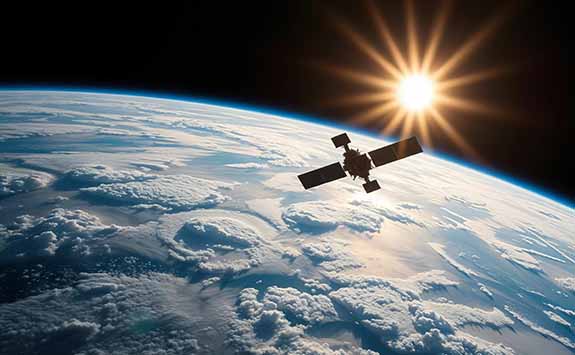
Space serves as a platform for geospatial research and innovation. It provides a vantage point for observing and analysing the Earth's surface.
Our geodesists are working to advance mapping and engineering surveying. They achieve this by improving the analysis of Global Navigation Satellite System (GNSS) data.

Observational astrophysics
Using a variety of observatories we study the small to the vast, including pulsars, active galactic nuclei, galaxies and cosmology.
We aim to answer fundamental questions about the Universe.
Our group uses a wide range of astronomical observatories to answer fundamental questions about the Universe. This includes:
- studying how galaxies form and evolve
- measuring the properties of pulsars
- evaluating parameters of cosmological models
- testing theories of gravity
Quantum and physics technologies
Quantum and physics technologies hold the potential to enhance communication, measurements, and sensing. This helps us to solve complex problems faster.
We use some of the key principles of quantum mechanics including superposition, tunnelling and entanglement. Quantum technologies offer transformative advantages to the space sector, including:
- enhanced computing power can solve complex problems faster than conventional computing
- quantum communications are highly secure and very fast
- the precision of quantum sensing offers unprecedented accuracy in measurements such as timekeeping or gravitational measurements