Comment Mary Ann Macham
Comment: The extraordinary journey of an enslaved woman to Britain
Published on: 23 December 2025
Writing for The Conversation, Genevieve Johnson discusses the story of Mary Ann Macham, an enslaved woman who arrived in North Shields on Christmas Day, 1831.
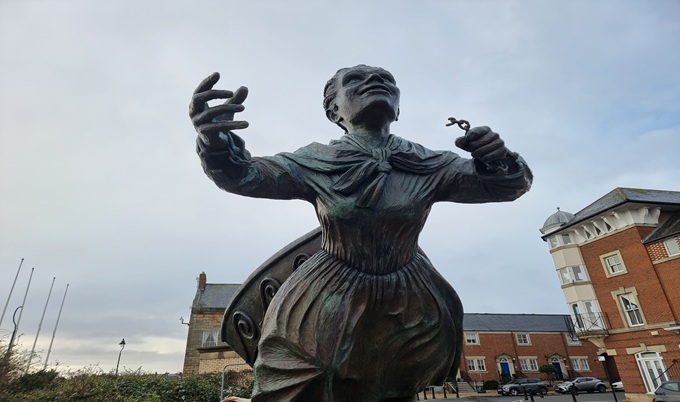
A newly unveiled statue in North Shields is casting fresh light on the extraordinary life of Mary Ann Macham – a woman whose courage carried her from the brutality of slavery in the US state of Virginia to freedom on the banks of the River Tyne on Christmas Day, 1831.
With the help of a friend in Virginia who was enslaved to the harbour master, Macham (who was enslaved on a plantation) hid beneath a tree and in the forest for six weeks while men on horses and bloodhounds searched for her. She was then smuggled to the harbour, where the second mate of a ship stowed her away with the cargo.
After many weeks at sea, including a stop in the Netherlands, Macham reached Grimsby. There she was taken by road to North Shields and welcomed by two “Miss Spences” on Christmas Day.
The Spence family were Quakers and committed abolitionists who offered her refuge and support. Macham’s story, dictated to members of the Spence family, was later published in the Christmas 1950 issue of Tynemouth Parish. Her powerful account survives today, with the original text available through the African Lives in Northern England website.

Macham lived in freedom in North Shields for the next 62 years. She worked in the Spence household and married a local man, James Blyth. Though her story is little known nationally, exhibitions about her have been held at the Old Low Light Museum in North Shields and the Discovery Museum in Newcastle. Local newspapers have told her story with pride and affection.
Macham’s story is an early example of a pattern which continued for most of the century, of Black American fugitives from slavery or anti-slavery activists coming to Britain and Ireland to work, lecture, publish and live.
Other figures such as Frederick Douglass, whose legal freedom was paid for by Quakers in Newcastle, and Moses Roper, who lectured far and wide, eventually settling for a time in Wales, are fairly well known. There are several possible explanations for why Macham’s story hasn’t had the same recognition.
First, there is still a distinct lack of attention paid to Black British history in general, particularly anything before Windrush, the ship that brought the first large group of Caribbean migrants to the UK in 1948. Second, Macham was not, as far as the records show, an abolitionist or anti-slavery activist in the traditional way of public lecturing, as Douglass was. She told her story knowing it would be shared, but otherwise it seems she used her freedom in Britain as simply that – freedom.
Where she lived is another possible explanation for the relative ignorance of her story. Less attention is paid to diverse histories in north-east England compared with, for example, London.
Why people came to Britain
Several factors made Britain attractive as a place of freedom. There was no legal chattel slavery in Britain and Ireland (though much continued in the British colonies), and the landmark Somerset v Stewart case of 1772 ruled that an enslaved person must be held to be free by virtue of their presence on British soil.
Fugitive and formerly enslaved people came consistently to Britain and Ireland throughout the 19th century. Arguably, nowhere were they more warmly received and, to an extent, understood than in the most industrialised, and therefore often most deprived, areas of the country, where workers made up a large portion of the population.
In the 19th century, the north-east was a thriving hub of anti-slavery activity, playing host to many Black abolitionists and playing an active part in publishing Black literature and facilitating freedom. Examples of this include the local Quaker sisters-in-law Anna and Ellen Richardson, who raised funds for the freedom of Frederick Douglass, and the Spence family, who welcomed Macham in North Shields and helped her start her new life.
Work on Black histories in the north-east include research by the local African Lives in Northern England Project and by Northumbria University’s Brian Ward, who published a book about Martin Luther King’s visit to Newcastle in 1967 and the wider historical context.
Many workers in industrialised places in Britain in the Victorian era – such as Manchester, the coal fields of Wales and the north-east of England – also claimed to feel “enslaved”. They saw parallels between their condition and that of the American slave, an idea perpetuated in contemporary literature such as Uncle Tom’s Cabin (1852).
Of course, the experience of a white, free workforce cannot realistically be compared with the life of those in chattel slavery. However, the feeling of oppression, capitalist exploitation, poverty and mutual support among struggling people meant that regions like the north-east were ideally placed to welcome those fleeing persecution and seeking refuge.
The sentiment that fostered a welcoming atmosphere in North Shields for Macham persists to this day. Following the exhibition about her at the Old Low Light Museum in 2019, £800 was raised through fundraising to lay a stone at her grave, which previously only held the name of her husband.
The stone was laid in 2020 by students from John Spence Community High School – named after the family who helped Macham. This and the statue stand as a lasting tribute to her courage, and the hearts of the community that welcomed her on Christmas Day in 1831 and continues to honour her.
Looking for something good? Cut through the noise with a carefully curated selection of the latest releases, live events and exhibitions, straight to your inbox every fortnight, on Fridays. Sign up here.
Genevieve Johnson, Associate Lecturer in history, Newcastle University
This article is republished from The Conversation under a Creative Commons license. Read the original article.