Green Futures Fellowship
Newcastle engineer awarded £3m to help tackle climate crisis
Published on: 18 December 2025
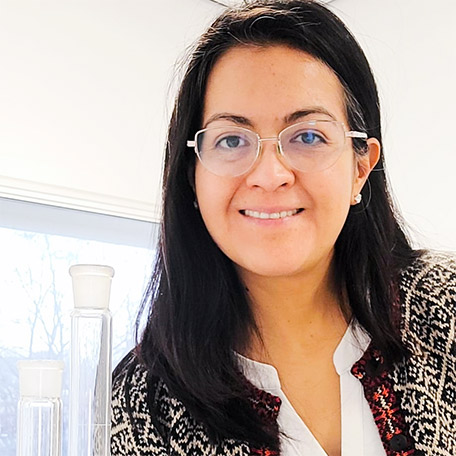
Dr Sharon Velasquez Orta has been awarded a Green Futures Fellowship by the Royal Academy of Engineering.
Her project: CHANGE: Carbon dioxide conversion by intensified electrobiocatalysis will harness microbes and bioelectrochemical reactors to transform waste CO₂ into fuels and other valuable products.
She joins the inaugural cohort of 13 Green Futures Fellows, each receiving £3 million as part of a landmark £39 million programme funded by the Department for Science, Innovation and Technology to scale breakthrough climate innovations over the next decade. The funding will support ambitious ideas and cutting-edge engineering into commercially viable technologies capable of making a lasting impact on the climate crisis.
The first awardees include innovators developing technologies that turns waste CO2 into useful products like plastics, fuels and chemicals, engineers creating more efficient and recyclable solar panels, and a project to extract critical metals for batteries, magnets, solar panels and fuel cells by filtering salty water.
Tiny superheroes
This prestigious 10-year research grant will help her develop a practical technology that turns carbon dioxide into fuels using microbes and bioelectrochemical reactors. Her climate solution hosts microbes under certain conditions to pave the way for new carbon dioxide conversions not possible under traditional chemical reactions.
This opens new ways for environmental sustainability, from cleaning water to making energy. An example of the technology application is in Anaerobic Digesters, where the technology can boost the energy content of biogas through upgrading it to pure fuels. Using it in anaerobic digesters can cut at least three Megatonnes of CO2 and save £120 million annually.
The fellowship provides 10-year support to further develop nature-based solutions using bacteria, yeast or microalgae in biological or electrochemical reactors. Providing a certain future for the development of a new portfolio of biotechnologies that will help construct our circular economy in the next decade.
Dr Sharon Velasquez Orta is Senior Lecturer in Sustainable Chemical Engineering, Employability Lead for the School of Engineering and Deputy Director for Business Innovation and Enterprise. She researches new biologically driven Net Zero technologies that can achieve energy and product generation from carbon dioxide, wastewater, or solid waste remediation. She has showcased new methods for the production of renewable energy, and materials from liquid, gaseous and solid waste streams through biological and bioelectrochemical methods. Biofuels produced from biomass waste include bioethanol, biodiesel, biomethane, biohydrogen or jet fuel.
Dr Velasquez Orta said: “This outcome is the result of two decades of extensive research at Newcastle University, and I’m delighted that this work has been recognised with the RAEng prestigious fellowship. The funds will support the exploration and scaling up of an innovative system to embark on our global journey to Net Zero, while opening up new, exciting opportunities for farmers and industry through a growing circular bioeconomy.
“Microbes are amazing tiny creatures, important for our planet; their abundance and diverse metabolism can help us reverse the effects of Climate Change and catalyse our nature restoration in the coming years.
“The RAEng fellowship leverages my expertise to successfully deliver breakthrough solutions to turn waste into value, strengthening our global position in environmental biotechnology for climate change mitigation.
“I’m truly excited to be part of the Royal Academy of Engineers' prestigious research community and access mentorship and training from experienced professionals, which will help grow the technology to achieve positive global societal, economic and environmental impacts.“
The challenge of our generation
Baroness Brown of Cambridge DBE FREng FRS FMedSci, Fellow of the Royal Academy of Engineering and Chair of the Green Future Fellowship Steering Group, said: “The climate crisis is the challenge of our generation. We need era-defining solutions that address the enormity of the challenge. Many of these solutions exist, but need the dual investment of money and time to make them a success. The Green Future Fellowships support innovators who are pushing engineering boundaries, building bold solutions to climate change mitigation, adaptation and resilience. The inaugural Green Future Fellows are pioneering truly advanced technologies and engineering solutions to protect the world we live in.”
UK Science Minister Lord Vallance said: “We can’t solve the climate crisis without engineering solutions. By supporting new approaches to key problems - storing renewable energy, extracting greenhouse gases from the atmosphere, and the huge carbon footprint of some industrial processes - these fellowships are empowering researchers to tackle global warming.
“Investing in this work reflects the Government's wider commitment to make the UK the natural home for the best science that we all benefit from, and our ambition to make the UK a clean energy superpower."
At least 50 Green Future Fellows will be appointed over five years. Successful applicants become a Green Future Fellow for the 10-year award duration, receiving up to £3 million alongside non-financial support such as training, mentorship, access to the Academy’s network of exceptional innovators, and additional tailored support.
To find out more about how Dr. Velasquez Orta uses microbes to fight climate change, watch this video: Microbes - Episode 5 - Climate Change Catastrophe!
Adapted with thanks from the Royal Academy of Engineering.