Conversation National Gallery arts funding
Comment: What National Gallery cuts reveal about arts funding
Published on: 17 February 2026
Writing for The Conversation, Dr Adam Behr discusses how the National Gallery cutting staff numbers indicates wider problems in the arts industry.
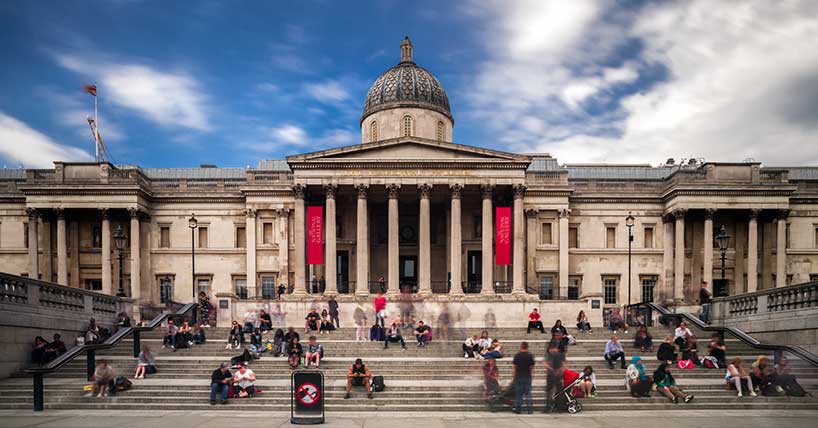
London’s National Gallery has launched a “voluntary exit” scheme for staff to address an £8.2 million deficit, with the possibility of redundancies to follow. The news bodes ill for cultural institutions and cuts, in contrast to the recent announcement of additional cultural funding from the UK government.
If the National Gallery – one of Britain’s leading attractions with over 4 million visitors a year – is struggling to balance its books, it indicates wider structural problems in the arts industry. The National Gallery’s predicament is indicative of pressures that have been building across the arts. Among these are increased operating costs, public funding not keeping pace with inflation, and increased reliance on commercial income at a time when belts are tightening across the board.
Cash injections, when they come, are not enough in the face of longitudinal real-terms decline. Competing needs for infrastructural repairs and capital projects are leaving a gap in the recurring revenues that support educational work, staff and daily activity.
As with the crisis in higher education, years of funding pressure and inflation are catching up with the sector and exposing the underlying fragility. The dawning scale of the problem has prompted a parliamentary inquiry into the financial resilience of government-sponsored museums and galleries. This is an acknowledgement of the deep-rooted nature of the challenge.
With local authorities also under strain, galleries, museums, theatres and cultural venues are exposed when councils have to look for cuts in their non-statutory services. There has been a nationwide drop of over £2 billion in local government support for culture over the last 15 years.
As the resources for cultural institutions have shrunk, research shows that the problems are systemic. There is a high level of churn among skilled workers in cultural occupations. Low pay, insecure conditions and limited progression push workers, especially younger workers, out of arts, culture and heritage jobs. This weakens both the sector’s resilience in the face of change and institutional capacity to innovate.
At the same time, access to finance has become a barrier. Cultural organisations face growing difficulty in securing affordable capital, lenders not understanding their businesses and a lack of appropriate financial products.
This undermines entrenched assumptions about arts organisations. High footfall does not necessarily guarantee sustainability. Last year Tate cut 7% of staff even as visitor numbers recovered after the pandemic, albeit unevenly. It also challenges the belief that philanthropy can replace public funding, or that cultural institutions should operate like other businesses. The result is a sector exposed to shocks, with insufficient room to adapt.
Financial fragility and institutional risk
The closure of the Centre for Contemporary Arts (CCA) in Glasgow earlier this year is a case in point. The funding body, Creative Scotland, refused to add to its previous three-year £3.2 million commitment and cited concerns about the centre’s “ongoing viability”. The CCA faced many problems, from a staffing dispute leading to the closure of its café bar, to – more recently – anti-Israel protesters calling on it to endorse a cultural boycott, leading to a temporary closure and further tensions.
Organisations increasingly have to respond to complex and competing social pressures – including objections to their sponsors – while maintaining institutional stability. It’s a task made harder by funding models that leave scarce room for manoeuvre.
At its core, the CCA’s collapse reflected longstanding financial fragility. These additional pressures compounded an already finely balanced situation. When an organisation is reliant on emergency funding and operating with little margin for error, disruptions can have disproportionate effects.
The CCA episode demonstrates how cultural organisations are required to absorb disruption (political, reputational and operational) with diminishing financial buffers. They are expected by policymakers, campaigners and the public to widen access, sustain international partnerships, expand educational programming and generate enough income to survive. These all make sense on their own but, taken together, may pull in different directions.
The arts are expected to, and often do, serve as engines of regeneration. Meanwhile, they increasingly operate with an uncertain mixed economy funding model in which shrinking public subsidy prioritises an entrepreneurial approach to private sponsorship and commercial income.
This suggests that the National Gallery’s difficulties are not an outlier, but an indicator of a deeper fault line – a sign of how exposed even our best-known cultural institutions have become. An organisation of this scale and popularity being forced to cut staff underlines how little room there is to absorb rising costs or unexpected disruption. High visitor numbers and commercial activity can help, but can’t guarantee stability on their own.
Much of the postwar period was shaped by the Keynesian settlement – the consensus in favour of state intervention to support public goods and manage economic and social welfare. There was a broad acceptance that cultural institutions required public support to deliver benefits that the market alone could not. As that assumption has weakened, funding has become more fragmented and reactive, shaped by short-term pressures rather than coherent long-term strategy.
The result is organisations operating with minimal headroom and responding through tactical measures like staffing cuts instead of being able to plan ahead. What gets lost in the process is the capacity to invest in people, programmes and public value beyond the immediate funding cycle.
This article is part of our State of the Arts series. These articles tackle the challenges of the arts and heritage industry – and celebrate the wins, too.
Adam Behr, Reader in Music, Politics and Society, Newcastle University
This article is republished from The Conversation under a Creative Commons license. Read the original article.