Conversation Prime Ministers
Comment: From Harold Wilson to Liz Truss
Published on: 17 February 2026
Writing for The Conversation, Dr Martin Farr discusses what the fates of former prime ministers can teach Keir Starmer.
Despite his name – honouring Keir Hardie, the first leader of the Labour party – Keir Starmer is not known to be a student of political history. This apparent incuriosity helps define an indistinct political identity.
Asked which premier inspires him, Starmer cites Harold Wilson, an unusual choice – Attlee is much more revered in Labour – and superficially surprising. No politician was more political than Wilson: the moment a camera appeared his usual cigar and brandy was replaced with a pipe and a pint. But recent events have demonstrated that Starmer has reason to choose the man who was Labour prime minister twice in the 1960s and 1970s.
Wilson had been soft left, but in Downing Street was non-ideological, tricksy, and reactive. This was partly why he was subject to frenzied speculation about being toppled in office. Labour’s performance in the May 1968 local elections was catastrophic. The following day The Daily Mirror – Labour’s champion – extraordinarily called for Wilson’s removal: he had “lost all credibility: all authority”. Wilson was thereafter beset by rumours of coups. He was a suspicious person, and with reason.
When Anas Sarwar, leader of Scottish Labour, extraordinarily called for Starmer’s removal, the similarities were uncanny. Wilson was defiant: “I know what is going on; I am going on.” Starmer, too, went on, if without the wit.
Resignations and defenestrations
There have been 26 prime ministers since 1900. Nine were removed by voters: Arthur Balfour 1905, Stanley Baldwin 1929, Winston Churchill 1945, Clement Attlee 1951, Ted Heath 1974, James Callaghan 1979, John Major 1997, Gordon Brown 2010, and Rishi Sunak in 2024. Heath is the last to have won and lost power through general elections alone.
The British constitution requires nothing of a premier other than, effectively, that they can command a majority in the House of Commons. A century ago, the prime minister’s constitution was the issue. The Marquess of Salisbury in 1902, Henry Campbell-Bannerman in 1908, and Andrew Bonar Law in 1923 retired on grounds of health: all died within a year. Standing down in 1935, Ramsay MacDonald survived for two. Anthony Eden in 1957, and Harold Macmillan in 1963, cited health but their infirmity was political. Both lived for decades.
David Cameron alone resigned on a point of principle (Brexit). Baldwin, who resigned in 1923 over trade policy, is the closest comparison (though he returned to No 10 twice, and, in 1937, was able to exercise that most rare act of political instrumentality and retire on his own terms). Part of Starmer’s definitional equivocacy is that it’s hard to imagine a point of principle on which he would resign.
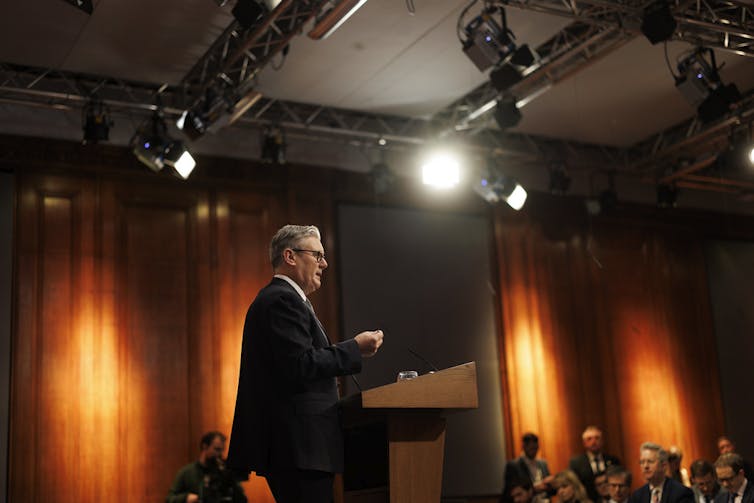
Being toppled in office happened to Herbert Asquith in 1916, David Lloyd George in 1922, Neville Chamberlain in 1940, and Margaret Thatcher in 1990. Asquith and Chamberlain were casualties of wartime coalition politics (Conservatives would not serve under Asquith; Labour would not serve under Chamberlain; Asquith was the more upset).
The Conservatives simply withdrew from supporting Lloyd George. Their 1922 Committee, which was formed as part of this action, was in part, and in effect, an institutionalisation of toppling. These days MPs can submit letters of no confidence to the 1922 Committee, and a ballot is triggered when 15% of them have.
Thatcher, dominant for a decade, overnight was rendered mortal by the concerted action of discontented former colleagues. This failed but it provided the pretext for another – Michael Heseltine – to mount a challenge. Unlike Starmer’s Downing Street operation, Thatcher’s team was slow and complacent. She beat Heseltine, but too narrowly; she resigned.
John Major prevailed, and he, singularly, later invited toppling. After incessant speculation about his leadership of both party and country, in June 1995, he invited his critics to “put up or shut up”. They did the former but Major survived. Starmer is unlikely to repeat the escapade.
Major’s successor, Tony Blair, occupies an intermediate category, being pressured (by the unique power dynamic with his chancellor Gordon Brown) to offer a date – a year hence – when he would stand down. If political pressure becomes too great, this may be the precedent for Starmer. It offers the appearance of agency.
The era of short tenure
Toppling has of late become rather à la mode. Theresa May in 2019, Boris Johnson in 2022, Liz Truss 49 days later. Since Cameron no premier has lasted three years. Starmer looks unlikely to break that record. Yet although MPs are much more rebellious than they used to be, two factors increasingly act to discourage them from toppling.
The first is that Britain has a parliamentary, rather than a presidential, system. Prime ministers are not elected, as such. Oppositions always call for elections when the government changes leader – they chose not to do so when in office themselves (Baldwin again, in 1923, is the closest to an exception). But in an age of electoral disengagement, the idea of an MP moving into 10 Downing Street without the benediction of voters is becoming increasingly untenable.
The second factor is who chooses. There have been three stages as to which successor kisses the monarch’s hand: Asquith and Macmillan became prime minister merely by general party assent; Callaghan and Major after their MPs voted; today that decision ultimately is of party members. Thus Truss. Her experience – and the country’s – may act to concentrate the minds of MPs tempted to topple.
Labour, significantly, has never toppled a prime minister. It’s not in the culture of so cooperativist a party: there’s no equivalent of the 1922 Committee. And whenever it might have happened, the challenger blinked: Herbert Morrison with Attlee; Roy Jenkins with Wilson; David Miliband with Brown; Wes Streeting may have just joined the roster of the rueful. Wilson more than merely survived his near-death experience: he lived to lead Labour into three more general elections, winning two, before emulating Baldwin and retiring on his own terms, in 1976.
And so Starmer’s affinity becomes clearer. Above all, like Wilson, Starmer is dogged. There is however, a profound difference. Wilson, strategically ineffectual, was tactically brilliant. Starmer has demonstrated a propensity for only the former. May’s local elections are approaching. A Wilsonian prime minister aware of political history might know what the following day’s Mirror may reflect.
Martin Farr, Senior Lecturer in Contemporary British History, Newcastle University
This article is republished from The Conversation under a Creative Commons license. Read the original article.