
reversible glue update
Bonding smart, releasing smarter – development of a reversible glue
Published on: 4 February 2026
Newcastle University engineers are at the forefront of adhesive technology that promises to change how we recycle.
They have developed a reversible glue that sticks things together like any other glue but can debond on demand. The glue’s reversible nature means it can be used in a multitude of applications, from laminates to bottle labels. Dissimilar materials that are glued together can be easily separated, enabling their reuse, repurposing, or recycling.
The reversible glue, developed by experts from Newcastle University’s School of Engineering, is a water-based emulsion – similar to a paint – that bonds materials together, but can be separated on-demand by acidic or alkaline water.
Two years ago, the team introduced the first version of a glue which uses inexpensive polymers containing electrical charges to both keep the emulsion stable and to stick to different surfaces. When a surface coated with a positively charged emulsion is joined to a surface coated with a negatively charged one, the two components stick together. However, if the bond is immersed in water that is either acidic or alkaline, the adhesive bond fails. This opens up possibilities for recycling, because it allows the separation on demand of components that have reached the end of their useful life. This technology required two formulations: one for each surface to be coated. It also had a tendency to drip on vertical surfaces.
In this latest version, the team added clays to the formulations. While clays are commonly used as thickening agents to inhibit dripping, their addition also had the remarkable effect of enabling debonding without the need for two separate formulations. This “one-pot” reversible glue is a game changer because of how it simplifies the recycling workflow.
Offering sustainable solutions
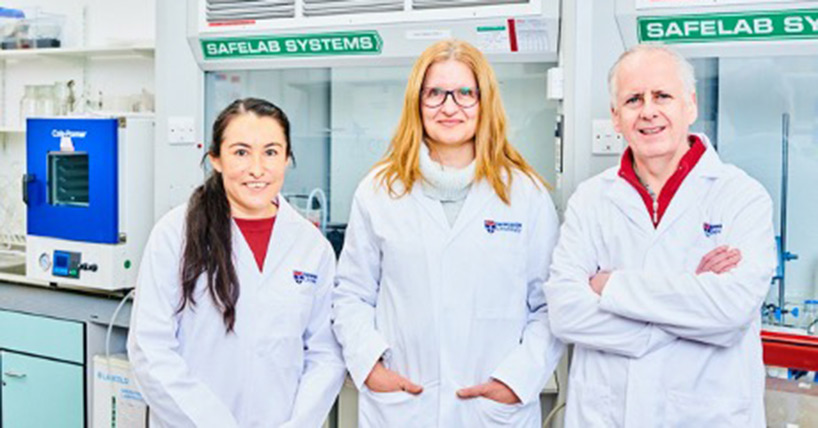
First author of the paper, Dr Adriana Sierra-Romero, Research Associate at the School of Engineering, said: “Reversible adhesives are starting to attract attention in industry. They’re not yet mainstream, but we expect adoption to grow as companies look for more sustainable solutions.”
The glue is based on current industrial manufacturing processes – those for making a paint – and is developed from cheap materials so it can be scaled up easily. Because it is water-based it does not have the volatile organic solvents used in many commercial glues, but unlike other water-based adhesives, exposure to humid environments does not cause bond failure. The team has shown that its shelf life at room temperature is at least a year, so it is also inherently stable. It is as strong as other water-based adhesives (so called white-glues), but crucially it works on a wider variety of surfaces.
The glue is targeted at plastic surfaces, but it can bond to other surfaces too. Plastics are where most applications are expected and it is effective at surfaces used in the packaging industry like polypropylene and polyethylene, which are inaccessible to many glues. Target industries include packaging as well as the recycling of automotive parts or in electronics.
Published in the leading journal, Soft Matter, published by the Royal Society of Chemistry (RSC) the work was funded by the Engineering and Physical Sciences Research Council (EPSRC). This technology was also recently a finalist in the RSC’s Emerging Technologies competition.
The lead investigator on the project, Mark Geoghegan, who is the Roland Cookson Professor of Engineering Materials, added: “It is really exciting to see how this technology is developing and I am so excited by the future opportunities for our invention.”
Professor Katarina Novakovic, Professor of Polymer Engineering and co-investigator on the project said: “It is more critical than ever to develop technologies that will enable net zero targets and our glue is doing exactly that. Newcastle University has a great record in sustainability, it is embedded in our curricula and research projects our students do. We are thrilled that we were able to bring Emmanuel Abotsi, an MSc student, to our team, and share with him our passion for sustainable use of resources.”
Newcastle University is ranked 22nd in the UK and 64th in the world for sustainability in the QS World Rankings: Sustainability 2026.
Find out more about studying Chemical Engineering at Newcastle University.
Reference:
Sierra-Romero, A., Abotsi, E., Novakovic, K., & Geoghegan, M. (2026). One-pot polymer–clay composite reversible adhesive. Soft Matter. Advance article. https://doi.org/10.1039/D5SM01039J