National ICT Knowledge Centre
New centre to support next-generation semiconductor systems
Published on: 17 March 2026
Newcastle joins a new £16.7m National ICT Knowledge Centre to strengthen the UK’s ability to design next-generation electronic systems and support the ambitions of the UK Semiconductor Strategy.
Led by the University of Sheffield, the Centre for Heterogeneous Integrated MicroElectronic and Semiconductor Systems (CHIMES²) will develop new ways to combine multiple microchips into smaller, faster and more energy-efficient systems - a critical challenge as electronic devices continue to shrink and increase in complexity.
Semiconductors empower everything from smartphones and data centres to electric vehicles and medical equipment. As traditional circuit boards reach their limits, the future lies in “Heterogeneous Integration” — combining different semiconductor technologies into highly integrated, secure systems.
CHIMES²
CHIMES² brings together researchers from the Universities of Cambridge, Oxford, Queen’s University Belfast, Strathclyde, Edinburgh, Newcastle, King’s College London, Manchester, and the Science and Technology Facilities Council (STFC). CHIMES is funded by the Department for Science Innovation and Technology, delivered and monitored via UK Research and Innovation.
The centre aims to develop a national “Design Commons”, a shared platform of system architectures, integration workflows and reusable design tools. The Design Commons will support industry collaboration while also forming a core part of the UK’s semiconductor skills agenda, aligning with the Department for Science, Innovation and Technology’s Semiconductor Talent Expansion Programmes to provide hands-on training in advanced system design.
Professor Rishad Shafik leads the Newcastle team as part of the centre, while Professor Alex Yakovlev co-leads the team.
Professor Shafik, Professor of Microelectronic Systems, Newcastle University School of Engineering said: "Advanced machine learning increasingly demands new hardware methods that can scale in complexity while remaining highly energy-efficient.
“Our research through this IKC focuses on building next-generation integrated circuits that combine novel architectures with new generations of machine learning algorithms, such as Tsetlin machines, that are intrinsically built for low-complexity and scalability. By enabling modular and adaptable designs, we aim to create a foundation for more future-proof and energy-efficient intelligent systems across a wide range of applications."
Professor Yakovlev, Professor of Computer System Design, School of Engineering, added: “Newcastle's traditional strengths in microelectronics, both devices and design, which have been internationally recognised in the fields of strained silicon, asynchronous systems and real-power computing are entering a new phase - Edge AI and machine learning on a chip. This partnership is the ideal place for us to link with the best of the best in the UK in advancing the integration of smart systems on semiconductor technologies.”
Professor John Goodenough, Director of CHIMES² and Professor in the School of Electrical and Electronic Engineering, Faculty of Engineering at the University of Sheffield, said:
“This centre strengthens the UK’s capability to design the advanced electronic systems that will underpin future economic growth and technological resilience. By bringing together leading expertise from across the UK and embedding that capability into both industry collaboration and national skills programmes, we are building sustainable long-term impact.”
Press release adapted with thanks from CHIMES.
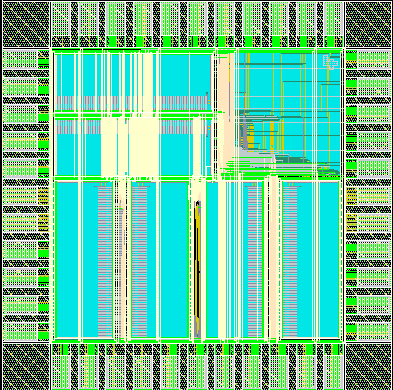
Image: Layout of a memory co-processor IC designed by Newcastle’s Microsystems AI (MAI) Lab supporting in-memory compute for Boolean based machine learning algorithms. Credit: Komal Krishnamurthy.