WPS guide
New guide offers tools to protect women’s rights during conflict
Published on: 6 March 2026
A guide, co-authored by Newcastle University experts, aims to equip military leaders, policymakers, and civil society advocates with tools to protect women's rights in areas experiencing conflict.
The ‘Women, Peace and Security: Holding the line’ report has been written by Dr Katharine A.M. Wright, Senior Lecturer in International Politics and Amy Hill, a PhD candidate in the School of Geography, Politics and Sociology. Also contributing were key figures from WO=MEN Dutch Gender Platform Anne-Floor Decker and Emine Kaya, along with Sorana Jude, Lecturer in Defence Studies, King’s College, London.
Launched to coincide with International Women’s Day 2026, the document is intended to underline that the Women, Peace and Security (WPS) agenda is not a symbolic add-on, but central to peace, justice, and human security.
It is based on insights and feedback shared during a closed session that brought together policy makers, diplomats, military leaders, and women’s rights experts. Dr Wright is a member of NATO’s Women, Peace and Security Civil Society Advisory Panel and co-organised the meeting, which took place at the 2025 NATO Summit in The Hague.
The event explored how the Women, Peace and Security agenda is playing out, particularly along NATO’s Eastern borders, where security pressures are acute and democratic values and integrity are increasingly under strain.
At the meeting, participants highlighted how, despite formal policy commitments from NATO, implementation continues to lag behind ambition. They also discussed ways in which they felt that ambition is now under threat from a wider backlash against women’s rights and gender equality, creating a growing gap between policy and lived realities.
The new guide brings together insights, real-life examples and practical tools as a response to these challenges. It distils the collective knowledge and expertise of those at the 2025 meeting to provide clear, actionable ways to strengthen Women, Peace and Security in the face of growing political and ideological resistance and highlights the work of those who continue to uphold and advance WPS principles on the ground.
Dr Wright, who is also Fulbright Scholar and Research Fellow on the Women and Public Policy Program at the Harvard Kennedy School, said: “Beyond the headlines that the Women, Peace and Security agenda faces pushback, backsliding and irrelevance; we find resilience, perseverance and hope but more fundamentally than that - an acknowledgement that a gender lens is necessary for addressing today’s international security realities effectively.”
Amy Hill said: ‘At a time when polarisation threatens from intensifying conflicts and hybrid threats, WPS: Holding the Line is both a warning and urgent call for political action to protect and honour the commitment of women who are today, more than ever, holding the line.”
NATO formalised its ambitious Women, Peace and Security policy in 2024, which reaffirmed the need to integrate gender perspectives into defence and deterrence. In doing so, it established four strategic priorities: gender-responsive leadership and accountability, meaningful participation, prevention, and protection. Since then, the Alliance has agreed a number of further policy commitments to translate it into action.
It is underpinned by the landmark United Nations Security Council Resolution 1325, passed in 2000, which acknowledges the disproportionate and unique impact of armed conflict on women and girls and urges states to increase the participation of women and incorporate gender perspectives in all peace and security efforts.
Emine Kaya, Programme Manager for Gender, Peace and Security at WO=MEN: Dutch Gender Platform, said: "Around the world, women are holding the line every day: sustaining communities under fire, defending democratic values, and shaping responses to rapidly evolving threats. This publication recognises their leadership and calls for renewed political will to safeguard and strengthen the WPS framework for the next 25 years."
Both the event in 2025 and the new guide have been supported through ESRC IAA funding.
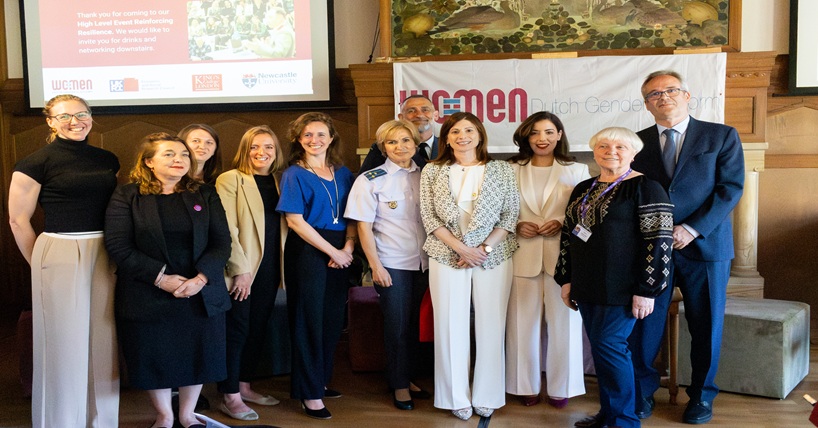
Shown in the photo are: L to R, speakers and organisers of the High-Level event in The Hague: Amy Hill, Emine Kaya, Sorana Jude, Katharine Wright, Anne-Floor Decker, Nevena Miteva, Dany Poitras, Irene Fellin, Fatimazhra Belhirch, Olena Suslova and Koen Davidse.