Base editing reveals role of master gene
First use of precision editing reveals role of master gene
Published on: 25 June 2026
Scientists have, for the first time, used an extremely precise genome editing technique called base editing to study gene function in human embryos.
Using the technique, researchers including those at Newcastle University and the Newcastle Fertility Centre, part of Newcastle upon Tyne Hospitals NHS Foundation Trust, found that a gene called NANOG is essential for forming the future body from an embryo. Without it, the embryo loses its ability to differentiate into different body tissues.
This reveals fundamental differences between early development in human and mouse embryos, underscoring the importance of directly investigating human embryonic development.
The work is published today in Nature.
The role of NANOG
The research led by the University of Cambridge Loke Centre for Trophoblast Research, has shown that the genome editing technique can be used to alter a single gene in human embryonic cells, enabling the study of very early human development in unparalleled detail.
The technique, called base editing, is a more precise version of the genome editing technique CRISPR/Cas9. It can change a single nucleotide base pair - the basic building block of DNA - within a human genome of approximately 3 billion base pairs.
Using base editing, the researchers blocked a gene called NANOG in very early-stage human embryos, and found that the cells of the early embryo could not develop into more specialised pluripotent cells called the epiblast - which later form the body.
The results reveal the crucial role of NANOG in the development of human embryos, and helps scientists better understand how human embryos develop in the first few days after an egg is fertilised.
Without NANOG, the cells that later become the placenta and yolk sac - the tissues that support the developing embryo - could still form.
While human embryo base editing has been previously reported, this is the first time that this technique has been used to study gene function in human embryos. The results show that the extreme precision of the technique reduces the likelihood of unintended chromosomal abnormalities, which can occur with another more widely used version of CRISPR/Cas9.
Understanding more about the role of genes required for human development, such as NANOG, could in future help to improve IVF success rates and better understand early pregnancy loss.
Base editing could also potentially be used in future to edit specific genes for debilitating inherited conditions - like cystic fibrosis and Huntington’s disease - in human embryos to prevent the conditions being passed on to future generations. However, this would not be legally permissible in the UK at present. Before any future clinical use, extensive safety testing, further development of the technique, and broad public debate and support would be required.
The work was carried out by author Professor Mary Herbert while at Newcastle University and who is now at Monash University, Australia. She said: “The study led by the Niakan lab (University of Cambridge) uses a cutting-edge form of genome editing known as base editing, to address the fundamental question of how early human embryos prepare to establish a pregnancy
"Using base editing to silence a key developmental regulator, the study advances our understanding of how early human embryos specify the precursor cells that eventually go on to form all cell types of the human body. A better knowledge of how this fundamental process is regulated will enable us to gain new insights into why the majority of human embryos fail to establish a viable pregnancy."
The research also involved Dr Meenakshi Choudhary, Newcastle Fertility Centre, and Biosciences Institute, Newcastle University.
Professor Kathy Niakan at the University of Cambridge Loke Centre for Trophoblast Research, who led the study said: “Base editing represents a significant advance on conventional CRISPR/Cas9 because it carries a far lower risk of causing unintended chromosome errors. Base editing can precisely change a single nucleotide base pair to another in an entire human genome of around 3 billion base pairs - that’s an incredible feat.”
She added: “Our results indicate that the NANOG gene is critical for the development of pluripotent cells, the building blocks that are fundamentally important to human development.”
Pluripotent cells can develop into any other type of cell in the body and are widely used in biomedical research, from drug testing to disease modelling. Human embryonic stem cells, which are pluripotent, arise in a part of the developing embryo that has high levels of NANOG activation. This has caused scientists to suspect that NANOG plays an important role in their creation.
Human development does not always follow the mouse blueprint
Decades of animal research, particularly in mice, were essential for identifying NANOG as a gene likely to play a major role in early development. But this study shows that NANOG does not function identically in human and mouse embryos.
In previous mouse studies, loss of NANOG disrupted both the epiblast and the yolk sac - a tissue that supports the developing embryo. In this human embryo study, loss of NANOG primarily affected the epiblast, the future body-forming line of cells.
Until now it has not been possible to directly investigate the function of NANOG in human embryos because the genome editing techniques available, like conventional CRISPR/Cas9, cause too much unintended damage to the DNA. This work underscores the importance of directly investigating human development.
Professor Mary Herbert, Newcastle University Visiting Professor, added: “Importantly, the study reveals differences between mouse and human embryos in the mechanisms governing cell specification during late preimplantation development. This highlights the importance of using human embryos for this type of research.
"In addition to its biological significance, the study demonstrates the power of base editing as a research tool to address previously intractable questions related to the molecular regulation of early human development.
"Unlike earlier genome editing technologies, base editing enables targeted DNA sequence changes without the need for DNA double strand breaks. This is especially important for early embryos, which appear to lack efficient mechanisms for repairing double strand breaks.
"The work represents an important technical advance that will enable scientists to accelerate progress towards a more complete understanding of the causes of arrest during early human development. The knowledge gained from this type of research will underpin future developments designed to improve outcomes of assisted reproductive technologies and potentially reduce the risk of early pregnancy loss.
"The UK is the very fortunate position of having a robust legal and regulatory framework that enables research on donated human gametes and embryos for strictly defined purposes. We express our deep gratitude to those who so generously donated eggs and sperm for use in this study."
The researchers describe the advantages of this technique, and what its use has revealed about the development of pluripotent cells - the building blocks that are fundamentally important to human development.
Ethical and legal compliance
The embryos, eggs and sperm used in the study were unused samples donated by couples who had undergone IVF treatment. Most donors had completed their family, and wanted their surplus embryos, eggs or sperm to be used for research.
The embryos were only cultured in the lab for up to six and a half days after fertilisation, and then allowed to perish.
The study was done under a research licence and strict regulatory oversight from the Human Fertilisation and Embryology Authority (HFEA), the UK Government's independent regulator overseeing fertility treatment and research. The research was also reviewed and approved by Newcastle and North Tyneside Research Ethics Committee.
The study is published today in the journal Nature.
Reference: Bower, O.J. et al: ‘Base editing reveals an essential role for NANOG in human embryogenesis.’ Nature, June 2026. DOI: 10.1038/s41586-026-10792-1
Adapted with thanks to Cambridge University.
Image descriptions and credits
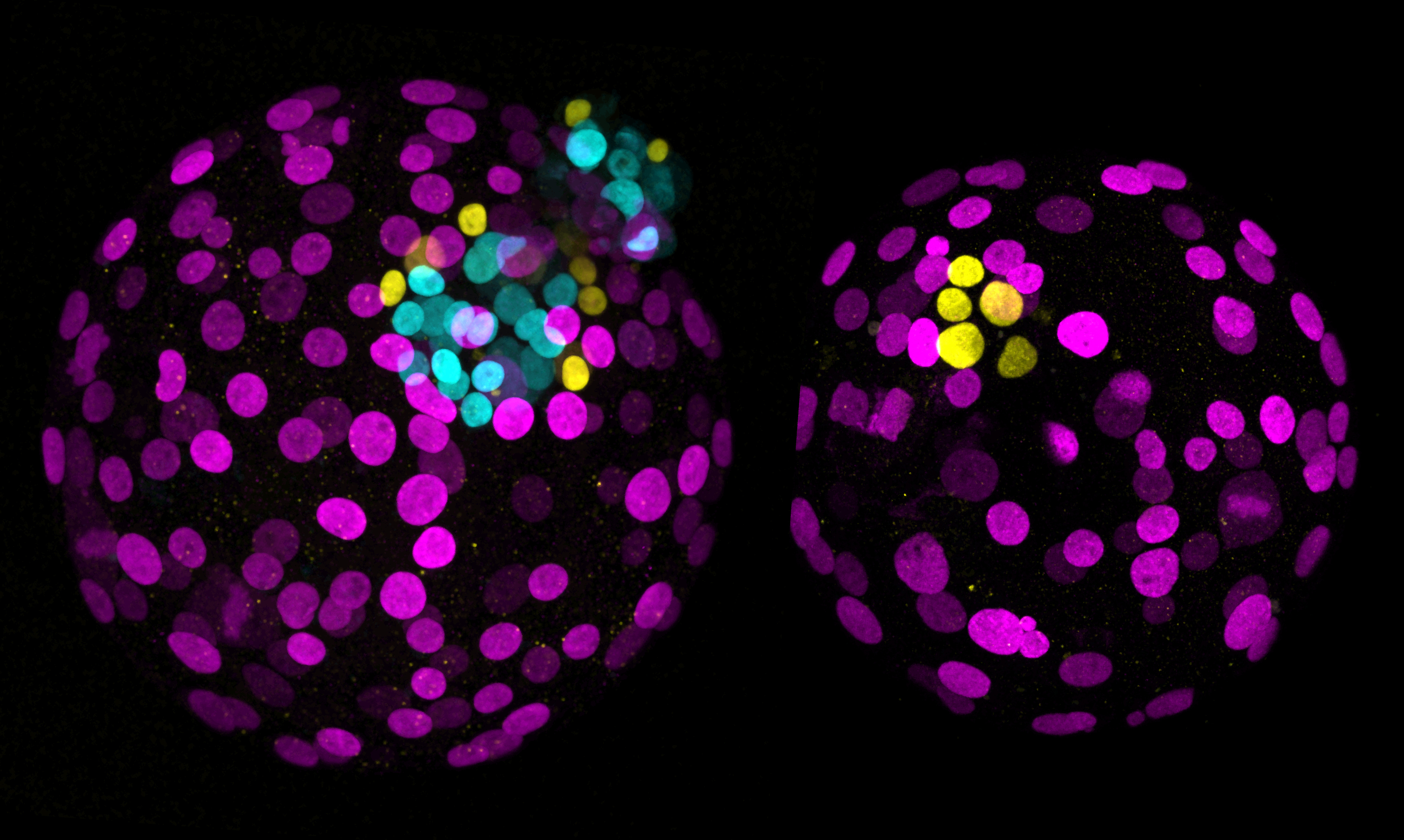
Image shows: Day 6 human embryos showing the effect of NANOG presence versus absence.
In the normal embryo (left): magenta cells will become the placenta, yellow cells will become the yolk sac, and cyan cells will become the epiblast, which later forms the body.
In the embryo where genome editing was used to block NANOG (right): no cyan cells were seen - the epiblast could not develop. Loss of NANOG did not significantly affect the development of cells that would become the yolk sac or placenta, the tissues that support the developing embryo.
Credit: Katarina Harasimov, Oliver Bower and Kathy Niakan, Loke Centre for Trophoblast Research, University of Cambridge.
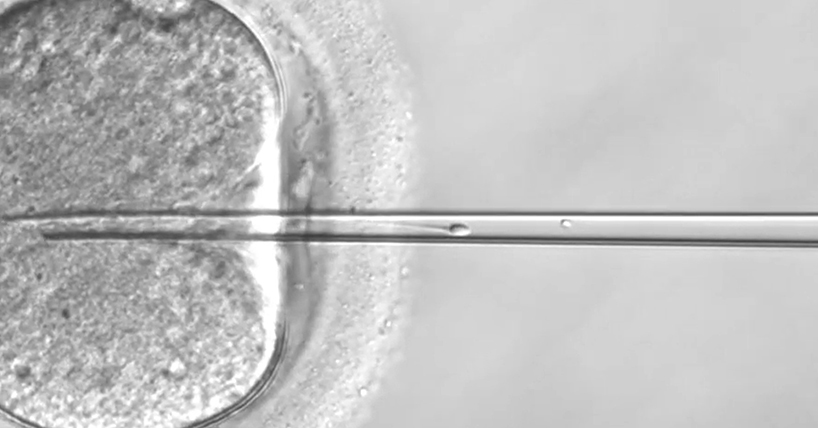
2nd image (black and white): embryo - taken from a video of human embryo development in the presence of NANOG.
Development of human embryos in the first week after fertilisation. After the egg is fertilised, the embryo divides from one-cell to a 200-cell structure called a blastocyst. At this stage, 90% of cells will become the placenta, and only 10% will form the epiblast, which later form the body, as well as the yolk sac.
Credit: Oliver Bower, Katarina Harasimov and Kathy Niakan, Loke Centre for Trophoblast Research, University of Cambridge.