Beach Spectres
Volunteers help turn Whitley Bay beach into maths experiment
Published on: 15 June 2026
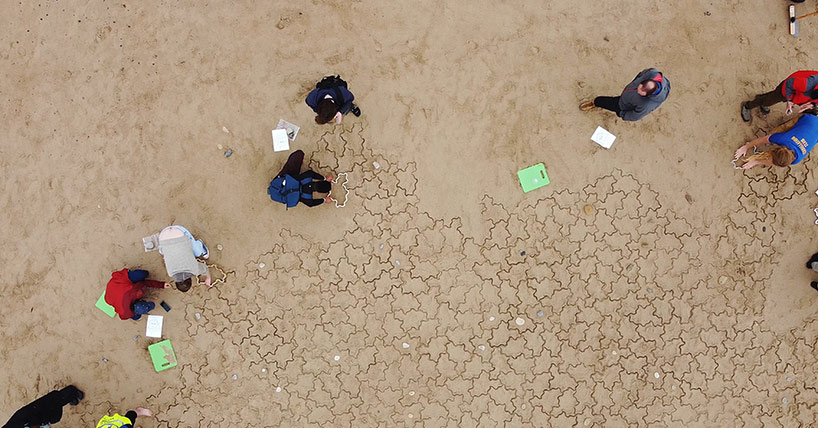
Members of the public joined mathematicians from Newcastle University to create what organisers believe is the largest aperiodic tiling ever attempted on Whitley Bay beach.
The Beach Spectres event was organised by Christian Lawson-Perfect, mathematician and learning software developer in Newcastle University’s School of Mathematics, Statistics and Physics.
The goal was to make the largest aperiodic tiling (a way of covering a plane with tiles so that a pattern never repeats periodically, even though it completely fills the space) ever. Attendees joined in by laying down a ‘cookie cutter’ “spectre” shape so that it eventually covered the beach.
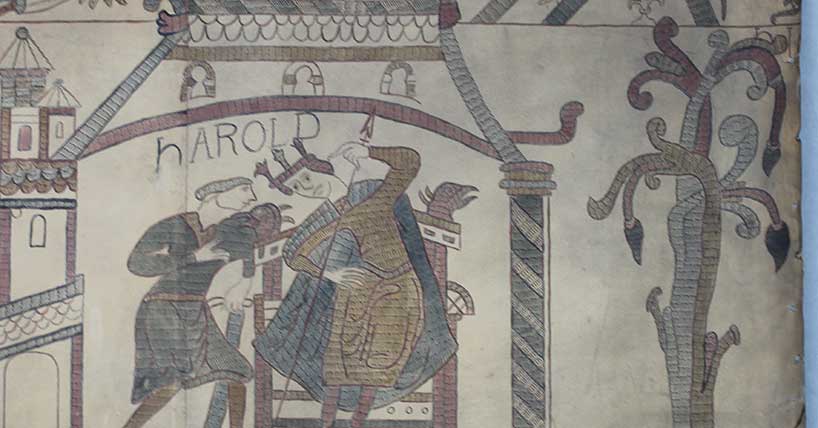
Beach Spectres project was inspired by a breakthrough in mathematics: the discovery of the spectre tile. The shape was identified by David Smith, while Craig Kaplan was the mathematician who coordinated the proof. It is currently the only known single shape that must tile a plane aperiodically – meaning the pattern can extend forever without ever repeating in a regular way.
The project funded by Matt Parker and the Talking Maths in Public conference's MEGA grant.
Christian Lawson-Perfect said: “The event went way better than I expected. I'm really pleased that all the preparation paid off - the actual tiling process went as smoothly as we could have hoped. But most importantly, we talked to hundreds of members of the public who had either seen the event advertised and came down to the beach to join in, or were just passing by and curious about what we were doing.
“I talked to people of every age - small kids, enthusiastic teens, up to adults and pensioners. I was overwhelmed by how many people said they were glad we were doing the event, and who responded with curiosity and positivity about the maths, challenging the stereotype that most people hate maths. Unsurprisingly, very few people had heard about the aperiodic monotile before the event, but I think most left with a better understanding of why it's interesting, and why we research tessellations in general.”
“I wasn't prepared for the number of people who asked when we're doing it again!”
Find out more about Beach Spectres.
.jpg)