Conversation Force of Nature
Comment: Force of Nature
Published on: 24 July 2026
Writing for The Conversation, Professors Hayley Fowler, Hannah Cloke and Jim McQuaid explore how the wildlife series reveals the ways extreme weather pushes animals to their limits.
A chimpanzee digging for water in a dried-up Senegalese riverbed. A colony of 40,000 flamingos scattered by a hurricane. A polar bear hunting on ice that is disappearing beneath its feet. These are not scenes from some distant climate-altered future. They are happening right now. And this year they are coming to Sunday night television.
Extreme weather is often told as a human story. A new ITV documentary series, Force of Nature reminds us that it is an ecological story too.
Between us, we have spent decades studying the atmosphere and the extremes it produces. One of us flies through it onboard a research aircraft, measuring dust, smoke and pollution plumes. And two of us have spent our careers unpicking how a warming climate is supercharging rainfall, floods and heatwaves, and how societies can better prepare for weather extremes.
So when ITV announced Force of Nature, a new six-part wildlife series narrated by actor Andrew Lincoln that puts extreme weather at the heart of the story, we all paid attention. For scientists like us who study the atmosphere for a living, this is the series we have been waiting for.
Three years in the making by Plimsoll Productions, the team behind some of the most-watched natural history on television, Force of Nature follows animals around the world as they face hurricanes, floods, droughts and wildfires. Executive producer, Mark Brownlow, who previously produced Blue Planet II, calls this “the most important story of our time”. Watching the series, it is hard to disagree.
Scientists can now measure a changing climate with extraordinary precision. The UK exceeded 40°C for the first time in July 2022. Scientists have found that, if the legendary summer of 1976 happened again in today’s climate, it would peak at 38 or 39°C.
Evidence shows that the short, intense bursts of rainfall that drive flash flooding are becoming more severe in a warming climate. Valencia-style flooding, which killed more than 200 people in 2024, is perfectly possible here in Britain.
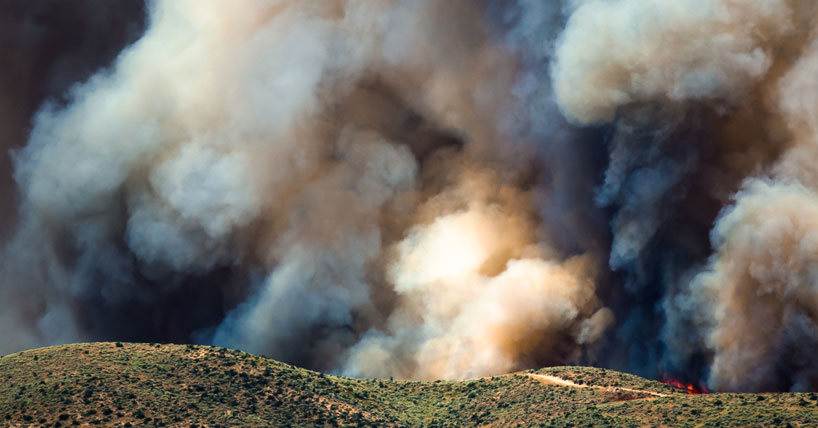
Wildfire smoke can travel can travel thousands of miles with Canadian wildfires turning UK skies vivid hues in summer 2023. This summer, smoke from Canadian wildfires shrouded the Statue of Liberty in New York, US, raising concerns about delays at the World Cup final.
Scientists can trace soot and dust across continents, even to Greenland, where they feed microbes that darken the ice sheet and accelerate melt. Yet knowledge alone rarely changes behaviour.
As authors Dan and Chip Heath wrote in their 2007 book Made to Stick: Why Some Ideas Survive and Others Die, “people may need statistics, but they believe stories”. Climate scientists often hope that more evidence will change minds. In reality, people only act on risks they can imagine. And that is exactly what Force of Nature does.
People struggle to act on risks they cannot picture. A warning of 40mm of rain in three hours means little until you have watched water pour through someone’s front door.
Force of Nature takes the same extreme weather that fills our scientific journals and shows what it means for creatures that have no forecasts, no warnings and no insurance.
Weather does not distinguish between us and them. The drought that ruins a harvest is the same drought pushing chimpanzees to the edge of their ingenuity. The storm surge that floods a coastal town is the same surge that scours a flamingo nesting ground. The smoke that turns skies orange is rolling over forests and everything living in them. Watching animals confront these events strips away the abstraction. It makes the risk tangible, and tangible is what climate communication desperately needs.
What makes the series particularly effective is its focus on resilience. These animals are not presented as passive victims of a changing climate. They adapt, improvise and survive against the odds. That matters, because fatalism is almost as dangerous as denial. If people believe nothing can be done, they are less likely to act.
The UK is built for a climate that no longer exists. The word unprecedented is increasingly used with abandon to describe extreme weather. Hope, grounded in an honest understanding of the risks ahead, is what is needed to drive action to make homes more resilient, to strengthen flood defences and early warning systems, and to rapidly reduce fossil fuel emissions.
Television has changed public attitudes before. In 2017, the BBC series Blue Planet II turned plastic pollution from a niche environmental concern into a kitchen-table conversation almost overnight.
Force of Nature, made by some of the same hands and backed by ITV’s climate content pledge, has the potential to do the same for extreme weather.
Millions of people who would never open a scientific paper will watch a sea otter ride out a marine heatwave. That reach matters.
But a television series will not stop the storms from coming. We need to cut fossil fuel emissions rapidly, adapt our infrastructure and prepare for weather extremes that are already becoming more common.
Societies rarely prepare for risks they cannot imagine. For too long, extreme weather has existed at the edge of our collective imagination: something that happens elsewhere, or sometime in the future. Force of Nature shows that it is here now, shaping the lives of animals and people alike.
Showing the immediacy of the need to act may be the programme’s most important achievement.
Jim McQuaid, Professor of Atmospheric Science, University of Leeds; Hannah Cloke, Regius Professor of Meteorology and Climate Science, University of Reading, and Hayley J. Fowler, Professor of Climate Change Impacts, Newcastle University
This article is republished from The Conversation under a Creative Commons license. Read the original article.