PRONTO study
Improving emergency care for stroke patients
Published on: 24 July 2026
Newcastle University is leading a study across four NHS ambulance services to help paramedics identify severe strokes more quickly, aiming to speed up treatment and improve patient outcomes.
The PRONTO study is investigating new ways to rapidly identify people who have experienced a large vessel occlusion (LVO) stroke, caused by a blockage in one of the brain’s major arteries.
Patients experiencing an LVO stroke may require an emergency procedure known as a thrombectomy, which removes blood clots and restores blood flow to the brain.
The faster the procedure is delivered, the greater the patient’s chances of survival and recovery.

Directing patients to specialist care
Christopher Price, Professor of Stroke and Applied Health Research at Newcastle University, and Dr Lisa Shaw, Reader in Stroke Research, are co-leading the study.
Professor Price said: “Results from studies using the LVOne test in hospital were promising, so we're now hoping to show that it can help to identify patients suitable for thrombectomy whilst they are still in the ambulance.
"If the study is a success, then the test would speed up treatment and improve recovery for a large number of stroke survivors.”
Currently, ambulance clinicians have no specific test available to reliably identify an LVO stroke before arriving at hospital. The PRONTO study hopes to change that.
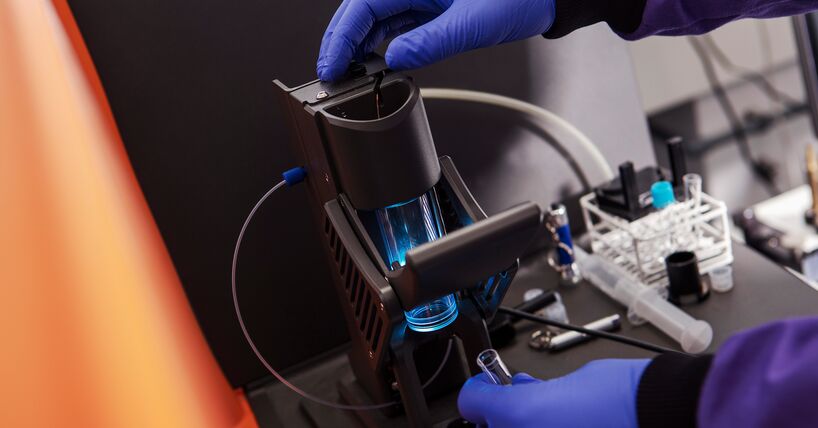
The trial combines a simple fingerpick blood test, known as the LVOne test and developed by Upfront Diagnostics Ltd, with direct communication between ambulance crews and hospital specialists.
The test measures levels of two blood biomarkers – d-dimer and GFAP – which previous hospital-based research suggests may help identify patients experiencing an LVO stroke.
By identifying suitable patients while they are still in the ambulance, the study could enable them to be taken directly to specialist centres capable of performing thrombectomy, avoiding delays caused by additional tests at local hospitals.
At present, thrombectomy services are only available in a limited number of regional stroke centres, meaning many patients first attend a local hospital for assessment before being transferred for treatment if required.
Supporting nationwide stroke research
The study is being delivered in partnership with four ambulance services and six hospital trusts in North East, North West and South West England and Wales.
In Wales, the PRONTO trial is currently available to crews who are conveying patients to Swansea’s Morriston Hospital.
Josh Miller, Head of Research and Innovation at the Welsh Ambulance Service, said: “This research is evaluating whether a new ambulance assessment is sufficiently accurate for future use in identifying people who have LVO stroke and may need thrombectomy.
“Armed with this new information, patients could potentially be taken straight to specialised hospitals that are equipped and ready to perform the necessary thrombectomy.
“In time critical medical emergencies such as LVO strokes, this has the potential to make a huge difference their chances of survival and recovery.”
The researchers hope the findings will demonstrate that rapid blood testing in ambulances can help stroke patients receive the right treatment, at the right place, and at the right time, ultimately improving outcomes for thousands of people affected by stroke every year.