Nepal disaster WWA study
Climate change contributing to permafrost thawing and glacial thinning
Published on: 17 September 2026
The catastrophic rock and ice collapse on the northern Nepalese border was influenced by a range of climatic and geological factors, most of which are worsened by the impacts of climate change.
An international team of glaciologists and climate scientists, including Professor Bethan Davies from Newcastle University, carried out a rapid scientific analysis and identified the role of climate change and its impacts on the high altitude landscape.
Over 1,400 people were killed - and more than 5,000 remain missing - after a massive section of overhanging glacier and rock fell from Langtang Lirung mountain on 26 August 2026. The collapse caused an enormous water, ice and debris flood that swept downstream resulting in catastrophic damage.
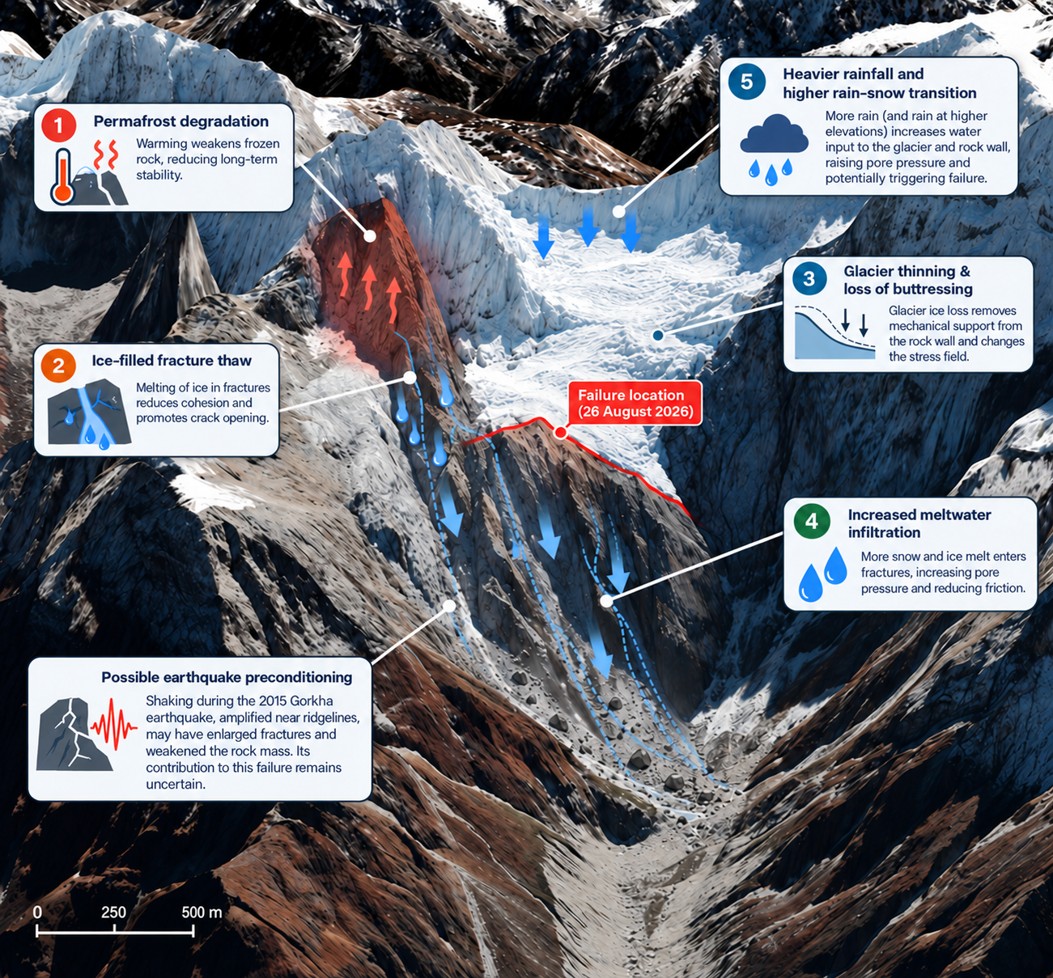
Rather than a single extreme weather event, scientists found that the disaster happened as a compound crisis. Decades of atmospheric warming - caused primarily by the burning of fossil fuels - have melted the glacier and pushed the freezing threshold line (0°C isotherm) upward by around 100 metres of altitude per decade. This has resulted in glacier recession and thawing occurring in permafrost within rock fractures that historically hold high mountain walls together, rendering them unstable. A massive 2015 earthquake is likely to have also further preconditioned the slope for collapse.
The key findings of the study were:
- Glacier thinning: Warming has driven substantial glacier recession, removing stabilising ice from around the failure site, and contributing meltwater.
- Permafrost thaw: Relentless warming has lifted the altitude of the freezing threshold on the high Himalaya, exposing ice and permafrost deep in the bedrock to thaw temperatures and weakening mountain slopes.
- Compound preconditioning: Although its specific contribution to this disaster cannot yet be confirmed, a massive 7.8 magnitude earthquake in 2015 may have further contributed to the slope failure alongside the geological and climatic factors.
- Warm temperatures and increased melt water: July and August 2026 - directly before the collapse - were the warmest on record locally. High snowfall in October and November 2025 added large amounts of melt water in the months preceding collapse.
- Attribution analysis: Climate change has caused about 1.5°C of warming in the collapse region during July and August. Annually, climate change has pushed up temperatures by about 2°C to date.
- Adaptation limits exceeded: While Nepal has early warning systems and disaster roadmaps, the scale of this tragedy exceeded physical adaptation limits, highlighting the difficulty in adapting to worsening disasters and risk for greater loss and damage.
- Future warnings: Glaciers and high altitude permafrost respond over decades to temperature rises. As such, past warming has already locked in future destabilisation increasing the urgency of fossil fuel phase outs to prevent future catastrophic collapses.
Professor Bethan Davies, Chair in Glaciology, Newcastle University, said: “Climate warming, clearly attributed to humans burning fossil fuels, is melting ice and snow in the Himalayas, decreasing glacier coverage and thawing permafrost, destabilising the mountain sides and leading to an increase in these kinds of disasters. Urgent action is needed in order to avoid even faster melt and an increased risk of future disasters.”
Changing high mountain environment
The study was produced by World Weather Attribution, who brought together an international team of scientists with a range of expertise in analysing the various factors that may have played a role in the rock and ice collapse. This paper is a synthesis of all those factors and how much - if at all - climate change is influencing them. In addition, the team carried out an attribution analysis using established peer-reviewed methods to look at the role of climate change in raising the July and August temperatures that preceded this collapse as well as precipitation in the region.
Dr Ben Clarke, Extreme Weather and Climate Change Researcher, Imperial College London, said: “This disaster was not an extreme weather event, but the fingerprints of climate change are still clear to see in long-term changes. While this is a complex event, our analysis brings together scientists with a diverse range of expertise to set out the factors that likely contributed to this catastrophe.
“We found that climate change is transforming the high mountain environment influencing many of the possible drivers of this collapse. This increases the risk in a region that is already exposed to high seismic activity.”
Professor Walter Immerzeel, Mountain Hydrologist, Utrecht University, said: “We are witnessing fundamental, irreversible shifts in Himalayan mountain environments. Climate change from the burning of fossil fuels is pushing the freezing line - the zero-degree isotherm - upward by roughly 100 metres per decade, exposing perennially frozen ground and bedrock to thaw conditions that are longer and warmer than before.
“When you combine high-elevation permafrost degradation with glacier retreat and record summer heat, the structural integrity of these mountain walls is compromised. The catastrophic impacts of what can then happen are clear for all to see.”
Madhab Uprety, Senior Technical Advisor and Asia-Pacific Focal Point, Red Cross Red Crescent Climate Centre, said: “The tragic loss of more than 1,300 lives and many thousands more missing is a devastating reminder that we are already hitting the limits of climate adaptation. To prevent future disasters from turning into human catastrophes, we need transformative action on every front. Aggressive global emissions cuts to slow warming, and real international support to address the unavoidable losses and damages faced by vulnerable frontline communities.
“In addition to the human tragedy on an unimaginable scale, the cost of recovery for this disaster is substantial. For a nation that’s done virtually nothing to contribute to this problem, it underlines the need to find fairness in helping climate vulnerable nations cope with the problems they have not unleashed.”
Manjeet Dhakal, Director of Climate Analytics South Asia, said: “The Bhote Koshi catastrophe is a stark warning of the growing risks people are facing with the rapidly warming Himalaya. Scientific evidence is clear that rising temperatures are transforming glaciers, snow, permafrost and the wider mountain environment, creating increasingly complex and cascading hazards.
“The magnitude of this disaster is testing Nepal’s response capacities and the limits of adaptation. Every fraction of a degree of warming matters. Science must now drive urgency: deeper and faster global emission reductions, greater investment in understanding complex mountain risks, strengthened monitoring and early warning, climate-resilient development, and international climate finance support at the scale and speed that frontline countries like Nepal need".
Professor Friederike Otto, Professor of Climate Science, Imperial College London, said: “This report isn't a traditional World Weather Attribution study because we aren't looking at a single extreme weather event but a multi-stage mountain disaster with many factors influencing causality. Yet the climate justice reality is as sharp as ever. Communities in Nepal are paying with their lives for a crisis driven by fossil fuel emissions thousands of miles away.
“When warming destabilises the roof of the world, no amount of local adaptation can fully shield vulnerable people downstream from this scale of destruction. Without much faster action to transition to zero fossil fuel emissions we will inevitably see more disasters of this scale occurring in the years to come.”
Pictured above - Climate-sensitive and other key preconditioning processes potentially contributing to failure. Conceptual representation of the main mechanisms through which climate variability and climate change may have influenced the stability of the Rasuwa rock wall in addition to earthquake preconditioning. Credit: Professor Walter Immerzeel, Utrecht University
Press release adapted with thanks to World Weather Attribution