Microsystems
We are building on Newcastle's heritage of cutting-edge microelectronics research. We work at the leading edge of all aspects of microsystems.
We work at the leading edge of all aspects of microsystems.
Microsystems technology is an important basis for many real-world electronic systems. It permeates many aspects of our lives, such as mobile phones, medical devices and the Internet of Things.
We expect such systems to be ever more capable, energy-efficient and autonomous. This means exploring new architectures and applications. Many systems provide simple signal analysis.
Our research will help them to migrate to full artificial intelligence and machine learning. Also, increased capability cannot come at the cost of reduced battery life.
There is a significant impetus for investigation into new hardware design methods. We also need to train a new generation of engineers who can implement them.
Our research interests
Fundamental architecture
We design and develop core circuits, algorithms, and microsystems with low to zero energy footprints.
We are developing new mathematical and computational models and paradigms. We are re-evaluating fundamental physics. We explore the challenges of fabrication processes.
System implementations
We perform implementation of microelectronics into physical CMOS chips. We design embedded systems using microcontroller units and programmable logic devices such as FPGAs. We are able to utilise these in the medical and artificial intelligence domains.
Community engagement
We have strong links with the electronics industry, as well as academic colleagues across the UK and internationally. These links are crucial. They create an industrial-academic ecosystem for promulgating our research outputs.
Training the next generation
We provide exciting research projects for undergraduate students studying electronic and computer engineering.
Our MSc programmes provide training in embedded systems, microelectronics and autonomous systems. We recruit and train PhD students in various disciplines fitting within our broad objectives.
Our research
We have built our international renown over several decades. We are the world leader in asynchronous and low-power circuits and systems.
We have a proud history of serving the electronics community. Our expertise spans circuits and design methodologies through to fully functional systems. We perform world-leading research while training the next generation of engineers.
We are renowned for promoting industrial adoption of formal design and verification methods. In recent years, we have expanded into four domains:
- power-modulated computing
- artificial intelligence
- biomedical electronics
- design productivity
List of our current research projects
Asynchronous design methods and tools
Semiconductor scaling continues, with an increasing degree of integration. At the same time, there are increasing limitations on and unpredictability of power and energy.
Thus, computation systems need more and more timing flexibility and heterogeneity. This is the case even within individual chips.
The Microsystems group has a long history of successful research. Our research ranges from theoretical methods to practical implementation. We investigate all aspects of system timing and asynchrony. Our research continues with projects in:
- synchronisation
- SoCs and NoCs
- GALS
- asynchronous systems
- designing systems for survival
Energy and power sources are often unreliable and unpredictable. This is especially so for embedded systems using harvested energy.
How to best deliver energy to computation units and how the units can best make use of this energy become critical research problems.
Many of our current projects focus on answering these questions by:
- increasing the system survival zone
- creating methods for near-threshold computing system design
- enhancing the variation tolerance of circuits
- developing efficient on-chip power delivery and conditioning including control and sensing techniques
Embedded genomics and Big Data
Whole genome sequencing (WGS) is a Big Data application. It is used by a variety of applications in sectors that include:
- healthcare
- agriculture
- pharmaceutical
Current computational WGS has major limitations. These can inhibit their widespread usage. They include low throughput and very high energy consumption.
We are designing new hardware/software co-design methods for empowering low-cost embedded genomics.
We work with genomics researchers at Newcastle University. We are also designing algorithms and runtime systems to exploit computation and memory resources. At the same time, they also maintain low energy footprints.
Energy-driven computing and power-compute co-design
ICT systems are more and more bound in their capabilities and operations by the energy available to them.
Energy driven computing is a new paradigm which states that computation should be a result of energy supply (computing on energy). We are one of the initiators of this paradigm.
Modelling and design methodologies for extremely low power
The Microsystems group works closely with to the School of Computing. We continue to carry out research on the edge between computer science and electronic engineering.
We are currently engaged in research on powerful modelling methods. These support the design of computation units for use in environments where power and energy supplies are uncertain.
Andrey Mokhov is leading the research.
Neuro-silicon interfaces
Computing and electronics could generate considerable new ways of helping society. A crucial technological area is the potential use of computing in real-time health monitoring and care. An exciting aspect is the interfacing of silicon-based computation devices with biological neurons.
Power, performance and reliability interplay in many-core systems
Power and energy availability affects system performance and survivability. It also impacts system reliability. There is a complex, but poorly understood, interplay between:
- power supply (related to voltage)
- system computation throughput
- reliability
- how fast the circuits age and degrade
The Microsystems group is applying its considerable expertise in related areas to new research, which aims to:
improve the understanding of these complex relationships
develop methods to improve system designs based on such discoveries
Pervasive AI and learning automata
Electronic applications enabling pervasive artificial intelligence (AI) have unique and conflicting challenges. These include extreme energy efficiency, accuracy and continuous learning. We are developing a new generation of AI hardware architecture to address these challenges.
We have built our architecture on the principle of learning automata. Mikhail Tsetlin proposed the theory of learning automata in the 1960s. It has long been a basis for non-linear control systems. It allows for formulation of machine learning using propositional logic and game theory.
We are working with our collaborators at the University of Agder, Norway, led by Professor Ole-Christoffer Granmo. Together, we are enabling powerful new AI applications through our hardware innovations.
System design for optogenetic retinal prosthesis
The Microsystems group includes the neuroprosthesis lab. Its primary interest is in developing neural stimulators and state of the art implantable systems. The new field of optogenetic neuroprosthesis uses this technology.
Our research in this area will generate new understanding in core neurobiology. We are using neuro-inspired designs to make better circuits and systems.
Telemetry for neuroscience research
The Microsystems group and the Institute of Neuroscience work together. They are providing an enabling technology to support neuroscientists. This technology will help them in their research into how the brain works.
In the long term, this research will lead to improved treatment of nervous system injuries such as strokes and spinal cord injuries.
We are developing a radio telemetry system to transmit multiple muscle or nerve signals from a device implanted within the body. Radio frequency induction provides the power from an external coil placed over the skin. This avoids the need for battery replacement.
Interdisciplinary research
We apply our expertise in electronics, algorithms and mathematical models to other fields. These include medicine, life sciences, manufacturing and business:
- cyber-physical systems
- implantable electronics
- power-efficient genome computing
- distributed computing for drug discovery
- dynamic dependency graphs for software build systems
- asynchronous circuit design to build high performance computing hardware for supporting financial transactions
- use of petri nets for business process modelling and mining
Research themes
Human health
Several of our larger projects are focussed on improving human health.
One activity in this area is our work on whole genome sequencing (WGS). This is a Big Data application used in the healthcare, agriculture and pharmaceutical sectors. Currently, computational WGS has some limitations which we are seeking to solve. We are creating new hardware/software co-design methods to resolve issues such as low throughput and high energy consumption.
Another project which contributes to bettering human health is our neuro-silicon interface research. This new area of computing technology can potentially be used in real-time health monitoring and care.
Another area where our research is improving human health is in biomedical electronics. We are developing advanced electronic processing architectures for devices such as pacemakers and visual prostheses.
Impact
Our research makes an impact in both academia and industry.
Success stories
Research Excellence Framework (REF) 2014
Our group was commended by the REF panel as producing best research outputs. We contributed to one of the best University Research Impact case studies: Powering Industry with Causality Modelling.
Student awards
Our students take part in and win design awards from national and international competitions. These are hosted by professional institutions, such as IEEE, IET and ACM, and by industry.
The Microsystems team of PhD students won the Xilinx Open Hardware 2018 award with FANTASI (FAst NeTwork Analysis in SIlicon)
Tousif Sheikh Rahman won an IET Final Year Student Project Competition in 2019 with his presentation 'Implementation of whole genome sequencing algorithms'.
Best paper awards
Our researchers regularly present at prestigious conferences around the world.
List of our awards
IET Computers & Digital Techniques Premium Award
Dahir N, Mak T, Al-Dujaily R, Missailidis P, Yakovlev A. Highly adaptive and deadlock-free routing for three-dimensional networks-on-chip. In: IET Computers & Digital Techniques 2013, 7(6) 255-263
Graeme M. Bragg, Charles Leech , Domenico Balsamo , James J. Davis , Eduardo Wachter , Geoff V. Merrett , George A. Constantinides and Bashir M. Al-Hashimi. An Application- and Platform-agnostic Control and Monitoring Framework for Multicore Systems. 3rd International Conference on Pervasive and Embedded Computing, Porto Portugal, 29-31 July 2018. Best Paper Award.
Abeyrathna, K. Darshana, Ole-Christoffer Granmo, Rishad Shafik, Alex Yakovlev, Adrian Wheeldon, Jie Lei, and Morten Goodwin. “A Novel Multi-step Finite-State Automaton for Arbitrarily Deterministic Tsetlin Machine Learning.” In International Conference on Innovative Techniques and applications of Artificial Intelligence, pp. 108-122, Springer, 2020. Best Paper Award.
Jie Lei, Adrian Wheeldon, Rishad Shafik, Alex Yakovlev and Ole-Christoffer Granmo, From Arithmetic to Logic Based AI: a Comparative Analysis of Neural Networks and Tsetlin Machine, 27th IEEE International Conference on Electronics Circuits and Systems, 2020. Best Poster Award.
PhD opportunities
We produce high quality graduates who go on to forge successful careers across the world, in many fields.
We have a successful history of producing high quality PhD graduates.
We tackle the challenges of evolving pervasive applications such as:
- Internet of Things
- autonomous devices
- bio-implantable microsystems
Our expertise covers fundamental and applied research in complex microsystems engineering. It includes:
- circuits, architectures, algorithms, and systems
- design automation tools
- designing systems with low to zero energy footprints
- converting energy to computation
- communication with maximum energy utilisation in a wide band of operating conditions
Enabling success in your future career
We produce high-quality PhD graduates. Most go on to successful academic and industrial careers, in the UK, Europe, Asia and the Americas.
The area of Microsystems is experiencing continuous worldwide growth. The skills involved in obtaining a PhD degree in this rapidly growing area is extremely useful. This is the case not only for people who intend to follow a career within microelectronics, but also elsewhere.
Our PhD graduates hold senior positions in diverse fields, from computing science to rail transport systems.
PhD students at Newcastle University
You will make contributions to and attend high-quality international conferences. You will collaborate with colleagues and external experts. You will publish papers in recognised research journals.
The group has a highly connected environment and friendly atmosphere. Students on different projects work with one another:
- formally through our regular seminars, such as the ASL series, which is co-hosted with the School of Computing
- informally through daily contacts in the office and recreation spaces around the School
Our students include mathematicians, programmers, circuit designers, biologists, and others from diverse backgrounds.
Available PhDs
We regularly provide financial support to our PhD students on a case-by-case basis. There are opportunities to work within our current research projects with external funding.
Contact the Microsystems leader, Professor Alex Yakovlev, or Dr Patrick Degenaar, for further details.
We are seeking to recruit PhD candidates in the following areas:
- energy and power in computing
- asynchronous circuits and systems
- on-chip fine-grain control
- on-chip parametric sensing
- survivability
- variability-driven security
- biomedical electronics
- neural implants
- eligibility criteria
Summer internships and placements
Each summer, we take on around three interns to gain laboratory experience and skills. Typically, they are in the second year of their Engineering/Physics degree.
In exceptional circumstances, we recruit from other backgrounds and disciplines.
We must receive applications for interns by the end of January each year, for all research-led academics.
Teaching
Taught programmes
Our Electrical and Electronic Engineering undergraduate programmes give students a path to become a professional engineer addressing major global challenges.
Our Electrical and Electronic Engineering postgraduate taught (MSc) programmes equip students with the advanced skills and expertise to help shape the world.
Industrial lectures
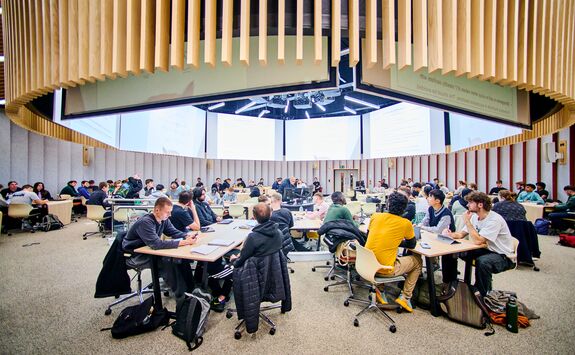
Technology in electronic microsystems is fast evolving, so industrial alignment is crucial for our teaching and research.
We regularly invite renowned technological experts from industry to deliver lectures. These lectures complement our academic curricula with industrial relevance.
List of collaborators
- Southampton (Profs Bashir Al-Hashimi, Geoff Merrett and Andrew Brown)
- Manchester (Prof Steve Furber)
- Imperial (Profs Peter Cheung and George Constantinides)
- Cambridge (Prof Simon Moore)
- Bristol (Profs Bernard Stark and Kerstin Eder, Dr Dinesh Pamunuwa)
- UPC Barcelona (Profs Jordi Cortadella and Josep Carmona)
- Politecnico di Torino (Prof Luciano Lavagno)
- TU Vienna (Prof Andreas Steininger)
- IHP Frankfurt on Oder (Dr Milos Krstic)
- TU Denmark (Prof Jens Sparsoe)
- TU Trondheim (Prof Snorre Aunet)
- Fern Universitaet Hagen (Prof Joerg Desel)
- Augsburg (Prof Walter Vogler)
- CEA-LETI (Dr Pascal Vivet)
- TNPG Grenoble (Prof Laurent Fesquet)
- USC Los Angeles (Prof Peter Beerel)
- Columbia University (Prof Steve Nowick)
- University of Utah (Profs Chris Myers, Ken Stevens and Erik Brunvand)