Published: 16 March 2018
School in the Cloud film to premiere at prestigious festival
A documentary which charts Professor Sugata Mitra’s efforts to establish his School in the Cloud in India and the UK will be given its world premiere.
Big questions
School in the Cloud, directed by award-winning director Jerry Rothwell, will be shown for the first time at the CPH:DOX festival in Copenhagen. It has also been shortlisted for the festival's Politiken Audience Award, which has a prize of 50,000 Danish Krone.
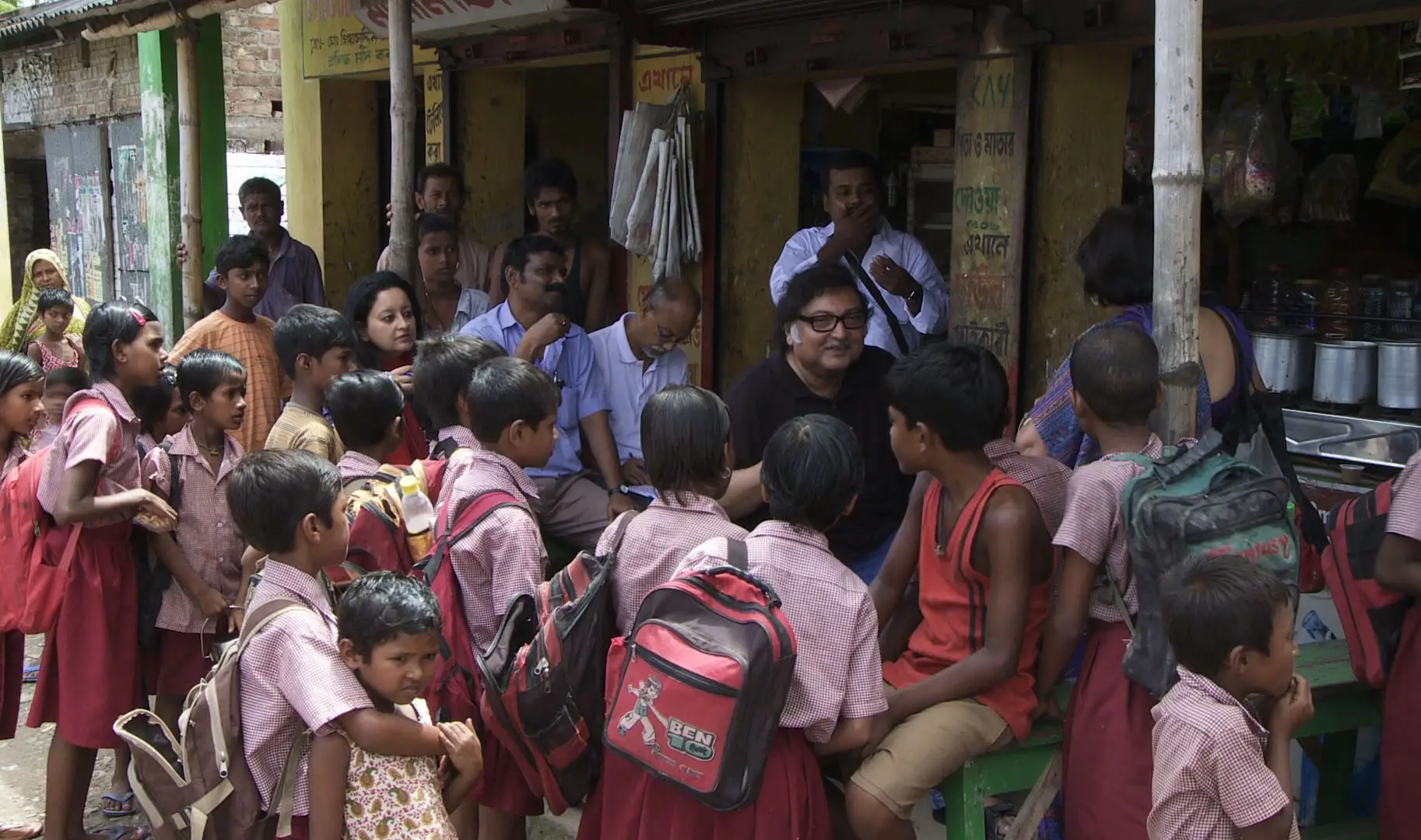
Filmed over three years in the UK and India, it follows Sugata, Professor in Educational Technology, at Newcastle University, after winning the $1m Ted prize in 2013. In particular, it focuses on the ‘school in the swamp’ in remote Korakati, in the Sunderbans of Bengal; and George Stephenson High School, in Killingworth, North Tyneside, where the first School in the Cloud lab opened.
The School in the Cloud asks youngsters big, child-focused questions. Working in groups, they find their own answers using the Internet, supported by educators of all kinds – from Skype Grannies to parents and educators - who give them the freedom to explore their curiosity.
Jerry’s film is factual, concise and emotive at the same time. It is a story of hope and I am lucky to be a part of it.
Thinking diffferently
“The thing which kept striking me during filming was that although there’s a huge difference between the schools in the two countries, they both offer children something fundamentally new” says Jerry, who worked with Indian filmmaker, Ranu Ghosh.
“In the UK children use technology every day but using the computer in groups to research a big question got them talking and thinking critically about the information they found. In Korakati, where children had never seen a computer, the lack of experience wasn’t a barrier. They quickly became confident to follow their interests, ranging from information about chemistry to online DJing.”
Jerry also found working with Professor Mitra inspiring. “I think his strength is that he didn’t come from an education background originally,” he said. “And that’s allowed him to think differently about education, what we need it for, how we access it, how it might develop in the future.”
A story of hope
Professor Mitra enjoyed the filmmaking experience. “I had no idea what the finished film would look like, and was a bit apprehensive,” he says. “But when I saw the final draft, I was very impressed. Jerry’s film is factual, concise and emotive at the same time. It is a story of hope and I am lucky to be a part of it.”
But while he was the brains behind the School in the Cloud project, Professor Mitra is under no illusions who the stars of the film are – the children. “In a village called Chandrakona, the children had just discovered the Internet,” he says. “Jerry started to creep up. 'Jerry, stay back, stay back', I muttered. One of the children turned around and said loudly, 'STAY BACK' and then grinned at me and said in Bengali, 'Does that mean don't disturb us in English?”
The film premieres in the Bremen Teatre on Tuesday, 20 March, and Jerry and Sugata will be taking part in a question and answer session afterwards.
School in the Cloud was produced by Met Films and partly funded by the Sundance Institute in association with TED.
School in the Cloud will go on cinematic release in the UK later this year.