Published: 8 January 2020
Medical students team up to support their local NHS emergency services
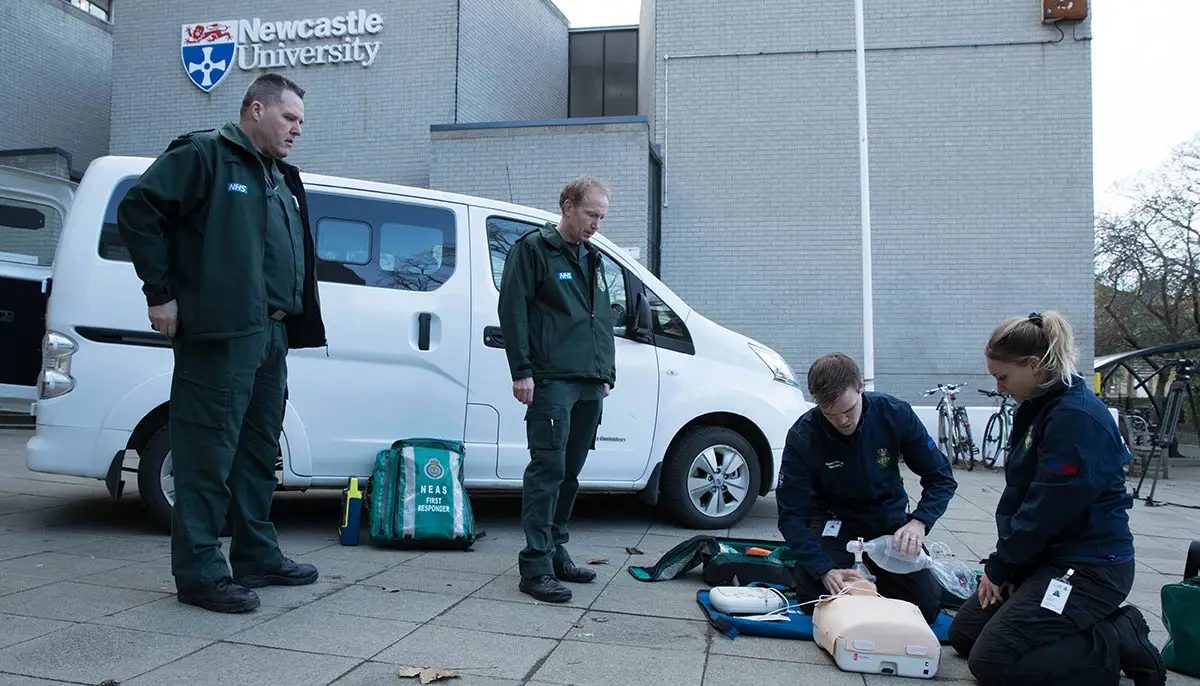
Newcastle University medical students are putting their skills to use early by volunteering their time for North East Ambulance Service to respond to patients dialling 999 in the Newcastle area.
The new scheme launched in January, between North East Ambulance Service (NEAS), Newcastle University and Newcastle University Students’ Union (NUSU), to provide lifesaving support to people in an emergency.
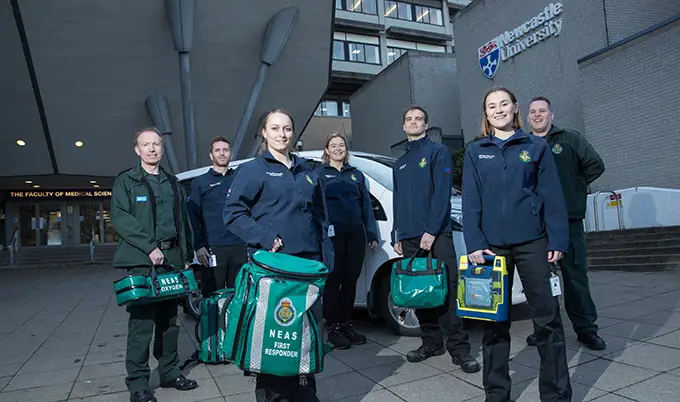
The Newcastle University first responder initiative sees medical students provide a uniformed service dispatched by the NHS Trust. Pairs of students volunteer their time across shifts throughout the week.
All students are training to be doctors and were inspired to develop their skills and put their training into practice at real emergencies.
Following a competitive written application and interview process, 25 successful recruits underwent a dedicated training programme provided by NEAS over the course of two months. They also received training from medical specialists, including cardiologists and trauma paramedics.
The initiative allows medical students to support the ambulance service in the local community by responding to immediate life threatening emergencies to patients. It also enables them to play an active role in supporting the NHS, which is providing their medical training.
Newcastle University Medical School is providing the first ever University First Responder service in our region, which will no doubt help in the quest to save even more lives
Supporting the local community
Newcastle University student lead, Ollie Kirby said: “I used to work for London Ambulance Service before moving to Newcastle to study medicine, which is why I was motivated to work with the North East Ambulance Service to set the initiative up. It’s taken a lot of hard work from NEAS, the University and the Student Union, but everyone has been very supportive and it’s a truly collaborative project.
“Fundraising will take place over the coming year to secure a dedicated service vehicle which would allow for more students to be recruited, more shifts to be staffed and more 999 calls to be attended.”
NUSU was first approached by student lead volunteer, Ollie Kirby, in early 2018, and have provided support in the recruitment of students; health and safety; uniforms and the use of their electric vehicle for shifts.
Katie Blundell, NUSU’s Volunteer Development and Employability Manager said: “From our first meeting with Ollie we knew this was an amazing project to be involved with and support the development of. Throughout, I have been impressed by the desire of the student volunteers to support their NHS colleagues, and to express their gratitude to the general public who are instrumental in their medical training, by providing this service to the local community.”
"Every second counts"
Volunteer community first responders are an integral part of patient care within NEAS. They are volunteers, trained and dispatched by NEAS to deal with emergencies prior to the arrival of an ambulance. They are dispatched at the same time as an ambulance but may arrive first as they are nearer, and can provide early interventions in those crucial first minutes of an emergency. They will deal with a specific list of emergencies, providing care and support to both the patient and their family.
Clinical Operations Manager Gareth Campbell said: “The service launched operationally in January, in time to assist with the increasing number of calls due to winter pressures on the NHS.
“Every second counts in the event of a life-threatening emergency. NEAS has a number of Community First Responders operating across our region on a daily basis, providing an initial response and care whilst an ambulance is travelling to scene. Newcastle University Medical School is providing the first ever University First Responder service in our region, which will no doubt help in the quest to save even more lives.”