Waste Not
The artificial nose helping sniff out food waste
Published on: 29 April 2026
An ‘artificial nose’ developed at Newcastle University could help detect when milk or chicken is about to go off, enabling households to decide if food is still safe and reduce waste.
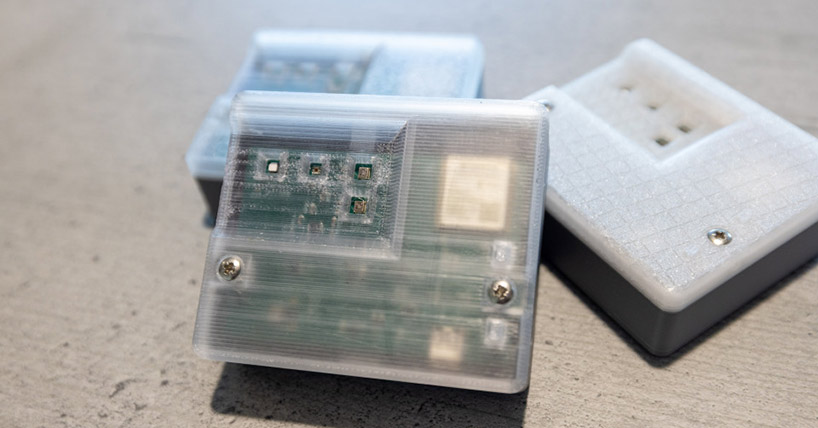
Designed for use in domestic and commercial fridges, the sensor unit uses AI to assess freshness, which could assist families and businesses to cut waste, save money, and lower their carbon footprint.
Led by Dr Oktay Cetinkaya, Lecturer in Sensor Systems at Newcastle University, the Waste-Not! project is built around a unit with low-power, low-cost sensors that detects odours and gases associated with food degradation. It has been checked and validated across a range of food types, including fruit, vegetables, meat, and dairy.
The system integrates with a mobile app to provide recipe suggestions and encourage community food sharing.
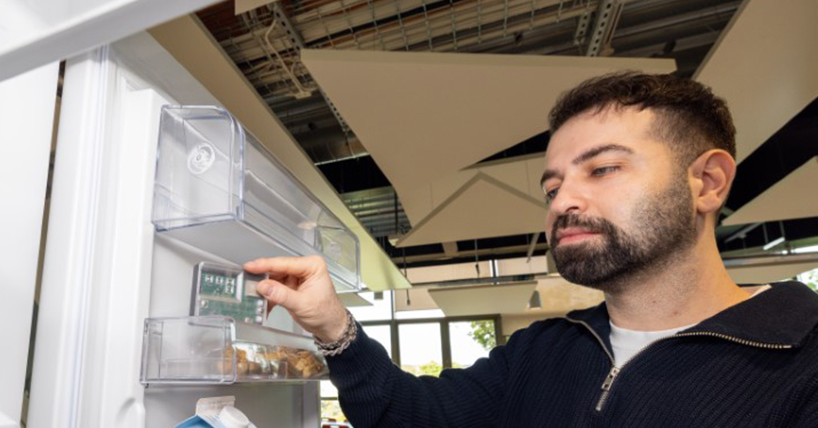
Keeping track of food freshness in the fridge
Waste-Not! – in effect an artificial nose – combines sensors for gas, light, temperature, and humidity within a single module. Data from these sensors are processed using lightweight machine learning models trained on both laboratory and real-world datasets covering multiple food categories.
The models track spoilage indicators alongside contextual data such as fridge door activity, including opening frequency and duration. These signals are further combined with information from barcode scanning and image processing, such as expiry dates. The resulting outputs are delivered via the mobile app, translating technical measurements into clear, actionable insights for users.
Dr Cetinkaya said: “The system functions as an ‘artificial nose’ by combining multiple sensor signals to detect early signs of spoilage, including odours that can’t be seen.”
“The key advantage of the Waste-Not! app is its ability to fuse low-cost sensor data into an objective measure of freshness. This supports more informed decisions, improving both safety and effectiveness. In contrast, existing approaches rely heavily on expiry dates, user judgement, or passive sensors that provide only limited air-quality information.”
Scaling up
Newcastle University students are contributing to the project through analysing and testing the data and developing the app. Following successful laboratory trials, Waste-Not! has been tested in real-world settings, including households, food banks, cafes, and local takeaways. The studies are ongoing for the development of more accurate AI models and improving the guidance for users.
For the next stage, the team aims to work with regional partners to link surplus food sources with communities by recruiting bike couriers into the app through micro-incentives and is looking for funding to take this forward. This will enable tracking of collections, quantities shared, and associated carbon savings. The rollout targets are a 15-20% cut in avoidable household food waste across participating sites.
Dr Cetinkaya added: “By linking behavioural insights with measured reductions in waste, emissions, and how frequently food is being thrown away, the project will generate one of the most comprehensive regional datasets to inform future waste-reduction policies and community food initiatives.”
Dr Cetinkaya, who received the “Newcomer of the Year Award” from the North East Recycling Forum for Waste-Not!, and was Highly Commended in the Hawley Award for Engineering Innovation, is also planning to extend the technology beyond fridges. He said: “We believe this odour-sensing technology can be adapted for early detection of mould in homes, addressing another critical issue in indoor environments.”
Read the blog article - Waste-Not!: the artificial nose that sniffs out food spoilage
Reference:
Aktas, Dilara, Beyza Ezgi Ortlek, Meltem Civas, Elham Baradari, A. B. Kilic, F. E. Bilgen, A. S. Okcu, M. Whitfield, O. Cetinkaya, and O. B. Akan. "Odor-based molecular communications: State-of-the-art, vision, challenges, and frontier directions, IEEE Communications Surveys & Tutorials, 2025.