
reversible glue electric
Reversible glue technology goes electric
Published on: 14 May 2026
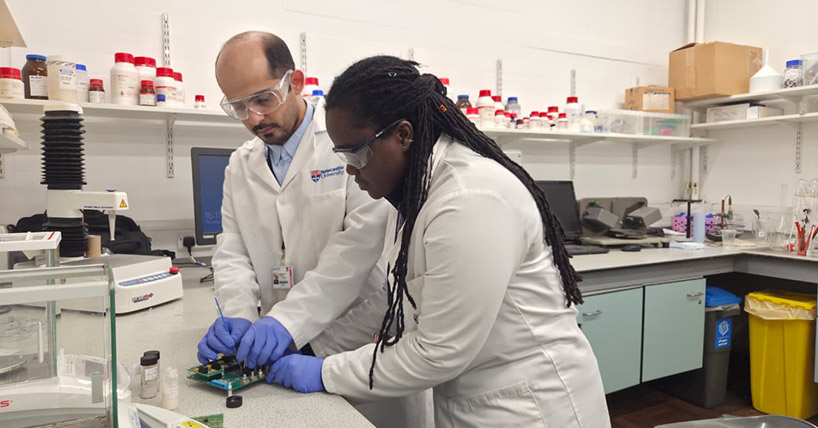
A collaboration between electrical and chemical engineers at Newcastle University is responsible for a reversible glue that can change how we recycle electronic waste.
The team has already demonstrated reversible adhesive technology with wide applicability in general packaging applications, but this new glue is electrically conductive. This means that it can join electronic components, just like solder does. Unlike solder, however, a simple wash with a green solvent like acetone, or using an alkaline solution, will allow the components to be separated for reuse or recycling.
This is a “one-pot” glue and is water-based, so it does not emit organic solvent vapours and does not require a hardener, unlike some glues. It is also as strong as other water-based glues. The glue is made in the same way as a paint, but silver particles are added rather than pigments, and this gives the formulation its electrical properties. Other conducting glues exist, and many of these also include silver for optimal conductivity, but none can easily be debonded.
Addressing the e-waste problem
Electronic waste (e-waste) is a massive problem with 62 billion kilos produced globally (similar to the weight of a million semi-detached houses), and less than a quarter of this is recycled. Much of this electronic waste contains critical minerals that are mined in only very few locations, some of which are politically unstable. The glue will help address the e-waste problem.
The glue is based on current industrial manufacturing processes – those for making a paint – and is developed from cheap materials so it can be scaled up easily. It is water-based and so it does not have the volatile organic solvents used in many commercial glues, but unlike other water-based adhesives, exposure to humid environments does not cause bond failure.
The glue works very well on metal surfaces, but it also sticks to other surfaces too, such as plastics and printed circuit boards.
Published in the journal, Advanced Electronic Materials, the work was funded by the Engineering and Physical Sciences Research Council (EPSRC) and the Royal Commission for Jubail and Yanbu of the Kingdom of Saudi Arabia, which provided a PhD scholarship for the first author of the paper, Bassam Aljohani.
Bassam, a PhD student at the School of Engineering, said: “Electrically conductive adhesives have been around for a long time, and making them reversible provides the solution to a very real problem that urgently needs addressing.”
Keeping costs down and the environment clean
The lead investigator on the project, Mark Geoghegan, who is Roland Cookson Professor of Engineering Materials, added: “One of the reasons that conducting glues are rarely used is because silver is expensive and toxic in the environment. Being reversible, our glue means that the silver can be recovered and reused, which is important to keep costs down and the environment clean.”
Professor Volker Pickert, who is Professor of Power Electronics and co-investigator on the project, pointed out: “Solder has the best conductivity, but the best formulations contain lead and now companies need to ask themselves whether the conductivity outweighs environmental considerations. In some cases, it will, but there is an opportunity here to revisit how we join electrical components.”
Dr Ama Asiedu-Asante, who is a researcher in Professor Pickert’s group and a co-author of the work said: “It's not just about solder. The electronics industry relies on permanent joining methods, including screws, which can make automated recycling more difficult. There is now increasing recognition that water-based formulations can support more sustainable electronics, and this work demonstrates how they can deliver both performance and reversibility.”
Dr Adriana Sierra-Romero, co-author of this publication, stated: "Alongside the article, the publication of our patent highlights the broader potential of this technology to enable more sustainable, repairable, and reusable electronic systems."
Professor Katarina Novakovic, co-author on the paper and a project co-investigator commented: “As international policy focus shifts away from sustainability, we remain committed to advancing critical solutions for the unsustainable use of resources.”
Newcastle University is ranked 22nd in the UK and 64th in the world for sustainability in the QS World Rankings: Sustainability 2026.
Find out more about studying Chemical Engineering at Newcastle University.
Find out more about studying Electrical Engineering at Newcastle University.
Reference:
A.Aljohani, A. B.Asiedu-Asante, A.Sierra-Romero, K.Novakovic, V.Pickert, and M.Geoghegan, “An Electrically Conducting Water-based Reversible Adhesive.” Advanced Electronic Materials (2026): e00617. https://doi.org/10.1002/aelm.202500617