
Royal Society Fellowship Hayley Fowler
World-leading climate expert recognised with Royal Society Fellowship
Published on: 27 May 2026
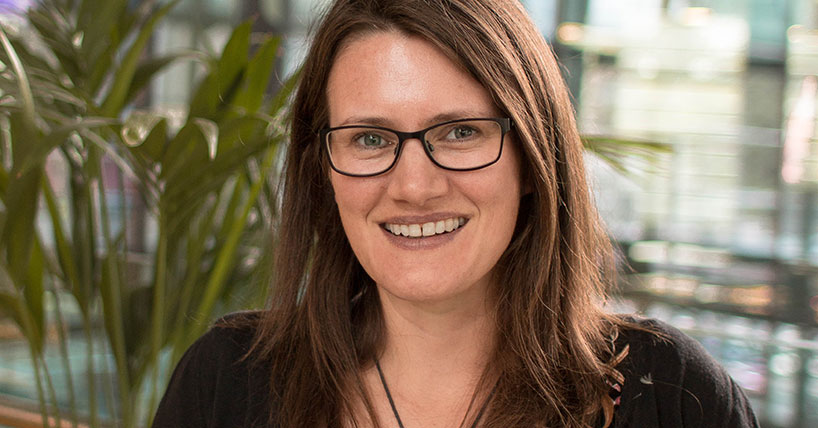
Professor Hayley Fowler has been elected a Fellow of the Royal Society in recognition of her pioneering work on climate change impacts.
She joins over 90 outstanding researchers from across the world who have been elected this year to the Fellowship of the Royal Society, the UK’s national academy of sciences.
Hayley Fowler FRS is Professor of Climate Change Impacts in the School of Engineering and a Director of the Centre for Climate and Environmental Resilience. Her research advances understanding of changing weather and precipitation extremes and their impacts on flood and drought risks, including developing high-resolution climate projections to inform adaptation strategies. She has been instrumental in the development of new downscaling techniques to bridge the gap between modellers and users of climate information, and is passionate about the need for the public to know more about the ongoing climate crisis.
Professor Fowler is a Fellow of the American Geophysical Union and was a Royal Society Wolfson Research Fellow for her work on understanding climate change impacts on hydrological systems, extreme rainfall and flooding, following a Philip Leverhulme Prize and a NERC Postdoctoral Fellowship. She is also member of the UK’s Climate Change Committee.
Last year, Professor Fowler was awarded a Royal Society Faraday Discovery Fellowship to tackle extreme weather risks. She was among the seven researchers who were announced as the first recipients of the Royal Society Faraday Discovery Fellowships, prestigious long-term awards to support exceptional mid-career research leaders in the UK.
She said: “I am deeply honoured to be elected a Fellow of the Royal Society, particularly as a woman in science as we are still significantly under-represented among the membership. Of course, this great honour could not have been achieved without the brilliant young scientists and engineers in my research group, and my former postdocs and PhD students, and many collaborators around the world. Together, we will keep on striving to improve forecasts of extreme weather and information for climate adaptation so we can save lives and livelihoods in our rapidly warming climate.”
Professor Chris Day, Vice-Chancellor and President, Newcastle University, said: “Professor Hayley Fowler’s election as a Fellow of the Royal Society is a richly deserved recognition of her world-leading contribution to climate science. Her pioneering research into extreme weather, flooding and climate resilience, is helping us to better understand and tackle of some of the most urgent challenges facing communities around the world. Her work showcases the global impact Newcastle University’s research, and we are incredibly proud of her outstanding achievement.”
Global pioneers
This year’s cohort includes pioneers and leaders across a range of scientific fields, from astronomy and cancer research to mathematics and biotechnology.
Sir Paul Nurse, President of the Royal Society, said: “I am delighted to welcome this newest group of exceptional scientists to the Fellowship of the Royal Society.
“Their contributions reflect the highest standards of scientific endeavour. Whether advancing our understanding of vaccines or exploring the transformative potential of mathematics and computation, their work exemplifies the enduring value of curiosity, creativity and rigorous inquiry.
“Our Fellowship is strengthened not only by individual distinction, but by the diversity of perspectives and experiences its members bring. This incoming cohort highlights the truly international character of contemporary science and underscores the vital role that plays in achieving breakthroughs that benefit us all.”
The Fellows and Foreign Members join the ranks of Stephen Hawking, Isaac Newton, Charles Darwin, Albert Einstein, Lise Meitner, Subrahmanyan Chandrasekhar and Dorothy Hodgkin.
Press release adapted with thanks from the Royal Society. Read the original press release.