1976 heatwave
The UK is forecast to reach 45°C by 2056
Published on: 24 June 2026
More extreme heatwaves than 1976 are expected over the next two decades, changing British life significantly.
Britain could reach peak temperatures of 45°C by 2056, with more extreme heatwaves than 1976 expected to significantly change life in the UK over the coming decades. This was announced by Newcastle University, the University of Reading, the Met Office, the Royal Meteorological Society, the Centre for Ecology and Hydrology and the Climate+ Co-Centre, in partnership, on the 50th anniversary of the 1976 Heatwave.
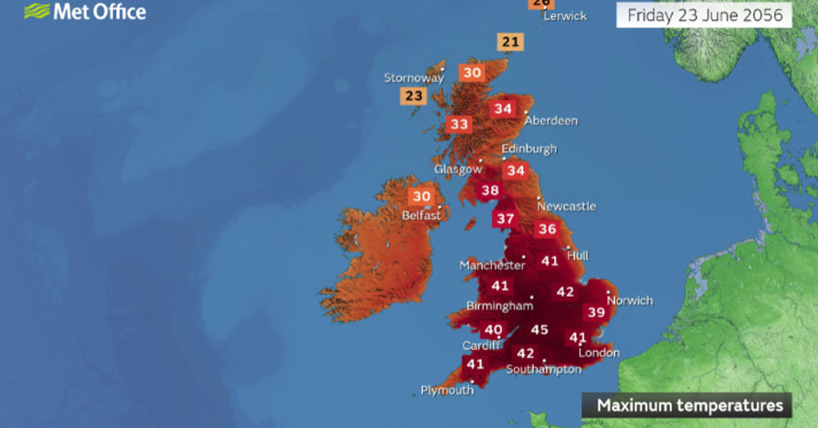
A plausible scenario for 23rd June 2056 produced by the Met Office shows peak temperatures of 45℃ in England, 38℃ in Scotland, 41℃ in Wales and 30℃ in Belfast. This 14-day heatwave event sees the UK sustain temperatures of over 40℃ for nine consecutive days and is only plausible because of high greenhouse gas emissions, the majority of which come from burning fossil fuels.
Weather presenters and meteorologists Laura Tobin, Peter Gibbs and Clare Nasir presented the 2056 forecast at an event at The Lightroom, King's Cross, London, marking the 50th anniversary of the 1976 heatwave, whose 15-day peak began on 23 June.
The 1976 heatwave peaked on 3 July with a temperature of 35.9°C, and it remains one of the most iconic weather events in UK history. It is embedded in the national memory through images of crowded beaches, parched lawns and standpipes in the streets as water supplies ran short, forcing people in many regions to rely on standpipes.
The heatwave of 1976
Professor Hayley Fowler FRS, Professor of Climate Change Impacts, Newcastle University, said: “As a climate scientist who has worked on changes to extreme weather events for 25 years, I hoped we wouldn't ever need to explain this devastating story to the public. During the heatwave of 1976, few remember the summer's failed harvests, rising food prices, extensive wildfires and the heat-related illness and death suffered by many. On the 50th anniversary of this iconic event, we are showing the public that these impacts will become part of normal life in the coming decades if we don’t rapidly reduce fossil fuel emissions and adapt our schools, homes, hospitals and workplaces to cope with the extreme heatwaves we face.”
Professor Liz Bentley, Chief Executive of the Royal Meteorological Society, said: “In the summer of 1976, I was an eight-year-old growing up in Yorkshire. Parts of the region had restrictions on water supplies, with no running water in our house and a standpipe in the road. I thought it was great fun queuing with my friends to fill up pots and pans and carry them home for my mum to use. Looking back, I wonder how she coped bringing up three young children, but at the time I was completely unaware of the wider drought crisis unfolding around us.
“What many people remember as a glorious summer also brought real hardship to communities across the country. Heatwaves will become more frequent and more severe over the coming decades. It will be mothers, children, older people and the most vulnerable who suffer most unless we act now to ensure our homes, communities and public services are prepared for a much hotter future.”
Clare Nasir, weather presenter and meteorologist said: "I remember the summer of 1976 and being told not to flush the loo every time to save water. My little brother took that advice to heart and never really grew out of the habit. It was funny then, but those memories feel very different today. As a weather presenter, talking about heatwaves isn't much fun anymore. Looking at the forecasts and the science, it's clear we're heading for more extreme heat unless we stop burning fossil fuels. The weather is giving us a warning - the question is whether we'll listen."
Adapted with thanks from The New Society.