Bhutan GLOF risk
Data suggests greater glacial flood risk faced by Bhutan
Published on: 30 June 2026
Researchers at Newcastle University have carried out the first comprehensive modelling of glacial lake outburst flood (GLOF) risk in Bhutan and identified previously unrecognised high-risk lakes.
Importantly, the research also identified communities living downstream that are at risk.
Published in Natural Hazards and Earth System Sciences, the team combined advanced flood modelling with analysis of downstream communities and infrastructure, linking individual glacial lakes to the people, buildings and transport networks that could potentially be affected by flooding.
This new approach combines both exposure and vulnerability to calculate risk - factors that have often been treated separately or only partially included in earlier assessments.
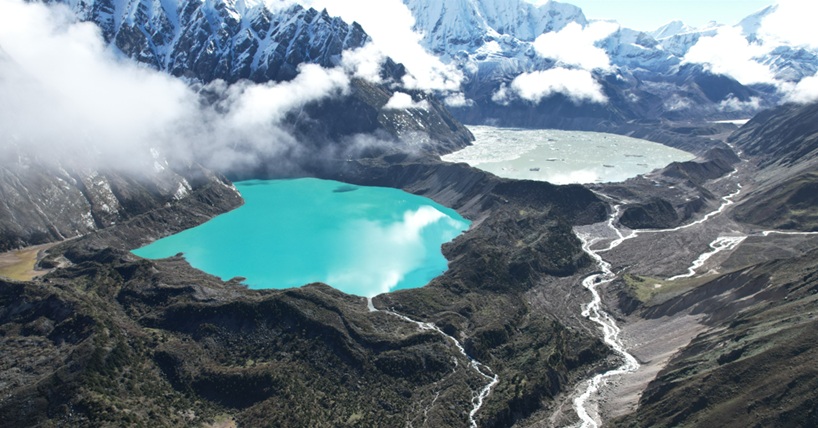
As the climate gets warmer, glaciers retreat and meltwater collects at the front of the glacier forming a lake. These lakes can suddenly burst and create a fast-flowing Glacial Lake Outburst Flood (GLOF) which can quickly spread over a large distance from the original site – up to 400 kilometres in some cases. GLOFs can be highly destructive and damage property, infrastructure, and agricultural land and can lead to significant loss of life.
The data revealed in this study indicated that more than 11,000 people, more than 2,500 buildings, more than 250 kilometres of road, approximately 20 km² of farmland and more than 400 bridges are located in areas that could be within the flood zone following a GLOF event.
The results offer a framework for enhancing existing GLOF risk reduction strategies and provide a more systematic basis for prioritising monitoring, mitigation and preparedness measures.
Lead researcher, Sonam Rinzin, a Doctoral student at Newcastle University, said: “By combining flood modelling with mapped infrastructure and population data, we have provided a more detailed picture of potential downstream impacts. Rather than focusing solely on the physical characteristics of lakes to determine the risk of a GLOF, our study demonstrates how integrating hydrodynamic modelling with socioeconomic data can provide a more robust basis for refining and prioritising preparedness planning.”
Data-driven insights into flood risk
Research from 2023 led by Newcastle University showed that High Mountain Asia, which includes Bhutan, and a wider area ranging from Kyrgyzstan to China, has the highest GLOF danger, with 9.3 million people potentially at risk.
As of 2021, there were 567 glacial lakes in Bhutan according to the inventory conducted by the National Centre for Hydrology and Meteorology. A previous study has also reported that Bhutan’s glacial lakes have increased by 17% since the 1960s.
The research team modelled hypothetical GLOF scenarios for 278 glacial lakes in Bhutan larger than 0.05 km² located within one kilometre of a glacier terminus. Using hydrodynamic simulations, they calculated how floodwaters would move through downstream valleys and interact with features such as settlements and farmland.
They then incorporated downstream exposure data into risk evaluations to classify the levels of hazard across these lakes, identifying one lake as “very high hazard”, five as “high hazard”, and 22 as “moderate hazard”.
Significantly, several lakes that were newly identified as high hazard had not been highlighted in earlier studies as being at high risk of GLOF impacts.
The findings also extend beyond lake-level assessments to consider administrative regions downstream. Five local government areas associated with very high GLOF risk were identified, and eight with high risk, with some of these not previously recognised in national assessments.
The research team included scientists from the University of Zurich, Indian Institute of Technology, and the International Centre for Integrated Mountain Development, Nepal, as well as Professor Rachel Carr and Professor Stuart Dunning from the School of Geography, Politics and Sociology, Newcastle University.
Professor Rachel Carr, Professor of Glaciology, Newcastle University, said: “This research provides a new, data-driven approach that could be applied in other mountainous regions around the world facing similar hazards. Future efforts should build on these findings by strengthening monitoring systems and extending risk mitigation measures to protect lives and livelihoods.”
The research highlights the growing role of high-resolution datasets and computational modelling in natural hazard science. By combining satellite data about lake numbers and locations, and terrain data, the team were able to simulate multiple flood scenarios at a national scale.
Reference: Rinzin, S. et al. Advancing glacial lake hazard and risk assessment in Bhutan through hydrodynamic flood mapping and exposure analysis, Natural Hazards and Earth System Sciences, 26, 1015–1037. DOI: 10.5194/nhess-26-1015-2026