Living Labs Horizon EU grant
Project will explore how technology and culture work together
Published on: 19 August 2026
Newcastle University will lead a cross-European project to explore how Extended Reality and Artificial intelligence (AI) are transforming how people experience and share culture in Europe today.
An interdisciplinary research approach
The £3m Living Cultural Labs: Empowering Communities Through Intercultural Encounters in Virtual Worlds (LIL-ECHOES) project will be led by Newcastle University and involves 15 other partners across eight UK and European countries, including academic institutions, policy organisations, museums and libraries, as well as Extended and Virtual Reality organisations.
The project is part of a Horizon Europe grant scheme which funds research into the impacts of virtualisation on cultural life, advancing inclusive access to culture, and safeguarding European cultural and linguistic diversity in the digital age.
It will generate evidence, design principles and policy recommendations to ensure that cultural digitalisation strengthens, rather than fragments, Europe’s social and cultural fabric.
Led by Dr Müge Satar, Reader in Applied Linguistics, the Newcastle team brings together an interdisciplinary mix of academics from both the Faculty of Humanities and Social Sciences, and the Faculty of Science, Agriculture and Engineering delivering expertise in AI, digital cultures and communication, intercultural communication, computing and software engineering, including: Dr Ahmed Kharrufa, Reader in AI for Digital Education, based in the School of Computing, Professor Areti Galani from the School of Arts and Cultures, Dr Yao Wang, Lecturer in Intercultural Communication and Education, and Dr Caroline Claisse, Lecturer in Computing. The project will also involve a team of Research Software Engineers from Newcastle University, led by Dr Frances Turner.
The UK team will also include partnerships with Great North Museum: Hancock and Newcastle City Library, as well as University College London.
Dr Satar said: “This unique mix of partners- both from within Newcastle University and across the UK and Europe - is an ideal collaboration to explore how immersive technologies are reshaping cultural identities, social relations, and wellbeing.
“There is no doubt that technology has an impact on everything we do, but through this work we wish to learn more, and use this understanding to co-create inclusive and sustainable ways for people to enjoy culture within immersive spaces. We want these spaces to be ethical and human-centric, promoting intercultural understanding and social cohesion.”
Exploring immersive technologies in cultural spaces
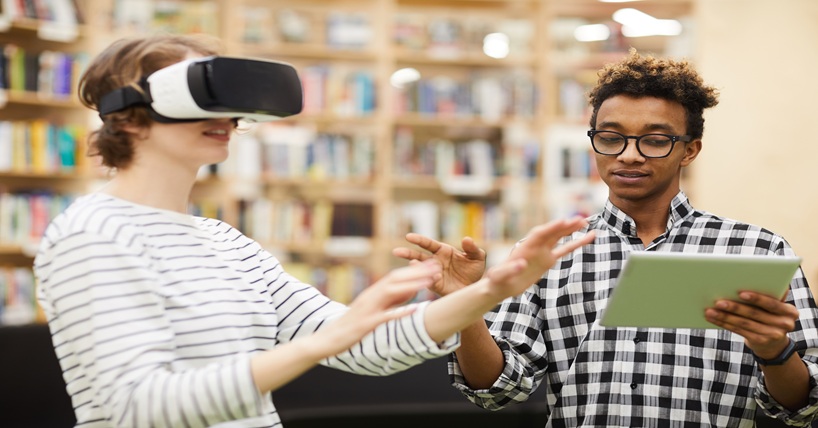
The project will use a network of Living Cultural Labs (LiLs) embedded in public cultural spaces across diverse European locations. The LiLs will study how people use immersive technologies like virtual reality to create and share culture and tell their stories. By working with communities and following interactions over time, the teams involved will explore what works, what changes, and how these technologies can best support people and their communities.
The project will develop immersive digital experiences and AI tools that help people connect, talk and learn together. It will gather examples of how people use these experiences and make this information freely available for others to use. Working closely with artists, cultural organisations, community groups and decision-makers will help ensure the project's benefits are widely shared and last into the future.
Dr Ahmed Kharrufa, Reader in AI for Education and CO-I on the project added: “No matter the potential applications and implications of Generative AI for the future, we need to understand how this affects us as humans. This project is so valuable as it gives us the chance to get to grips with how these two worlds collide; our rich and rewarding experiences of culture, but also the growing potential for digital interactions in this space, and importantly, how to ensure it happens in a way that enhances our experience.”
The team have already worked together on similar projects. Since 2019, Drs Satar and Kharrufa have worked with Professor Paul Seedhouse on the ENACT project, through which they developed a free web app that helps people learn languages and overcome cultural barriers. The details of this example of virtualisation of culture are highlighted in this FROM Blog, and the results published in this Bloomsbury Academic publication.