cities and extreme rainfall
How cities and extreme rainfall shape each other
Published on: 1 October 2026
An international team of scientists have introduced a new framework for understanding extreme rainfall in cities.
New research brings together recent advances in urban hydrology, boundary-layer meteorology, extreme precipitation and flood-risk research and proposes a new framework for understanding how cities and extreme rainfall interact and co-evolve.
The study was led by Professor Long Yang from Nanjing University in China. Newcastle University’s Professor Hayley Fowler FRS is among the co-authors of the paper, which was published in Nature Cities. Authors from around the world contributed to the study, including experts from Princeton University, Delft University of Technology, the French National Centre for Meteorological Research and the University of Texas at Austin.
Cities are not just recipients of storms
At the center of the Review is the concept of the Urban Rainfall Effect — the idea that cities are not only exposed to storms, but may also influence the development, intensity, movement and spatial distribution of rainfall. The authors argue that research on urban extreme rainfall should move beyond the traditional one-way view of “rainfall drives runoff” and instead adopt a coupled framework linking urban form, rainfall processes, runoff responses and adaptation measures.
The review paper identifies three major pathways through which urbanization can affect rainfall. First, urban roads, rooftops and building materials alter surface albedo, heat storage and evapotranspiration, enhancing sensible heat flux and contributing to the formation of urban heat islands. Stronger urban heating can increase boundary-layer buoyancy, promote convective initiation and intensify short-duration rainfall under favorable atmospheric conditions. Second, dense building clusters increase surface roughness and modify near-surface wind fields and turbulent transport. Urban roughness can induce low-level convergence, mechanical lifting and enhanced rainfall downwind of cities. Third, urban emissions provide aerosols that can act as cloud condensation nuclei or ice nuclei, altering cloud microphysical processes. Depending on moisture and stability conditions, aerosols may either suppress warm-rain formation or delay precipitation onset while allowing storms to grow deeper and more intense.
Together, these processes mean that the urban rainfall effect is not simply a matter of cities increasing or decreasing rainfall. Instead, the response depends on city size, urban morphology, building density, background circulation, moisture availability, aerosol loading and storm type.
Hayley Fowler FRS, Professor of Climate Change Impacts at Newcastle University’s School of Engineering and a Director of the Centre for Climate and Environmental Resilience, said: “We know that climate change is intensifying the short-duration rainfall extremes that can overwhelm urban drainage and cause devastating flash floods. This Review adds an important piece to that picture: cities are not simply passive recipients of extreme rainfall, but can themselves influence the processes that shape storms. Understanding these two-way interactions will be increasingly important if we are to design urban infrastructure and adaptation measures that are resilient to the rainfall extremes of the future.”
Adaptation measures may reshape rainfall feedback
The relationship between cities and extreme rainfall does not stop at the impact of urbanization on storms. As cities increasingly implement climate-adaptation strategies — including sponge-city infrastructure, green roofs, urban greening, cool roofs and ventilation corridors — these interventions also modify surface energy, moisture and momentum exchanges. In doing so, they may feedback on local rainfall processes.
These measures are usually designed to reduce flooding, mitigate heat or improve urban living conditions. Yet under specific meteorological conditions, they may also generate secondary feedbacks on rainfall processes. The Review therefore emphasizes that adaptation strategies should not be evaluated only in terms of whether they reduce flooding or heat. Their broader effects on local moisture, energy balance, boundary-layer dynamics and precipitation processes should also be considered.
Towards a co-evolution framework for cities and extreme rainfall
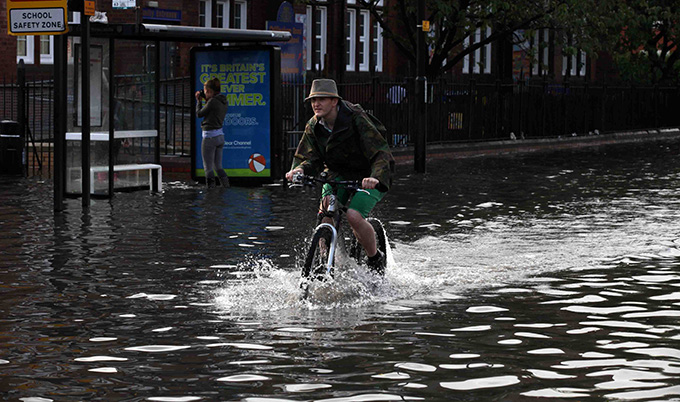
For urban hydrology, the urban rainfall effect has a fundamental implication: cities can alter not only runoff responses, but also the rainfall input itself. On one hand, urban atmospheric feedback may increase the frequency or intensity of short-duration extreme rainfall. On the other hand, impervious surface expansion, drainage networks and river-channel modifications can shorten concentration times and amplify flood peaks. The combination of altered rainfall and intensified runoff response can produce more rapid and severe urban flooding, including pluvial flooding, flash flooding and compound flood hazards.
The situation becomes even more complex when flood-control and climate-adaptation measures further modify land-surface conditions, thereby affecting future rainfall and runoff processes. The authors describe this as a dynamic feedback chain: urban expansion modifies rainfall; intensified rainfall increases flood risk; cities implement adaptation measures; adaptation measures alter energy and moisture exchanges; rainfall and runoff risks are then further adjusted.
This feedback chain forms the basis of the proposed co-evolution framework. It calls for a shift away from treating extreme rainfall as a fixed external boundary condition. Instead, cities, land use, climate adaptation, precipitation processes and hydrological responses should be studied as an interconnected coupled system.
The proposed framework has important implications for both research and urban planning. Future studies need high-resolution, multi-source urban rainfall observation networks that integrate rain gauges, weather radar, personal weather stations, microwave links and other emerging data sources to detect rainfall anomalies over cities and downwind regions. On the modelling side, the authors call for convection-resolving models at hectometer-scale resolution, together with improved urban canopy parameterizations capable of representing building drag, turbulent transport, surface energy balance, evapotranspiration and aerosol processes.
The Review also highlights the need to couple urban rainfall effects with runoff generation, drainage networks, surface ponding and urban flood models. Such integration would allow researchers and planners to assess the combined effects of changing rainfall inputs and changing urban hydrological responses. Adaptation measures such as green roofs, sponge-city infrastructure, cool roofs, blue–green spaces and ventilation corridors should also be evaluated within a hydro-meteorological feedback framework, rather than from a single-objective perspective alone.
Under the combined pressures of global warming and rapid urbanization, research on urban extreme rainfall is entering a new phase. Future resilient-city planning cannot regard storms only as external threats. Cities themselves are part of the rainfall system. Understanding the two-way feedback between urban environments and extreme precipitation is therefore essential for more proactive, scientific and systematic risk governance.
The Review highlights a key message for urban climate adaptation: to manage future rainfall and flood risk effectively, cities must be understood not only as places where extreme rainfall occurs, but also as active agents that can reshape the rainfall process itself.
Reference:
Yang, L., Smith, J., Uijlenhoet, R. et al. Co-evolution of cities and extreme rainfall. Nat Cities (2026). https://doi.org/10.1038/s44284-026-00530-z
Adapted with thanks from Nanjing University.