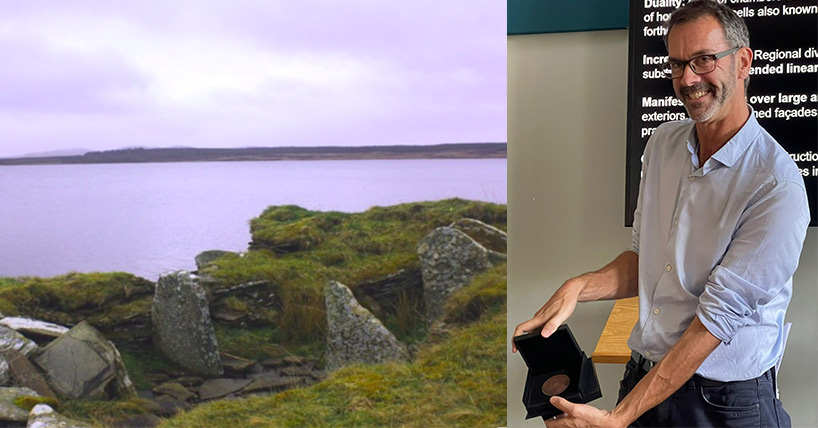
Rivers Memorial medal Chris Fowler
Newcastle archaeologist receives prestigious award for research
Published on: 13 October 2026
Professor Chris Fowler has been awarded the 2026 Rivers Memorial Medal in recognition of his internationally significant research on kinship in Neolithic Britain.
The Rivers Memorial Medal is awarded annually by the Royal Anthropological Institute (RAI) for "a recent body of work published over a period of five years which makes, as a whole, a significant contribution to social, physical or cultural anthropology or archaeology" and is one of the Royal Anthropological Institute's most respected honours.
Professor Fowler, from Newcastle University's School of History, Classics and Archaeology, received the award for research that has transformed understanding of kinship in prehistoric societies. His work combines analysis of Neolithic tomb architecture and burial practices with ancient DNA (aDNA) evidence to identify genetic relationships among individuals buried within tombs and draw inferences about the social relationships that led to their placement within a tomb. By integrating archaeological and genetic evidence with anthropological perspectives on kinship, Professor Fowler has developed new ways of understanding how kinship was created, maintained and negotiated in prehistoric communities.
Professor Fowler said: "I am absolutely delighted to receive this prestigious award, and I would like to thank the geneticists and archaeologists who have collaborated with me on much of this research. It is wonderful to see such recognition for the investigation of kinship in archaeological research."
Professor Fowler's work is at the forefront of international debates about how archaeologists can interpret kinship in the distant past and the opportunities and limitations of using aDNA to explore social relationships thousands of years ago.
Much of this work has been conducted in collaboration with leading international researchers, including geneticists Professor David Reich of Harvard University and Dr Iñigo Olalde of the University of the Basque Country, alongside archaeologists including Professor Vicki Cummings of Cardiff University.
This includes a landmark study published in Nature in 2021 that reconstructed an extensive Neolithic family tree from individuals buried in a 5,700-year-old tomb in Gloucestershire. The research, which attracted international attention, demonstrated how combining archaeological evidence with advances in ancient DNA analysis can reveal unprecedented insights into family structure and social organisation in prehistoric Britain.
More recently, Professor Fowler was heavily involved in a project that analysed tomb construction and aDNA evidence to investigate relationships between individuals buried in Neolithic chambered tombs in Caithness and the Orkney Islands, dating from approximately 3800–3200 BCE. This revealed that some male individuals buried in the same tomb or a neighbouring tomb were genetically related to each other through the paternal line, with the study concluding that the community conveyed ‘webs of descent’ by building and using these monumental tombs.
Professor Fowler said: ‘The study of kinship in archaeology is a dynamic and exciting field of research that will continue to grow in coming years.’ A new book exploring diverse ways to study kinship in the Neolithic, Kinship in Neolithic Europe, which is co-edited by Chris Fowler, Joshua Pollard and Alasdair Whittle is due out on 16th October.