
Conversation assisted evolution
Comment: Assisted coral evolution
Published on: 17 April 2026
Writing for The Conversation, Dr Liam Lachs, Dr Adriana Humanes and Dr James Guest, discuss how accelerating evolution could help corals survive future heatwaves.
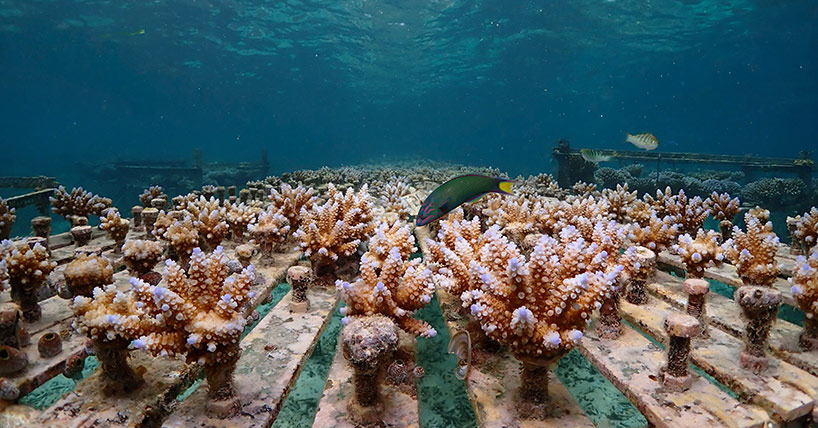
As global warming accelerates, extreme heatwaves are causing widespread death of tropical reef corals. Most corals rely on tiny algae cells living within their tissues that photosynthesise and produce energy. Corals use this energy to build their skeletons that create the reef structure.
In our warming world, evolution of heatwave tolerance will be critical for coral populations to persist. Natural adaptation occurs over many generations and is probably already under way. But these adaptation rates could be outpaced by ocean warming.
Scientists and reef managers are now calling for “assisted evolution” to help accelerate adaptation. One promising approach is selective breeding to enhance heatwave tolerance.
Our new study explores how such interventions could help corals withstand future heatwaves.
By examining the genetic basis of heat tolerance and other important life history traits including growth, energy reserves and reproduction, we reveal both the potential, and limits, of evolutionary adaptation to extreme heat stress. This work focuses on a captive-bred coral population we reared over eight years in Palau, an archipelago in the west Pacific.
The field of quantitative genetics can shed light on complex traits such as growth and heat tolerance, which are typically influenced by hundreds to thousands of genes. These tools can help us maximise evolutionary responses to selection, and have long been used in agriculture and animal breeding – from the crops we eat to the dogs we have at home.
Two key concepts are central. “Genetic merit” describes the value of an individual for breeding, and “genetic correlations” describe how traits share their underlying genetic basis.
Estimating these requires measuring certain traits like heat tolerance, and collecting information about relatedness among individuals, such as full- or half-siblings. But this is difficult in wild corals, which disperse widely and are typically unrelated to neighbouring individuals on the reef.
Our captive population, containing both related and unrelated individuals, provides a rare opportunity to apply quantitative genetics to adult corals.
Imagine a major heatwave has caused widespread coral mortality. Which corals should we select for propagation or breeding?
Choosing survivors seems intuitive, but survival alone does not guarantee a genetic predisposition for heat tolerance. A coral could survive by chance – perhaps it was shaded or had higher energy reserves, while all its relatives died. Selecting such individuals for breeding would fail to improve heatwave tolerance of future generations.
However, if entire families tend to survive or perish together, that indicates a genetic basis for heatwave tolerance. Using quantitative genetics in such cases can help make more informed choices.
But if no natural heatwave occurs, how can we proactively identify good corals for management? To do this, we need a proxy: an easy-to-measure trait that is genetically correlated with — and so predicts — an individual’s genetic merit for heatwave survival.
We tested coral heat tolerance under four different temperature exposures, ranging from a month-long exposure of 32.5°C to a rapid heatshock reaching 38.5°C.
These high experimental temperatures go beyond what happens in nature. As the simulated conditions grew hotter, we found ever weaker genetic correlations with marine heatwave survival. These tolerance traits exhibit somewhat distinct underlying biology, so careful trait choice is essential. Testing the wrong proxy traits to identify target corals will fail to deliver any heatwave survival enhancement.

But adaptation involves more than just heat tolerance. Individual growth, energy reserves and reproduction are all critical for healthy populations. If enhancing heat tolerance comes at the cost of traits like these, it would undermine population viability.
Encouragingly, we found no detectable negative genetic correlations among any of the traits we studied.
Matching future stress
To explore how assisted evolution could enhance heat tolerance over time, we developed a computer simulation.
This showed us it was possible to reach tolerance levels capable of withstanding future heatwaves, but only under certain conditions.
Selection needed to directly target long-term heatwave survival. This meant choosing only the top 5% most tolerant corals as parents for breeding, and it had to be repeated over multiple generations.
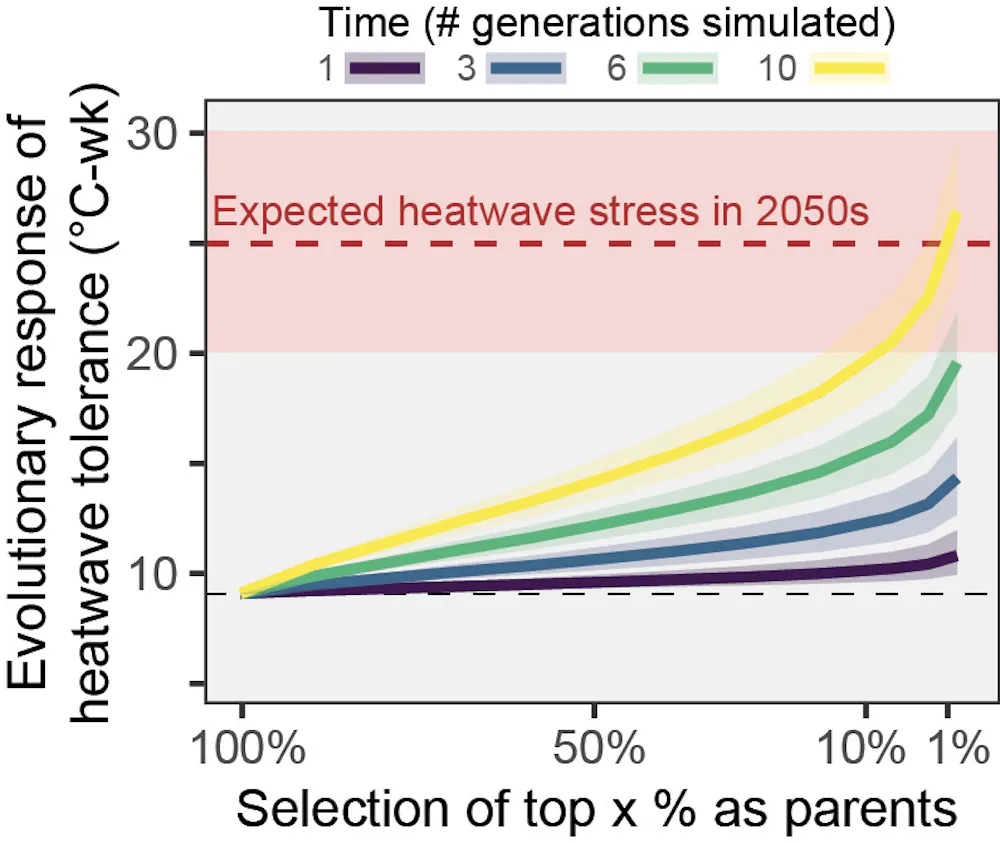
But such intense selection introduces other challenges, such as maintaining genetic diversity and scaling up selection efforts. If we need to breed from 50 corals to maintain genetic diversity and do only top-5% selection, then we need to test 1,000 corals. That becomes logistically very challenging.
Our modelling results show assisted evolution can deliver meaningful gains in coral heatwave tolerance. But success will depend on careful trait choice and strong, sustained selection.
Reducing greenhouse gas emissions remains essential to mitigate future warming. Alongside this, strategic management of local ecosystems — from conservation to assisted evolution — will be crucial to help key species adapt and persist in our rapidly warming world.
Liam Lachs, Postdoctoral Research Associate in Climate Change Ecology and Evolution, Newcastle University; Adriana Humanes, Postdoctoral Research Associate in Coral Reef Ecology, Newcastle University, Newcastle University, and James Guest, Reader in Coral Reef Ecology, Newcastle University
This article is republished from The Conversation under a Creative Commons license. Read the original article.
.jpg)